Mechanicsburg
Why One Month of Consistency Can Change the Entire School Year
Why One Month of Consistency Can Change the Entire School Year
What if one of the best things you could do for your child's school year had nothing to do with studying longer, buying more educational materials, or pushing for perfect grades?
What if the goal was simply to be consistent for the next 30 days?
September is when families establish the routines that often carry them through the rest of the school year. Homework returns. Activities begin. Bedtimes become more predictable. Children adjust to new teachers, new expectations, and new responsibilities.
It's tempting to approach the new year with ambitious goals.
"We're going to read for an hour every night."
"We're going to practice multiplication every morning."
"No more missing assignments!"
But dramatic changes are difficult to sustain.
A much more powerful approach is often surprisingly simple:
Do a manageable amount of academic work consistently, day after day.
Thirty days won't transform a child into a completely different student.
But one month is enough time to begin changing habits, strengthening skills, building confidence, and creating momentum that can influence the rest of the school year.
Academic Success Is Usually Less Dramatic Than It Looks
When we see a student who excels academically, it's tempting to assume we're seeing natural ability.
Sometimes we are.
But we're also seeing the result of hundreds of ordinary moments that nobody notices.
The book read before bed.
The multiplication facts practiced on Tuesday.
The homework completed before turning on the tablet.
The mistake corrected instead of ignored.
The assignment finished even though the student didn't feel like doing it.
None of those moments seems particularly significant on its own.
Together, they become powerful.
Academic growth usually isn't the result of one extraordinary study session. It's the accumulation of small efforts repeated over time.
Consistency Turns Decisions Into Habits
Think about the beginning of any new routine.
At first, everything requires a decision.
"When am I going to do my homework?"
"Do I have to read tonight?"
"Can I play first?"
"Can I do my Best Brains work tomorrow instead?"
Parents end up negotiating the same responsibilities over and over again.
Consistency gradually removes that negotiation.
If your child completes academic work at approximately the same time each day, the routine becomes predictable.
Homework happens after snack.
Best Brains work happens before screen time.
Reading happens before bed.
The exact routine will look different in every household. What's important is that children begin knowing what to expect.
The fewer decisions a routine requires, the easier it becomes to maintain.
Thirty Days Gives Practice Time to Add Up
Imagine two students.
One practices math for 15 minutes five days a week.
The other waits until Sunday and spends more than an hour trying to catch up.
Their total practice time might look similar.
Their learning experience probably won't.
Regular practice gives students repeated opportunities to retrieve information, apply skills, make mistakes, receive feedback, and revisit concepts.
This is one reason distributed practice, or spreading learning across multiple sessions, is such an effective learning strategy.
The lesson for parents is simple:
You don't necessarily need more practice.
You need practice that happens more consistently.
The First Week May Not Look Impressive
This is where families sometimes become discouraged.
You establish a new routine on Monday.
By Friday, your child is still complaining.
Multiplication facts aren't suddenly automatic.
Reading hasn't jumped three levels.
Homework still requires reminders.
It can feel like nothing is changing.
But learning doesn't always provide immediate visible feedback.
During those early days, your child is practicing two things simultaneously:
the academic skill and the habit of practicing it.
Both take repetition.
Give the routine time to work.
By Week Two, Resistance Often Becomes More Predictable
A successful routine doesn't necessarily mean your child becomes thrilled about doing academic work.
Adults don't leap out of bed every morning excited to exercise, clean the kitchen, or answer emails either.
Good habits don't eliminate effort.
They reduce the amount of debate surrounding it.
After a couple of weeks, children begin understanding:
"This is simply what we do."
That's an important transition.
The goal isn't to make children dependent on motivation.
It's to help them develop the discipline to complete important tasks even when they aren't particularly motivated.
That skill will matter far beyond elementary school.
By Week Three, Skills Have Had Time to Strengthen
Now the academic benefits of consistency can begin becoming more noticeable.
The multiplication fact that once required finger counting may come more quickly.
A child may read for longer without losing focus.
A grammar rule that seemed confusing begins looking familiar.
A student may recognize a type of math problem they previously struggled to solve.
Repetition creates familiarity.
Familiarity reduces the mental effort required to perform a skill.
That frees students to focus on increasingly difficult material.
This is especially important in cumulative subjects like mathematics, where today's foundational skills become tools for tomorrow's more complicated concepts.
By Week Four, Students Can See Their Own Progress
One of the most powerful things that can happen after several weeks of consistent practice isn't a perfect test score.
It's a child realizing:
"This is easier than it used to be."
That realization teaches an incredibly valuable lesson.
Effort works.
Practice matters.
Ability can grow.
Confidence built this way is very different from simply telling a child, "You're smart."
It's based on evidence.
The child remembers struggling.
They remember practicing.
And now they can feel the difference.
That creates genuine academic confidence.
Confidence Comes From Competence
We all want confident children.
But confidence can't always be created through encouragement alone.
Sometimes children need proof.
They need the experience of encountering something difficult and eventually becoming better at it.
That's why consistent practice can be such a powerful confidence builder.
A student who repeatedly experiences improvement begins approaching challenges differently.
Instead of:
"I can't do this."
the thought becomes:
"I don't know how to do this yet."
That single word, yet, represents a completely different relationship with learning.
Consistency Can Make Homework Easier
Parents sometimes worry that adding regular academic practice will create even more work for an already busy child.
But stronger skills can make the work children are already doing more efficient.
Consider math.
A student who automatically recalls multiplication facts can complete long division more efficiently than a student who must calculate each fact along the way.
Consider reading.
A fluent reader can devote more attention to comprehension than a child who must concentrate heavily on decoding individual words.
Consider writing.
A student with a strong understanding of grammar and sentence structure can focus more attention on developing ideas.
Foundational skills reduce friction.
As those skills strengthen, schoolwork can begin feeling more manageable.
Consistency Also Builds Independence
One of the most important goals for any student is learning how to work without an adult constantly directing every step.
Young children naturally require substantial support.
But over time, we want them to learn how to:
- Begin an assignment independently
- Follow directions
- Work through frustration
- Recognize mistakes
- Ask for help appropriately
- Finish what they start
Consistent routines create opportunities to practice those behaviors.
Instead of a parent repeatedly saying, "You need to do your work," the routine itself begins providing the expectation.
That gradual shift toward independence becomes increasingly important as students move into middle school, high school, and eventually college.
What Happens When We Keep Starting and Stopping?
Consistency doesn't require perfection.
Families travel.
Children get sick.
There are birthday parties, school events, late practices, and evenings when everyone is simply exhausted.
Missing a day isn't the problem.
The challenge comes when academic practice repeatedly starts and stops.
Three good days.
Then a week off.
A burst of practice before a test.
Then nothing until the next one.
Students spend valuable energy continually rebuilding the same habits and refreshing the same skills.
A better goal is not perfection.
It's returning to the routine quickly whenever life interrupts it.
One missed day is simply one missed day.
Start again tomorrow.
Why September Is the Perfect Month to Begin
September gives families something they won't have later in the school year:
time.
If your child establishes strong academic habits now, those habits have months to compound.
By November, they're no longer starting a routine.
They're continuing one.
By January, months of practice have accumulated.
By spring, the child who practiced consistently has had hundreds of opportunities to reinforce skills.
This is why the beginning of the school year matters so much.
You aren't just deciding what your child does tonight.
You're establishing what "normal" looks like for the months ahead.
The Best Brains Approach: A Little Every Day
This idea is central to the Best Brains approach.
Our students don't simply attend class with a certified teacher once a week and forget about academics until the next class.
Learning continues between classes through structured daily work.
That distinction matters.
The teacher provides instruction, guidance, correction, and appropriate challenge.
Daily practice gives students repeated opportunities to apply what they've learned.
Together, instruction and consistent practice help students strengthen math and English skills while developing habits that extend beyond any individual subject.
Over time, students learn something bigger than how to solve a particular problem.
They learn how to learn consistently.
If You Took the Summer Off, Try 30 Days
For families who paused Best Brains during summer, you don't need to think about making some enormous commitment today.
Start by rebuilding the routine.
Give it a month.
Let your child settle back into regular practice.
Notice whether assignments become easier.
Watch whether math facts return more quickly.
See whether your child becomes more independent about completing work.
Listen for changes in confidence.
You may be surprised by how much can change when a student simply returns to consistent practice.
The goal isn't to make up for summer.
It's to establish momentum for the school year ahead.
A Simple 30-Day Challenge for Families
If you'd like to try this principle at home, keep it simple.
For the next month:
- Choose a predictable time for academic work.
- Complete school and Best Brains assignments consistently.
- Read every day.
- Keep practice sessions manageable.
- Reduce distractions during work time.
- Encourage your child to attempt problems independently before stepping in.
- Praise consistency and improvement rather than perfection.
- If you miss a day, restart the next day.
Don't measure success by whether every day goes perfectly.
At the end of the month, ask a better question:
"What feels easier now than it did 30 days ago?"
That's where you'll often find the real progress.
Final Thoughts
Parents naturally want to know the secret to academic success.
Is it the right school?
The right teacher?
Natural intelligence?
The perfect curriculum?
All of those things can matter.
But one of the most powerful ingredients is far less exciting:
consistency.
Show up.
Practice.
Make mistakes.
Learn from them.
Come back tomorrow.
Do it again.
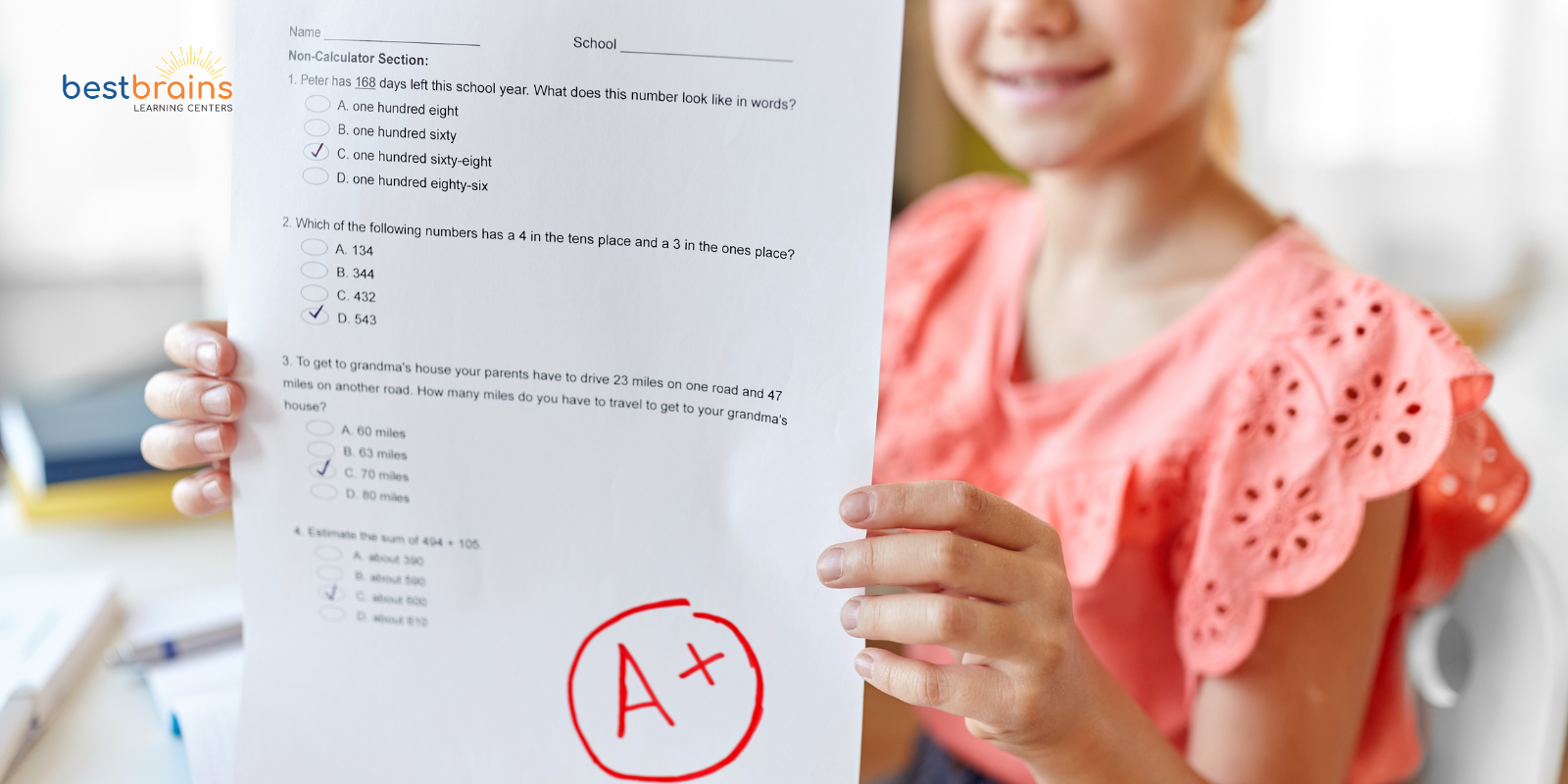
Thirty days of consistency won't guarantee straight A's.
But it can establish a routine.
It can strengthen skills.
It can reduce resistance.
It can build independence.
And perhaps most importantly, it can allow children to experience for themselves that effort produces progress.
Once a child learns that lesson, it doesn't have to end after 30 days.
It can shape the entire school year.
And eventually, it can shape the way they approach learning for the rest of their lives.
References & Further Reading
Cepeda, N. J., Pashler, H., Vul, E., Wixted, J. T., & Rohrer, D. (2006). Distributed Practice in Verbal Recall Tasks: A Review and Quantitative Synthesis. Psychological Bulletin.
Dunlosky, J., Rawson, K. A., Marsh, E. J., Nathan, M. J., & Willingham, D. T. (2013). Improving Students' Learning With Effective Learning Techniques: Promising Directions From Cognitive and Educational Psychology. Psychological Science in the Public Interest.
National Research Council. (2001). Adding It Up: Helping Children Learn Mathematics. National Academies Press.
Dweck, C. S. (2006). Mindset: The New Psychology of Success. Random House.
Willingham, D. T. (2009). Why Don't Students Like School? Jossey-Bass.