Mechanicsburg
But They Got an A”: Why Good Grades Don’t Always Mean Your Child Is Being Challenged
“But They Got an A”: Why Good Grades Don’t Always Mean Your Child Is Being Challenged
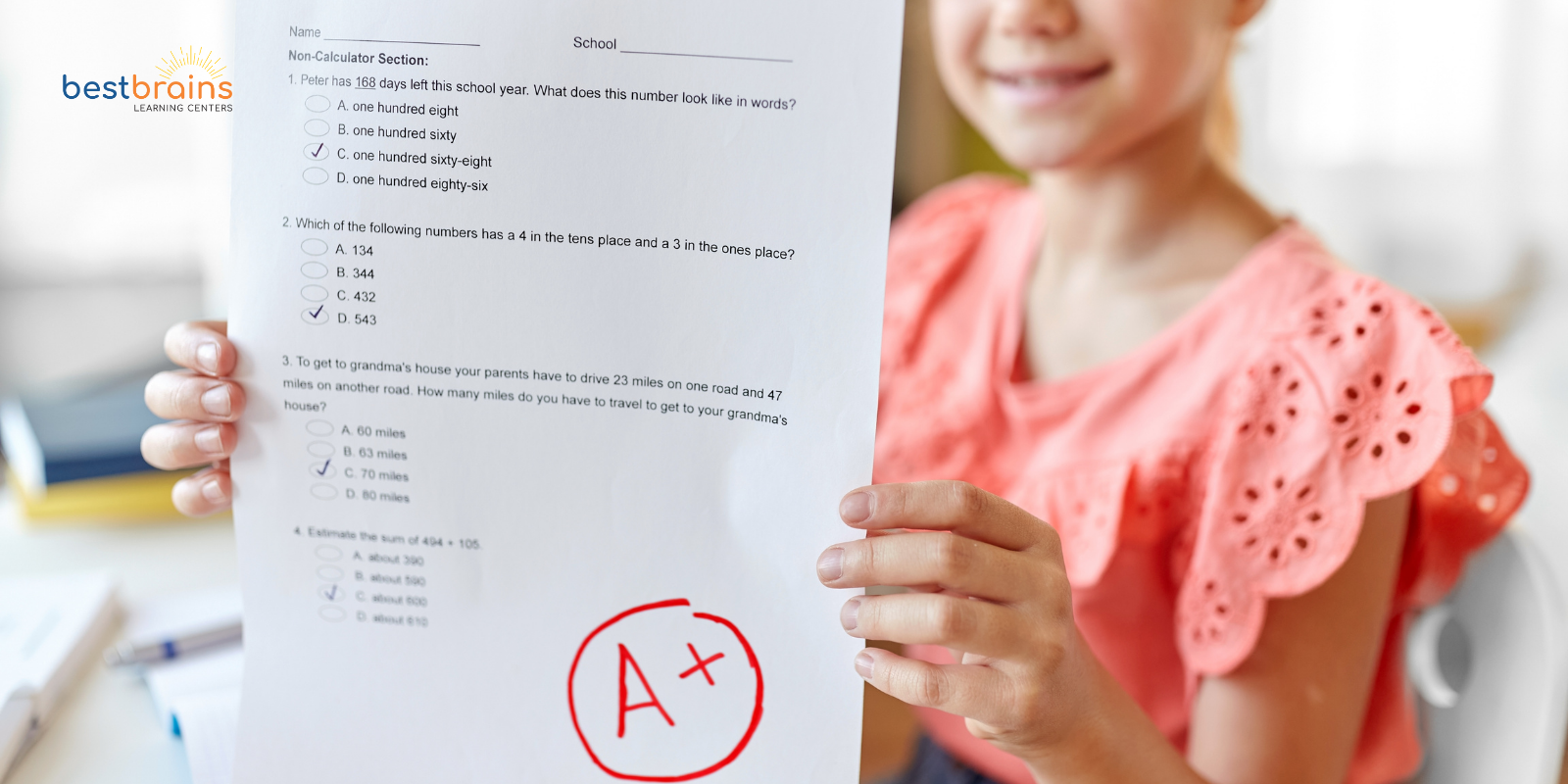
Your child brings home a test with a 96%. The report card is full of A’s. The teacher says they are doing well. From the outside, everything looks exactly the way a parent would hope.
So when someone suggests that your child might benefit from additional academic challenge, the natural response is: “But they’re already getting A’s. Why would they need more?”
It is a reasonable question. Good grades are worth celebrating, and a student who is succeeding in school does not need to be treated as though something is wrong. But grades answer only one question: how successfully is this student meeting the expectations being measured? They do not always tell us how much the student is growing, how deeply they understand the material, or whether the work is asking them to stretch.
A child can be earning excellent grades and still be capable of more.
An A Measures Performance, Not Potential
Grades are designed to communicate performance against a set of expectations. If a child has mastered those expectations, an A is an appropriate result. But the grade itself does not tell us how difficult that work was for the child.
Two students can both earn a 95% on the same assessment. One may have worked through unfamiliar ideas, made mistakes, studied carefully, and grown significantly. The other may have known almost every answer before the unit began. The grade looks the same. The learning experience was very different.
This is why parents should celebrate strong grades without assuming that grades are the complete picture of academic growth.
Challenge Is Not the Same as Struggle
Parents understandably do not want school to feel miserable. Children should not spend every evening frustrated, confused, or overwhelmed. But the opposite extreme is not ideal either. If academic work is almost always effortless, students may have fewer opportunities to practice persistence, flexible thinking, productive struggle, and recovery from mistakes.
Appropriate challenge lives in the middle. The student has enough knowledge to engage with the task, but the answer is not automatic. They may need to think, try a strategy, discover that it does not work, adjust, and try again.
That process is not evidence that a child is failing. It is often where learning happens.
Signs Your High-Performing Child May Need More Challenge
A report card alone cannot tell you whether your child is appropriately challenged. Their behavior around learning can often tell you more. Consider whether you regularly notice any of the following:
· Homework is completed unusually quickly with little thought or effort.
· Your child says school is “easy” or frequently complains that work is boring.
· They rarely need to study for tests and still earn very high grades.
· They finish classwork early and spend substantial time waiting for others.
· They avoid difficult activities even though they perform extremely well on familiar work.
· They become unusually upset when they finally encounter something they cannot do immediately.
· They enjoy advanced puzzles, books, math, coding, or other intellectual challenges outside school more than their regular assignments.
· Their grades are excellent, but you are not seeing much new growth from year to year.
None of these signs proves that a child is under-challenged. But they are useful reasons to become curious about what your child is learning, not simply what grade they are earning.
The Student Who Never Has to Study Can Hit a Wall Later
One of the hidden risks of consistently easy schoolwork is that students can earn excellent grades without developing strong learning habits.
A bright elementary student may be able to listen in class, complete the assignment quickly, and perform well on the test without much preparation. For years, that can look like an ideal situation.
Then the work becomes harder.
Perhaps it happens in middle school when classes require more organization. Perhaps it happens in Algebra, an advanced high school course, or college. For the first time, natural ability is not enough to make the answer immediate.
A student who has already learned how to study, practice, persist, ask questions, and learn from mistakes has tools for that moment. A student whose academic identity has always been “I’m smart because everything is easy for me” may find the transition much more uncomfortable.
The goal is not to make childhood schoolwork unnecessarily difficult. It is to make sure successful students also have opportunities to develop the habits they will need when genuine difficulty eventually arrives.
Sometimes High Grades Can Hide Weak Foundations
There is another reason to look beyond the letter grade: a child can compensate surprisingly well.
A student may earn an A in math while still counting on fingers for basic facts. They may understand new concepts well enough to get correct answers, but work more slowly than necessary because foundational fluency is weak. A strong reader may earn excellent English grades while having difficulty explaining deeper themes or supporting an interpretation with evidence.
This does not mean the A is meaningless. It means performance and foundation are not exactly the same thing.
As academic demands increase, the skills a student once worked around can become bottlenecks. Strong students benefit from solid foundations for the same reason struggling students do: foundational skills free up mental energy for higher-level thinking.
Enrichment Should Go Deeper, Not Just Faster
When parents hear “advanced work,” they sometimes picture pushing a child into next year’s textbook as quickly as possible. That is not the only way to challenge a strong student, and it is not always the best one.
Meaningful enrichment can ask students to think more deeply about material they already understand. In math, that may mean solving unfamiliar problems, explaining why a method works, comparing strategies, recognizing patterns, or applying a concept in a new context. In English, it may mean stronger vocabulary, deeper comprehension, more precise writing, or analyzing ideas rather than simply recalling details.
The goal is not acceleration for its own sake. The goal is growth.
A Child Who Is Used to A’s Still Needs to Make Mistakes
Mistakes are uncomfortable, especially for children who are accustomed to being correct.
Some high-performing students begin protecting the identity of being “the smart kid.” They choose tasks they know they can do. They become anxious about imperfect scores. They erase repeatedly. They hesitate to raise a hand unless they are certain. They may even avoid activities where they could be a beginner.
That is one reason appropriate academic challenge matters. In a healthy learning environment, a difficult problem gives a child a chance to discover that being wrong is survivable. They can examine the mistake, adjust their thinking, and try again.
A student who learns, “I can handle not knowing yet,” is developing something more durable than a perfect score.
What Parents Can Ask Instead of “What Grade Did You Get?”
Grades matter, but they do not have to dominate every conversation about school. Try occasionally asking questions that reveal more about the learning process:
· What was the hardest thing you had to think about this week?
· What is something you can do now that you could not do a month ago?
· Did you make a mistake that helped you understand something better?
· What subject feels easiest right now? Why?
· Is there anything you wish you were learning more about?
· When was the last time schoolwork really made you think?
These questions shift the focus from collecting points to noticing growth.
Talk to the Teacher About Growth, Not Just Grades
If your child consistently performs at a high level, parent-teacher conferences are an excellent time to ask more than, “Are they doing okay?”
Ask whether your child is working at the upper end of the expected range, how they respond when work becomes difficult, whether they rush because the work is easy, and whether there are opportunities for extension or deeper problem-solving.
A teacher may confirm that your child is being appropriately challenged. They may also identify an area where the student has room to grow that is not obvious from the report card.
Best Brains Is Not Only for Students Who Are Behind
One of the biggest misconceptions about after-school academic programs is that students only need them when they are struggling.
At Best Brains, we absolutely work with students who need to strengthen foundational skills or close learning gaps. But academic support can also mean enrichment.
A student who is earning A’s may be ready for more complex problem-solving, stronger math fluency, deeper reading comprehension, more advanced English skills, or simply a consistent environment where they are expected to think beyond what already comes easily.
Our certified teachers work with students at an appropriate instructional level rather than assuming that every child in the same grade needs exactly the same thing. Structured practice between classes gives students repeated opportunities to strengthen skills, develop independence, and experience the kind of productive challenge that builds real confidence.
The question is not, “Is my child failing?” The better question is, “Is my child still growing?”
The Goal Is Not More Work. It Is Better-Matched Work.
A child who already spends hours every night completing demanding school assignments does not necessarily need another pile of worksheets. More work is not automatically more learning.
The right challenge should be purposeful. It should meet the student where they are, strengthen what still needs strengthening, and move them toward something they cannot quite do independently yet.
For one student, that may mean closing a gap. For another, it may mean moving beyond grade-level expectations. Both are forms of growth.
Final Thoughts
Celebrate the A.
Tell your child you are proud of the work that went into it. Enjoy the report card. Strong performance deserves recognition.
Just do not let the letter grade be the only measure you use.
Ask whether your child is learning something new. Ask whether they ever have to wrestle with a problem. Ask whether they can tolerate mistakes. Ask whether their foundations are strong enough for what comes next. Ask whether they are developing the habits they will need when school eventually becomes harder.
A child does not need to be struggling before they deserve academic support.
Sometimes the student with the A does not need help catching up at all.
They need somewhere to keep growing.
References & Further Reading
National Research Council. (2001). Adding It Up: Helping Children Learn Mathematics. National Academies Press.
National Mathematics Advisory Panel. (2008). Foundations for Success: The Final Report of the National Mathematics Advisory Panel.
Dweck, C. S. (2006). Mindset: The New Psychology of Success. Random House.
Willingham, D. T. (2009). Why Don’t Students Like School? Jossey-Bass.
National Association for Gifted Children. Resources on differentiation, advanced learning, and meeting the needs of high-ability students.