Mechanicsburg

The Parent-Teacher Conference Questions You Should Actually Be Asking
The Parent-Teacher Conference Questions You Should Actually Be Asking
Parent-teacher conferences are usually short. Sometimes you have only 10 or 15 minutes to understand how your child is doing across an entire school day.
That makes the questions you ask especially important.
Parents often begin with the obvious: “How are their grades?” or “Are they behaving?” Those questions have value, but they rarely tell the whole story. A child can be earning good grades while working below their potential. Another child may understand the material but struggle with organization, attention, or independence. A student can even appear to be doing fine while quietly losing confidence in a subject.
A productive conference should help you understand not only what your child is earning, but how your child is learning.
Here are the questions that can help you leave the conference with a much clearer picture.
1. “Where is my child performing relative to grade-level expectations?”
A letter grade tells you how your child performed on assigned work. It does not always tell you whether that work is at, below, or above the level expected for the grade.
Ask the teacher where your child currently falls in key areas such as math, reading, and writing. If your child is meeting expectations easily, ask whether they are being appropriately challenged. If they are below expectations, ask which specific skills are creating the gap.
The more specific the answer, the more useful it becomes.
2. “What does my child do when the work gets difficult?”
This question tells you a great deal about confidence, resilience, and independence.
Does your child keep trying? Ask for help appropriately? Guess? Shut down? Rush? Avoid the task altogether?
A student’s response to difficulty can matter just as much as whether they eventually get the answer right. Productive struggle is a normal part of learning, but repeated avoidance or frustration may signal that the work is too difficult, foundational skills are weak, or confidence is slipping.
3. “Is my child working independently?”
A student can earn good grades while relying heavily on reminders, teacher prompting, or adult assistance.
Ask whether your child can begin work without repeated directions, stay focused, follow multi-step instructions, manage materials, and complete assignments with an age-appropriate level of independence.
These executive-function skills become increasingly important as students move into middle school and high school, when teachers expect students to manage more of their own learning.
4. “What foundational skill would make the biggest difference if we strengthened it?”
This may be one of the most useful questions you can ask.
Instead of asking generally what your child should “work on,” ask the teacher to identify one foundational skill that would have the greatest impact.
For one student, it may be multiplication fluency. For another, reading comprehension, vocabulary, writing organization, or attention to multi-step directions.
Focusing on a specific skill gives families something concrete to reinforce rather than trying to improve everything at once.
5. “Does my child seem appropriately challenged?”
Parents of strong students should ask this directly.
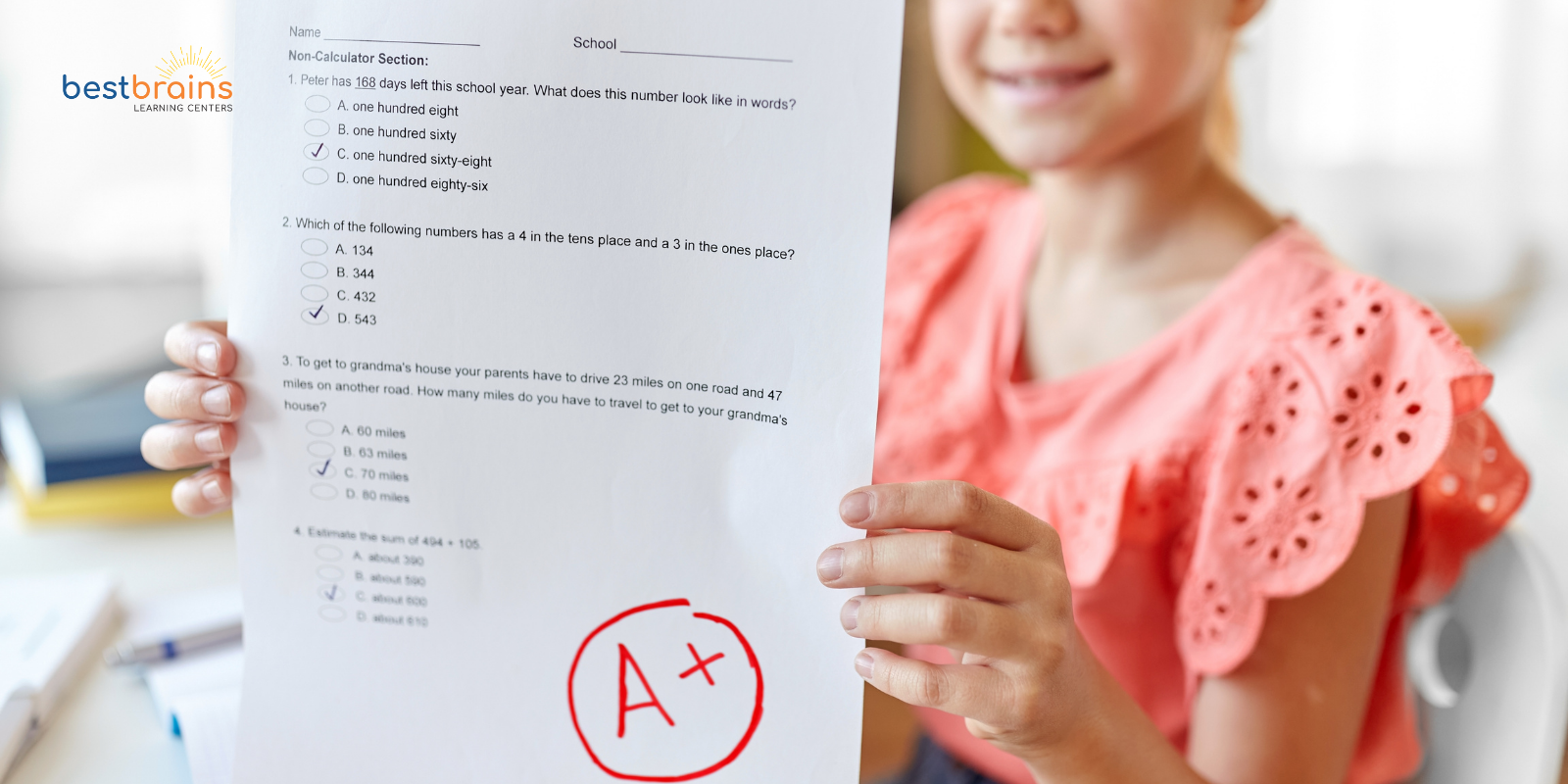
An A is worth celebrating, but an A does not necessarily mean a child is growing as much as they could. If assignments are consistently completed with little thought, your child rarely encounters unfamiliar problems, or the teacher describes the work as “easy” for them, additional enrichment may be beneficial.
Appropriate challenge should not mean constant frustration. It means regularly encountering work that requires thought, persistence, and the application of existing skills in new ways.
6. “How is my child’s reading comprehension, not just their reading level?”
Older students can sometimes read words fluently while missing important meaning.
Ask whether your child can explain what they have read, identify main ideas, make inferences, use evidence from a text, and understand increasingly complex vocabulary.
Reading comprehension affects far more than English class. Students need it to understand science texts, social studies assignments, written directions, and even math word problems.
7. “Are basic math skills fluent enough for the work you are teaching now?”
A student may understand a new math concept but still struggle because basic arithmetic requires too much effort.
Ask whether your child recalls addition, subtraction, multiplication, and division facts efficiently for their age, and whether weak fluency is slowing down higher-level work.
Math is cumulative. When foundational calculations become automatic, students have more mental capacity available for fractions, ratios, algebra, geometry, and multi-step problem solving.
8. “What mistakes does my child make repeatedly?”
Patterns in mistakes can reveal more than a test score.
Does your child misunderstand the same type of problem repeatedly? Skip directions? Make calculation errors? Rush? Fail to check work? Lose points because they cannot explain their reasoning?
Repeated errors help distinguish a one-time mistake from a skill or habit that needs attention.
9. “How does my child participate in class?”
Ask whether your child volunteers answers, asks questions, contributes to discussions, and appears comfortable taking academic risks.
A student who knows the material but rarely participates may be shy, but they may also lack confidence or fear making mistakes. A child who confidently explains their thinking may be developing important communication and reasoning skills that grades alone do not capture.
10. “What should we reinforce at home over the next six to eight weeks?”
End the conference by turning information into action.
Ask for one or two realistic priorities rather than a long list. A teacher might suggest reading nightly, improving multiplication fluency, slowing down to check work, practicing written responses, or building greater independence with homework.
Then choose a routine your family can actually sustain. Consistency usually matters more than intensity.
Questions That Go Beyond “How Are the Grades?”
If you have only a few minutes, these are the questions worth writing down before you walk into the conference:
· Where is my child performing relative to grade-level expectations?
· What happens when the work becomes difficult?
· Is my child working independently?
· What foundational skill would make the biggest difference right now?
· Is my child appropriately challenged?
· How strong is their reading comprehension?
· Are basic math skills fluent enough for current coursework?
· What mistakes or habits do you see repeatedly?
· How does my child participate and communicate in class?
· What are the top one or two things we should reinforce at home?
Listen for Specifics, Not Just Reassurance
Most teachers care deeply about their students and naturally want conferences to feel positive. Hearing “They’re doing great!” is reassuring, but it is also reasonable to ask what “great” specifically means.
What are your child’s strongest skills? Where is there room for growth? Are they working at their potential? How independently are they functioning? What will become harder later in the year?
The goal is not to search for a problem where none exists. It is to understand your child well enough to support both strengths and emerging needs.
Bring What You See at Home Into the Conversation
Teachers see your child in an environment you do not. You see your child in one the teacher does not.
If homework routinely takes far longer than expected, say so. If your child cries over math, avoids reading, says school is too easy, or needs an adult sitting beside them for every assignment, share that information.
School performance and home behavior can look surprisingly different. Putting both perspectives together often gives everyone a clearer understanding of what the child needs.
How Best Brains Can Support What You Learn at the Conference
A parent-teacher conference can identify priorities. The next step is turning those priorities into consistent practice.
At Best Brains, our certified teachers work with students in math and English while reinforcing fluency, comprehension, critical thinking, problem solving, and independent learning habits. Because students also complete structured work between classes, skills are practiced repeatedly rather than addressed only once a week.
If a classroom teacher identifies a specific area of concern, families can share that information with us. Likewise, if your child is performing above grade level and needs additional challenge, that is valuable information too.
The goal is not for Best Brains to replace classroom instruction. It is to work alongside it so students have the foundation, practice, and confidence to get more from what happens at school.
Final Thoughts
Parent-teacher conferences are short, but they can be incredibly valuable when parents arrive prepared.
Don’t leave knowing only whether your child is “doing well.” Leave understanding how they learn, where they are growing, where they are being challenged, and what would help them take the next step.
The best question may not be, “What grade is my child getting?”
It may be: “What does my child need next?”
That question turns a conference from a progress report into a plan.
References & Further Reading
Center on the Developing Child at Harvard University. Executive Function & Self-Regulation.
National Mathematics Advisory Panel. (2008). Foundations for Success: The Final Report of the National Mathematics Advisory Panel.
National Reading Panel. (2000). Teaching Children to Read: An Evidence-Based Assessment of the Scientific Research Literature on Reading and Its Implications for Reading Instruction.
National Research Council. (2001). Adding It Up: Helping Children Learn Mathematics. National Academies Press.
Hattie, J. (2009). Visible Learning: A Synthesis of Over 800 Meta-Analyses Relating to Achievement. Routledge.