Fuquay - Varina
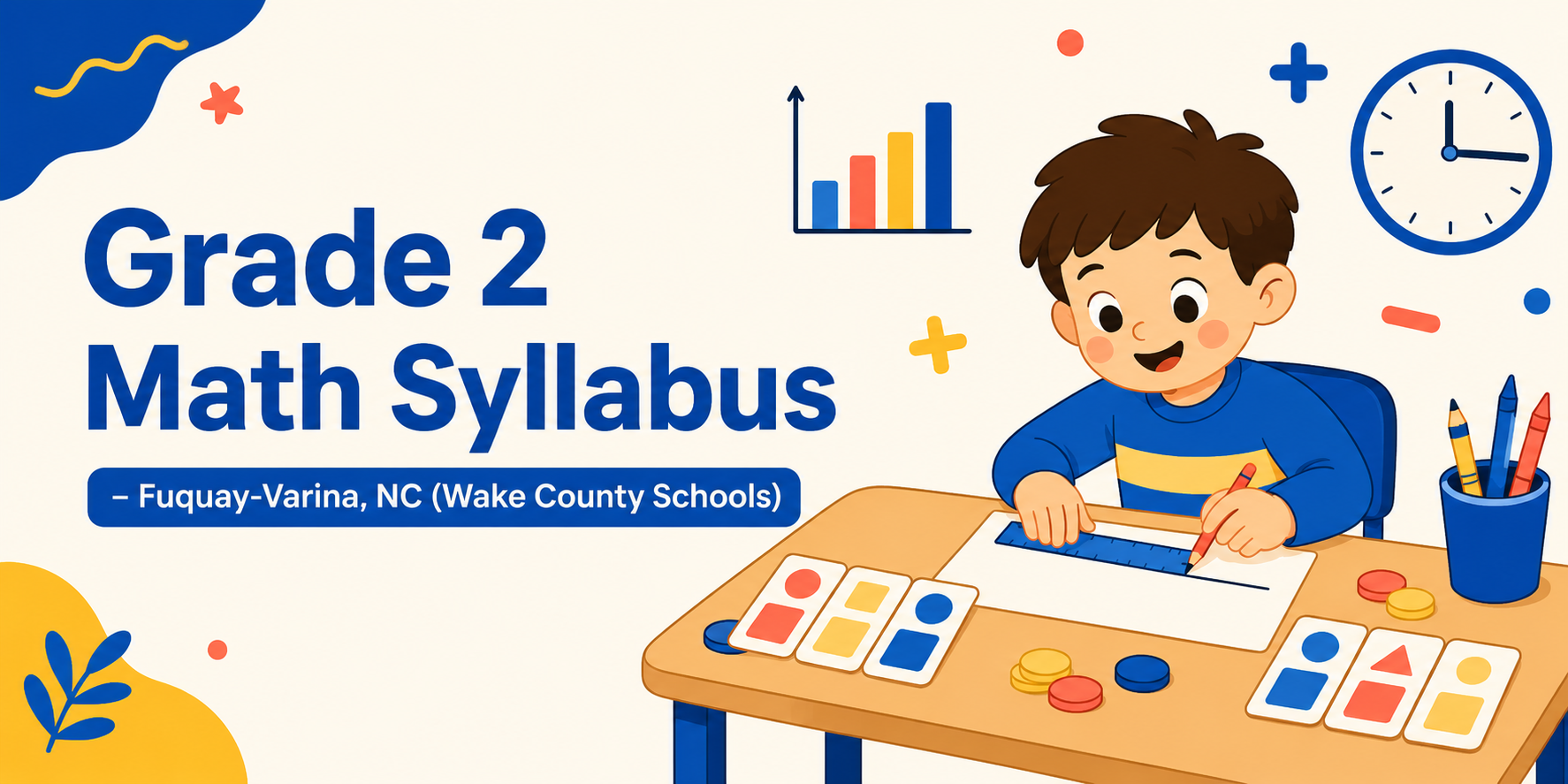
Grade 2 Math Program in Fuquay-Varina, NC: Where Arithmetic Gets Real and the Gaps Start to Show
Grade 2 Math Program in Fuquay-Varina, NC: Where Arithmetic Gets Real and the Gaps Start to Show
If Grade 1 is about learning that numbers mean something, Grade 2 is the year students discover what they can do with that knowledge. Second grade math is a dramatic step up — three-digit numbers, two-step word problems, measuring in inches and centimeters, and the beginning of multiplication thinking through repeated addition and arrays.
It's also the year that quietly sorts children into two groups: those who built a solid Grade 1 foundation and find the new material exciting, and those who carried small gaps forward and are now struggling to keep pace.
At Best Brains Learning Center of Fuquay-Varina, our Grade 2 Math program is designed to make sure your child is firmly in the first group — with small-class instruction, a mastery-based curriculum, and instructors who catch the cracks before they become chasms.
Why Grade 2 Math in Fuquay-Varina Deserves Your Attention Right Now
Fuquay-Varina is growing fast, and so are the expectations that come with it. Schools like Fuquay-Varina Elementary and Ballentine Elementary serve communities where parents are deeply invested in their children's futures — but even the best classrooms are paced for the average student in a room of twenty-five.
Grade 2 is also the last "pre-testing" year before the state assessments of Grades 3 and up carry real weight. Building fluency and deep understanding now, before the pressure arrives, is the smartest investment a Fuquay-Varina family can make.
What Best Brains Fuquay-Varina Covers in Grade 2 Math
Our Grade 2 curriculum aligns to the Wake County Public School System's second-grade standard course of study and extends beyond it, targeting the conceptual depth that separates a child who "gets by" from one who genuinely excels.
Three-Digit Place Value. Students move from tens-and-ones to hundreds-tens-and-ones, learning to read, write, and compare numbers up to 1,000. Crucially, they learn what each digit means, not just where it sits — the difference between a child who understands math and one who just follows procedures.
Addition and Subtraction Within 1,000. Using strategies like breaking numbers apart, making friendly numbers, and the standard algorithm, students build real computational flexibility. By the end of Grade 2, they should be fluent with addition and subtraction up to 100 and competent with three-digit problems.
Mental Math and Estimation. Adding and subtracting 10 or 100 from any three-digit number mentally — a skill that sounds simple but requires a solid grasp of place value that many children haven't fully locked in.
Even and Odd Numbers. Understanding why some numbers pair up evenly and others don't — and connecting this to early multiplication thinking.
Arrays and Repeated Addition. Arranging objects into rows and columns to write repeated addition sentences (3 + 3 + 3 = 9) is the first formal introduction to multiplication thinking, planting seeds that will matter enormously in Grade 3.
Measurement — Length. Measuring objects with rulers in both inches and centimeters, choosing appropriate tools, estimating before measuring, and comparing lengths. Students also solve word problems involving length — adding and subtracting measurements.
Measurement — Time. Reading clocks to the nearest five minutes, distinguishing AM and PM, solving problems involving elapsed time, and reading calendars. Time is notoriously tricky at this age because the analog clock demands both spatial reasoning and counting by fives simultaneously.
Money. Counting collections of coins and bills up to $5.00, comparing amounts, and making change — far more complex than it sounds when coins of different denominations are mixed.
Data and Graphs. Reading and creating picture graphs and bar graphs, solving one- and two-step problems from data, and beginning to ask "what does this information tell us?"
Geometry. Recognizing and describing 2D and 3D shapes, partitioning rectangles into rows and columns of same-size squares (an early area concept), and dividing circles and rectangles into halves, thirds, and fourths — the first foothold on fractions.
Skills a Fuquay-Varina Second Grader Should Master Before Grade 3
- Read, write, and compare three-digit numbers confidently
- Add and subtract fluently within 100; competently within 1,000
- Add or subtract 10 or 100 from any three-digit number mentally
- Identify odd and even numbers and explain why
- Write a repeated addition sentence to match an array
- Measure length in inches and centimeters using a ruler
- Tell time to the nearest five minutes on analog and digital clocks
- Count mixed coin/bill combinations up to $5.00
- Read and interpret a bar graph, solving one-step questions from it
- Partition shapes into halves, thirds, and fourths and name the parts
Where Fuquay-Varina Second Graders Most Often Get Stuck
Three-digit subtraction with regrouping — carrying and borrowing across place values trips up students who memorized steps in Grade 1 without understanding why they work.
Telling time to the nearest five minutes — this requires counting by fives around a clock face while tracking hours, which demands more coordination than it appears.
Mixed coin counting — knowing a quarter is worth 25 cents doesn't automatically translate to adding quarters, dimes, and nickels accurately under pressure.
Two-step word problems — deciding what to do twice, in the right order, is a serious cognitive leap from single-step problems.
Arrays — many children can draw an array but can't connect it to a repeated addition sentence, which means they're missing the early multiplication concept entirely.
Our instructors identify exactly where each child's understanding breaks down — not just where they got the wrong answer, but why — and build from that point forward.
How Fuquay-Varina Parents Can Reinforce Grade 2 Math at Home
- Practice skip counting by 2s, 5s, and 10s during car rides or walks — it directly builds the array/multiplication foundation
- Use real money for counting practice; it's more motivating than worksheets and more genuinely complex
- Ask your child to read analog clocks around the house at random moments
- When cooking or baking, let them measure and compare — "is this cup more or less than half full?"
- Play math games like Sum Swamp or Zeus on the Loose to build fact fluency in a low-pressure way
Why Fuquay-Varina Families Choose Best Brains
Best Brains Learning Center of Fuquay-Varina keeps class sizes intentionally small so every student gets noticed — not just the ones who raise their hand or fall far behind. Our sequenced curriculum means we know exactly where Grade 2 math leads and we build toward it, so children are never just treading water.
Schedule a Free Assessment
A free, no-obligation assessment gives you a precise picture of where your second grader stands right now — and a clear plan for what comes next.
📍 Best Brains Learning Center – Fuquay-Varina 7621 Purfoy Road, Suite 115, Fuquay-Varina, NC 27526 📞 (984) 297-0000
Building strong minds, one concept at a time.