Fuquay - Varina
 Featured
Abacus Classes for Kids in Fuquay-Varina, NC: The Ancient Tool That Builds Modern Math Brains
Abacus Classes for Kids in Fuquay-Varina, NC: The Ancient Tool That Builds Modern Math Brains
In an age of calculators, smartphones, and voice assistants that can answer any arithmetic question in an instant, it might seem counterintuitive to hand a child a wooden bead frame and ask them to add four-digit numbers with it. But the families who have watched their children go through abacus training know something the skeptics don't: the abacus isn't really about calculating. It's about building a brain.
The abacus has been used for thousands of years across Asia to develop mathematical fluency — and decades of research and real-world results have confirmed what those cultures always knew. Children who learn the abacus don't just get faster at math. They think differently about numbers. They concentrate better. Their working memory expands. And they carry a mental math capability that no app can replicate, because it lives inside them.
At Best Brains Learning Center of Fuquay-Varina, our abacus program brings this time-tested method to families in Fuquay-Varina, Holly Springs, and southern Wake County — structured, sequenced, and taught by instructors who understand both the technique and the child in front of them.
What Is the Abacus, and Why Does It Work So Well for Children?
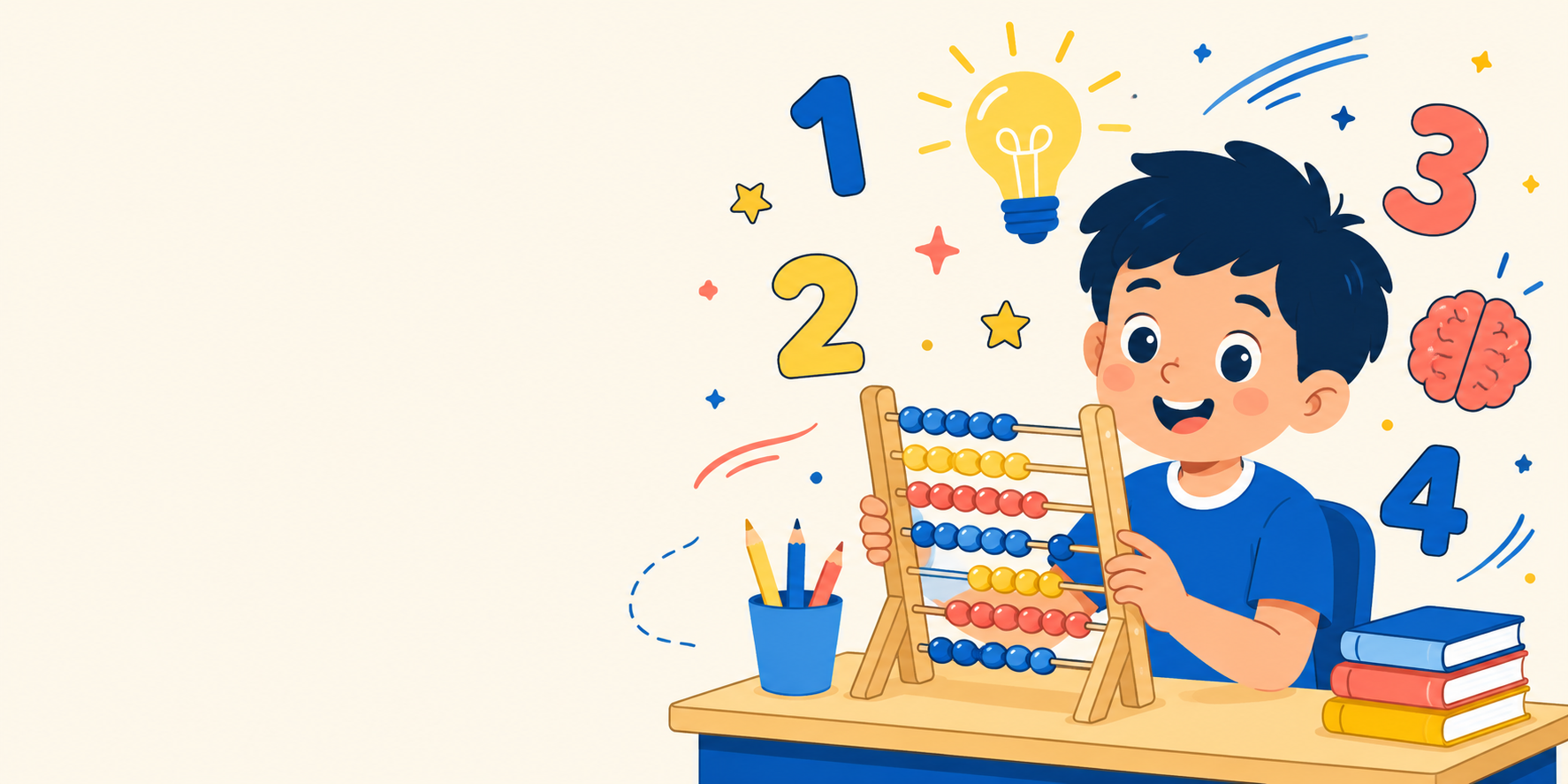
The abacus is a calculation tool made up of beads on rods, each row representing a place value — ones, tens, hundreds, thousands, and beyond. Students learn to move beads with precision to represent numbers and perform operations.
But the real magic happens after a student has worked with a physical abacus long enough that they no longer need it. At that point, they begin to visualize the bead movements in their mind — and they can perform complex arithmetic mentally, without paper, without a calculator, and with remarkable speed and accuracy.
This mental visualization is called the mental abacus, and it is the true goal of the program. The physical tool is the training ground. The mental tool is what the child keeps for life.
What the Best Brains Fuquay-Varina Abacus Program Covers
Our abacus curriculum is structured in progressive levels, each one building the speed, accuracy, and mental visualization capacity of the student.
Introduction to the Abacus — Place Value and Representation. Students begin by understanding the bead structure and learning to represent any number on the abacus. This alone deepens place value understanding in a way that pencil-and-paper exercises rarely do — students can feel the difference between tens and ones in a way that is immediate and physical.
Addition on the Abacus. Students learn the specific bead movements that correspond to addition, starting with single-digit facts and progressing to multi-digit addition. The movements are methodical and precise, building fine motor coordination alongside mathematical accuracy.
Subtraction on the Abacus. Subtraction movements are learned as the complement of addition movements — reinforcing the relationship between the two operations while building fluency in both directions simultaneously.
The Friends and Complementary Number Method. This is the technique that makes abacus arithmetic so efficient. Rather than counting beads one at a time, students learn to think in number pairs that make 5 and number pairs that make 10 — the same "making ten" strategy that underlies strong mental arithmetic, taught through physical movement that makes it automatic.
Multi-Digit Operations. As students advance through levels, they work with increasingly large numbers — two, three, and four digits — maintaining accuracy while building speed. The coordination required to move beads across multiple rows while tracking the overall number is a genuine cognitive workout.
Speed and Accuracy Drills. Timed exercises build the automaticity that is the hallmark of abacus-trained students. The goal is not just getting the right answer but getting it quickly and confidently — developing the kind of number fluency that makes all future math easier.
Transition to Mental Abacus. At the right stage of development, students begin to perform calculations with their eyes closed or without the physical tool, visualizing the bead movements internally. This is the moment when the training truly pays off — and for most students, it is also one of the most exciting moments of the program.
Advanced Levels — Multiplication and Division. More advanced students apply abacus thinking to multiplication and division, extending the mental math capability into the operations that dominate Grades 3 through 6.
The Skills the Abacus Builds Beyond Fast Math
Parents often enroll their children in abacus training because they want faster, more confident arithmetic. What they frequently discover is that the benefits go much further.
Concentration and Focus. Abacus work requires sustained, precise attention. You cannot move the right beads while thinking about something else. Students who train regularly develop a level of focused attention that transfers directly to the classroom — and to any task that requires sitting down and doing something carefully.
Working Memory. Tracking multiple place values simultaneously while performing calculations expands the cognitive capacity to hold and manipulate information in the mind. This is working memory — and it is one of the strongest predictors of academic achievement across all subjects.
Listening Skills. In abacus training, students often perform calculations from numbers read aloud — a practice called "flash anzan" at advanced levels. This builds auditory processing and the ability to act quickly and accurately on heard information, a skill that serves children well in every classroom they'll ever sit in.
Left and Right Brain Development. Research suggests that abacus training activates both hemispheres of the brain — the left (logical, sequential) through the mathematical operations and the right (spatial, visual) through the mental imagery of bead movement. This bilateral engagement is associated with stronger overall cognitive development.
Mathematical Confidence. Perhaps the most important benefit of all. A child who can look at a four-digit addition problem and solve it in their head — without hesitation, without a calculator, correctly — walks into every math class with a confidence that no amount of reassurance can manufacture. They have the skill. They know it. And it shows.
Who Is the Best Brains Abacus Program For?
Our abacus program is designed for students from Kindergarten and above. The earlier a student begins, the more time they have to develop the mental abacus capability — which is why many of our most impressive results come from students who started in Kindergarten or Grade 1.
That said, students who begin in Grades 3, 4, or 5 still make remarkable progress and gain significant benefits from the program. It is never too late to start — it is simply true that starting earlier gives students more time to develop.
Abacus training is especially well-suited to:
- Students who need to build confidence and fluency with numbers
- Children who are strong in math and want a genuine challenge beyond the classroom
- Students preparing for the more demanding arithmetic of Grades 3–6
- Children who struggle with concentration and would benefit from focused, structured practice
- Any child who is curious about numbers and loves the satisfaction of getting fast and accurate
Why Fuquay-Varina Families Choose Best Brains for Abacus
The abacus technique is specific and sequential — there is a right way to teach it, and shortcuts produce students who plateau early and never develop the mental abacus capability that makes the training truly valuable. At Best Brains Fuquay-Varina, our instructors are trained in the full program sequence, and our small group sizes mean every student's bead technique is observed and corrected in real time.
We also understand that abacus training is a commitment — not something that produces results after two or three sessions, but a skill that develops over months of consistent practice. We partner with families throughout that journey, keeping parents informed of progress and ensuring that at-home practice between sessions reinforces what's learned in class.
Schedule a Free Assessment
Wondering if the abacus program is the right fit for your child? A free assessment at Best Brains Fuquay-Varina is the best way to find out — we'll show you the program, let your child try it, and give you an honest picture of where they'd begin and what they'd gain.
📍 Best Brains Learning Center – Fuquay-Varina
7621 Purfoy Road, Suite 115, Fuquay-Varina, NC 27526
📞 (984) 297-0000
Building strong minds, one concept at a time.