Apex - Olive Chapel
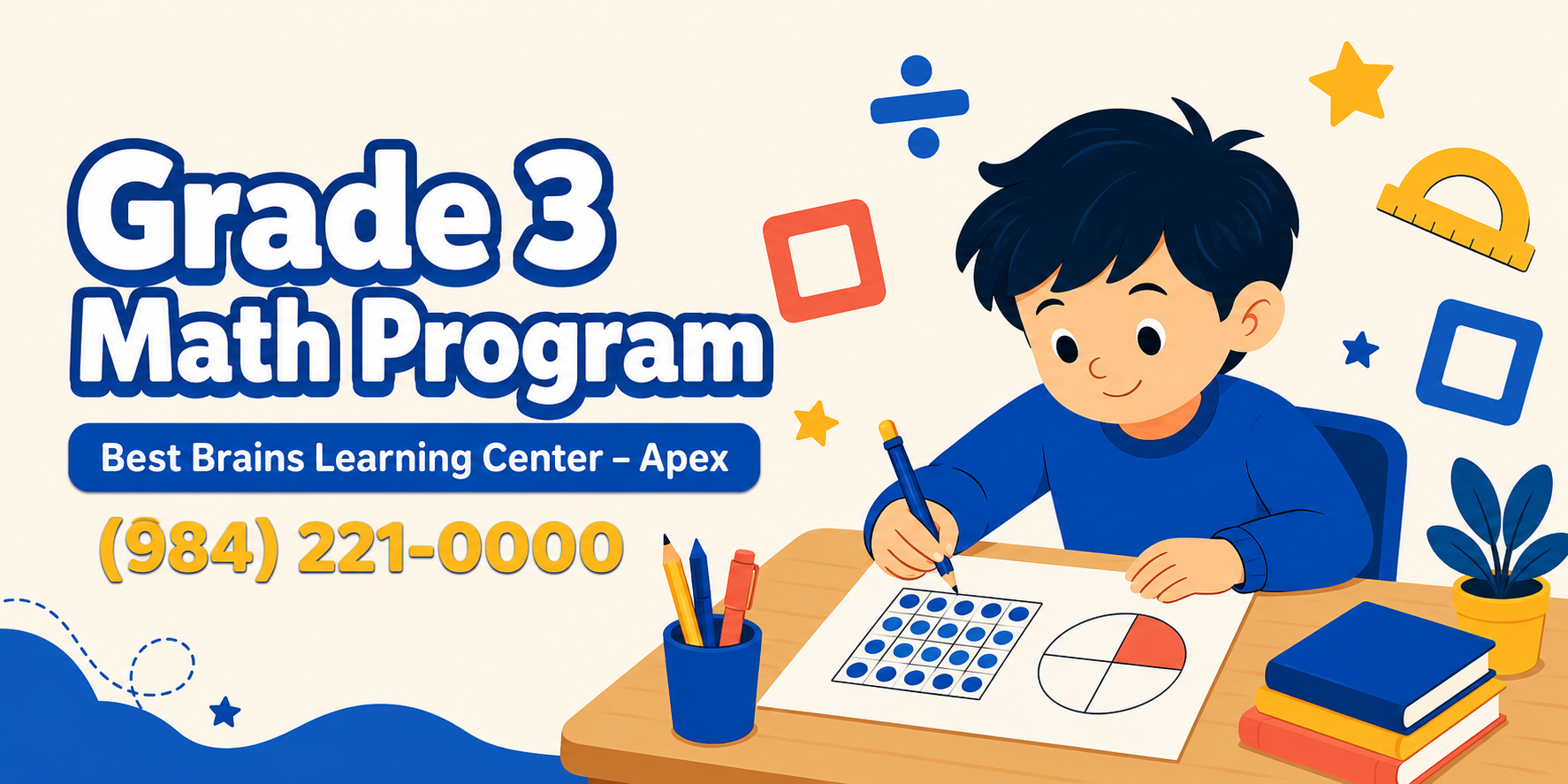
Grade 3 Math Program in Apex, NC: The Year Everything Gets Harder — and More Interest
Grade 3 Math Program in Apex, NC: The Year Everything Gets Harder — and More Interesting
If there is one grade that Apex parents consistently circle on the calendar with equal parts excitement and anxiety, it is Grade 3. This is the year multiplication arrives. Fractions arrive. Area and perimeter arrive. And for the first time in North Carolina, the end-of-grade test arrives — giving the year a weight that Grade 2 simply didn't have.
For children who walk in with a solid foundation, Grade 3 is genuinely exciting. The math becomes more sophisticated, more interesting, and more connected to the real world. For children who carry gaps forward from Grades 1 and 2, it is the year those gaps stop being invisible.
At Best Brains Learning Center of Apex, our Grade 3 Math program is designed to make sure your child experiences the former — walking into Grade 3 confident, curious, and completely ready for everything the year will throw at them.
Why Grade 3 Math in Apex Deserves a Plan
Schools like Apex Elementary, Apex Friendship Elementary, Salem Elementary, and Middle Creek Elementary serve communities where academic expectations are high and families are engaged. But even the strongest schools face the same structural reality: classroom instruction moves at the pace of the group, not the individual.
Grade 3 is when that pace starts to separate children into those who are building on a solid foundation and those who are quietly managing gaps. The end-of-grade test in May measures the full year's curriculum — there is no hiding from it in June. The time to address gaps is now, at the start of the year, not after the first graded assessment comes home.
What Best Brains Apex Covers in Grade 3 Math
Our Grade 3 curriculum aligns to the Wake County Public School System's third-grade standard course of study and extends beyond it — building the conceptual depth that separates children who understand math from those who merely follow procedures.
Multiplication — The Big One. Grade 3 is where multiplication is formally introduced, and it is the single most important concept of the year. Students learn multiplication as repeated addition, as equal groups, and as arrays — three different ways of seeing the same idea. They build fluency with all facts through 10x10, not through drill alone but through understanding why those facts work.
Division as the Inverse of Multiplication. Students learn that 24 divided by 6 equals 4 because 6 times 4 equals 24 — the relationship between multiplication and division is the key to making both operations feel manageable rather than like double the work.
Properties of Multiplication. The commutative property, associative property, and distributive property are not just vocabulary — they are the mental tools that let students break apart and solve unfamiliar facts, and the building blocks of algebraic thinking years later.
Multiplication and Division Word Problems. Identifying when a problem requires multiplication versus division, setting it up correctly, and solving it accurately — a skill that demands reading comprehension and mathematical reasoning simultaneously.
Place Value to 100,000. Rounding to the nearest 10, 100, and 1,000 — and understanding why rounding is a useful tool, not just a procedure to follow.
Addition and Subtraction Within 1,000,000. Applying fluency and the standard algorithm to much larger numbers. Students who understand place value deeply find this manageable; students who memorized steps without understanding often hit a wall here.
Fractions — Introduction. Grade 3 is students' formal first encounter with fractions. They learn to see a fraction as a part of a whole and as a point on a number line, compare fractions with the same numerator or denominator, and understand that equivalent fractions represent the same quantity. This is foundational for everything through Grade 6 and beyond.
Measurement — Area. Students discover area by counting unit squares, then learn the formula (length x width) and connect it back to multiplication. One of the most elegant moments in elementary math — when geometry and arithmetic meet for the first time.
Measurement — Perimeter. Finding the perimeter of polygons, solving for unknown side lengths, and understanding the genuine difference between perimeter and area — a distinction that confuses even well-prepared students.
Telling Time and Elapsed Time. Reading clocks to the nearest minute and solving problems that ask how much time has passed between two events — more cognitively complex than it appears, especially when crossing the hour boundary.
Liquid Volume and Mass. Estimating and measuring in liters and kilograms, and solving one-step word problems involving those measurements.
Data and Graphs. Creating and interpreting picture graphs, bar graphs, and line plots — connecting data skills to the new fraction concepts of the year.
Geometry — Quadrilaterals. Understanding that shapes can be categorized by their attributes and that some categories overlap — a logic-based concept that prepares students for more formal geometric reasoning ahead.
Skills an Apex Third Grader Should Master Before Grade 4
- Recall all multiplication facts through 10x10 fluently and instantly
- Divide confidently using the relationship between multiplication and division
- Solve one- and two-step word problems using all four operations
- Round whole numbers to the nearest 10, 100, and 1,000
- Add and subtract with numbers up to six digits using the standard algorithm
- Understand fractions as parts of a whole and as points on a number line
- Compare fractions with the same numerator or denominator accurately
- Calculate area using the formula and by counting unit squares
- Find the perimeter of any polygon given all side lengths
- Read a clock to the nearest minute and calculate elapsed time
- Interpret bar graphs and line plots and answer multi-step questions from them
Where Apex Third Graders Most Often Get Stuck
Multiplication fact fluency. Knowing facts eventually is not the same as knowing them instantly. Grade 4 assumes instant recall — a child still counting on their fingers is at a disadvantage from day one.
Area versus perimeter. These two concepts arrive together, use similar language, and are genuinely confusing without a strong conceptual anchor beyond the formulas.
Fractions on a number line. Most students can shade half of a rectangle. Far fewer can accurately place two-thirds on a number line — which is exactly what Grade 3 asks them to do.
Two-step word problems. Figuring out what to do twice, in the right order, while reading carefully is a demanding cognitive task at eight years old.
Elapsed time. Crossing the hour mark requires a mental strategy that students need to be explicitly taught, not just exposed to.
Our instructors at Best Brains Apex identify which of these sticking points a child has hit and address it at the conceptual level — not just with more practice problems.
How Apex Parents Can Reinforce Grade 3 Math at Home
- Practice multiplication facts in short daily bursts — five minutes in the car beats one long session per week every time
- Ask your child to explain why a fact works, not just what the answer is
- Cook together and let your child measure ingredients — real-world fractions at their best
- Point out area and perimeter around the house — "how many square feet is this room?" makes abstract concepts tangible
- Play multiplication games like Math War or Times Table Bingo for low-pressure fluency building
Why Apex Families Choose Best Brains
Grade 3 is the year parents realize they want a second layer of support — not because their child isn't capable, but because the curriculum genuinely accelerated. Best Brains Learning Center of Apex provides that layer in small groups where instructors know each student by name, track their progress week to week, and adjust instruction to meet each child where they actually are.
Schedule a Free Assessment
A free, no-obligation assessment gives you a precise picture of where your third grader stands — on multiplication, on fractions, on all of it. No guesswork, no waiting until October to discover there is a problem.
Best Brains Learning Center - Apex 1460 Chapel Ridge Road, Suite 190, Apex, NC 27502 (984) 221-0000
Building strong minds, one concept at a time.