Apex - Olive Chapel
 Featured
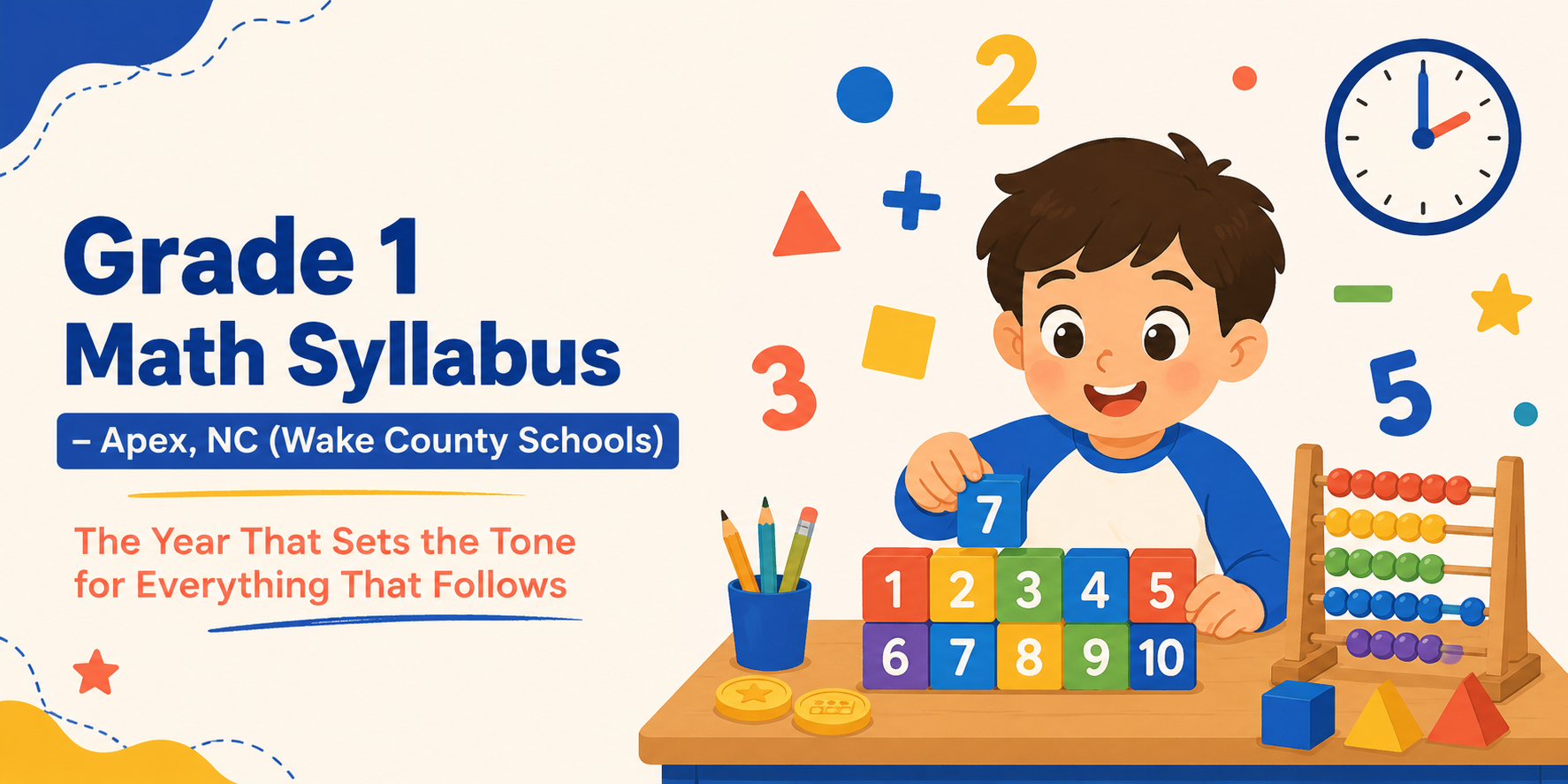
Grade 1 Math Program in Apex, NC: The Year That Sets the Tone for Everything That Follows
Grade 1 Math Program in Apex, NC: The Year That Sets the Tone for Everything That Follows
Ask any veteran elementary teacher which grade quietly determines a child's long-term relationship with math, and most will say the same thing: first grade. This is the year students stop simply recognizing numbers and start genuinely reasoning with them — adding, comparing, measuring, and noticing patterns in the world around them.
What gets built in Grade 1 doesn't just prepare a child for Grade 2. It becomes the structural support for every math class that follows, all the way through middle and high school. At Best Brains Learning Center of Apex, our Grade 1 Math program is built around that reality — small-group instruction, a sequenced curriculum, and instructors trained to catch the gaps that a busy classroom can't always slow down for.
Why First Grade Math Deserves Extra Attention in Apex
Apex continues to be one of the fastest-growing and most education-focused towns in the Triangle, and families here tend to expect a lot from their schools — and from themselves as parents. Schools like Apex Elementary, Apex Friendship Elementary, and Salem Elementary consistently see strong performance, but even strong classrooms are built for the average pace of twenty-plus students.
That means first grade in Apex is the year to build a foundation strong enough to support accelerated math tracks, CogAT and gifted screenings, and the more demanding curriculum that arrives in Grades 3 and 4 — not just the year to "get through."
What Best Brains Apex Covers in Grade 1 Math
Our Grade 1 curriculum maps to everything covered in the Wake County Public School System's first-grade standard course of study, then pushes a layer deeper so students understand the why, not just the how.
Number Sense. Before a child can add or compare confidently, they need a genuine feel for what numbers mean. Students practice counting forward and backward within 120, comparing values with greater-than/less-than/equal-to, and skip counting by 2s, 5s, and 10s.
Addition, Taught for Understanding. Rather than memorizing isolated facts, students learn addition within 20 through visual models, number lines, and the "make ten" strategy — building flexible mental math instead of fragile recall.
Subtraction as the Flip Side of Addition. Students learn fact families (4 + 3 = 7, 7 − 3 = 4, and so on), which lays early groundwork for the relational thinking that algebra will require years later.
Place Value. Understanding that the "1" in 14 means one ten — not just the digit 1 — is the single concept that unlocks the rest of arithmetic. Students compose and decompose two-digit numbers using tens-and-ones models until this becomes automatic.
Measurement. Comparing lengths, measuring with standard and non-standard units, and estimating before verifying — hands-on work that makes abstract math concrete.
Time. Reading analog and digital clocks to the hour and half-hour, and understanding how days, weeks, and months are organized.
Money Basics. Identifying coins, counting groups of coins, and solving simple money word problems — skills that come alive the next time a family makes a small purchase together.
Geometry and Shapes. Identifying the attributes of 2D and 3D shapes, comparing them, and combining simple shapes into composite ones — early spatial reasoning that pays off in science and advanced math later on.
Patterns and Early Algebraic Thinking. Identifying, extending, and describing repeating patterns — the seed of the rule-based thinking that makes algebra feel intuitive rather than foreign.
Data and Graphing. Sorting objects, building simple picture graphs, and answering questions from data — the start of statistical reasoning.
Skills an Apex First Grader Should Master Before Grade 2
- Count, read, and write numbers confidently up to 120
- Add and subtract fluently within 20 using more than one strategy
- Explain place value for two-digit numbers, not just recite it
- Compare and order numbers using math symbols
- Tell time to the hour and half-hour on analog and digital clocks
- Identify coins, know their values, and count simple combinations
- Describe and compare 2D and 3D shapes
- Solve one-step word problems independently
- Identify and extend repeating patterns
- Read and interpret a basic picture graph
Where Apex First Graders Most Often Get Stuck
Fact fluency — getting to the right answer eventually isn't the same as getting there quickly, and Grade 2 expects speed. Place value, conceptually — many students can recite it without truly understanding it, which shows up later as a ceiling on more advanced arithmetic. Multi-step word problems — reading carefully, identifying the operation, and computing accurately is a lot to coordinate at six or seven years old. Analog clocks — they require spatial reasoning and counting by fives simultaneously, unlike digital time. Mixed coin counting — combining different coin values is a surprisingly complex mental task at this age.
Our instructors are trained to catch these specific stumbling blocks early, often before a parent notices anything is off.
How Apex Parents Can Reinforce This at Home
- Count out loud during everyday moments — stairs, groceries, steps on a walk
- Use coins or small objects for hands-on addition and subtraction
- Practice analog clock reading at random points during the day
- Play counting and pattern-based games like Uno or Snakes and Ladders
- Point out shapes around the house or in the neighborhood and describe their attributes
Why Apex Families Choose Best Brains
Best Brains Learning Center of Apex pairs a sequenced, mastery-based curriculum with genuinely small class sizes, so instructors notice — and address — gaps before they compound. Our goal isn't just a child who can compute. It's a child who is curious about numbers and confident walking into every math class from here on.
Schedule a Free Assessment
A free, no-obligation assessment gives you a clear picture of exactly where your first grader stands today — and a plan for closing any gaps before Grade 2 begins.
📍 Best Brains Learning Center – Apex 1460 Chapel Ridge Road, Suite 190, Apex, NC 27502 📞 (984) 221-0000
Building strong minds, one concept at a time.