Abbotsford
Why Strong Readers Become Better Math and Science Students
If your child is struggling in math or science, the fix might not be more math or science practice at all — it might be reading.
Quick answer: Research consistently shows that reading comprehension is one of the strongest predictors of math and science achievement, especially in elementary and middle school. Kids don't just need to know their multiplication tables or the water cycle — they need to be able to read a question closely enough to understand what it's actually asking. When reading is shaky, that gap shows up everywhere else first.
It's an easy thing for parents to miss, because a struggling math grade looks like a math problem. But a growing body of research says the real bottleneck is often somewhere else entirely — in how well a child can read, parse, and hold onto what a question is asking before they ever pick up a pencil.
At a Glance
| Topic | How reading comprehension drives math and science performance |
| Audience | Parents of children ages 5–14 |
| Region | Abbotsford & Fraser Valley, BC |
| Curriculum context | BC Ministry of Education literacy and numeracy foundations |
| Bottom line | Reading comprehension is a hidden prerequisite for math and science success |
In This Guide
- The research: reading comes first
- Why word problems are where the gap shows up
- How reading comprehension affects science learning
- Where the effect is strongest — and weakest
- Signs your child's math or science struggle is actually a reading issue
- What helps: practical strategies for home
- How Best Brains Abbotsford connects reading to every subject
- Frequently Asked Questions
The Research: Reading Comes First
For years, math and science were treated as their own separate skill sets, taught and measured independently of reading class. Recent research paints a different picture.
A large longitudinal study tracking 355,883 children from ages 5 to 12 found that reading ability and math ability develop together through the elementary years — but the relationship runs mainly in one direction. Strong reading skills predict stronger later math achievement, not the other way around. The researchers behind the study concluded that solid reading skills are highly relevant to how well children go on to develop math skills.
A separate meta-analysis pooling 49 studies and more than 37,000 students found that reading comprehension has a significantly strong effect on math skills overall — and that this effect was even stronger for elementary-aged children, students with learning disabilities, and English language learners specifically.
Put simply: reading isn't just another subject sitting next to math and science on the timetable. For a large part of a child's schooling, it's the skill those other subjects are quietly built on top of.
Why Word Problems Are Where the Gap Shows Up
Here's the detail that surprises a lot of parents: reading comprehension doesn't affect every part of math equally.
Research shows reading skills have the biggest impact on conceptual understanding and applied math — the kind of thinking required in word problems and multi-step questions. The effect on straightforward computation (basic addition, multiplication facts) is much smaller.
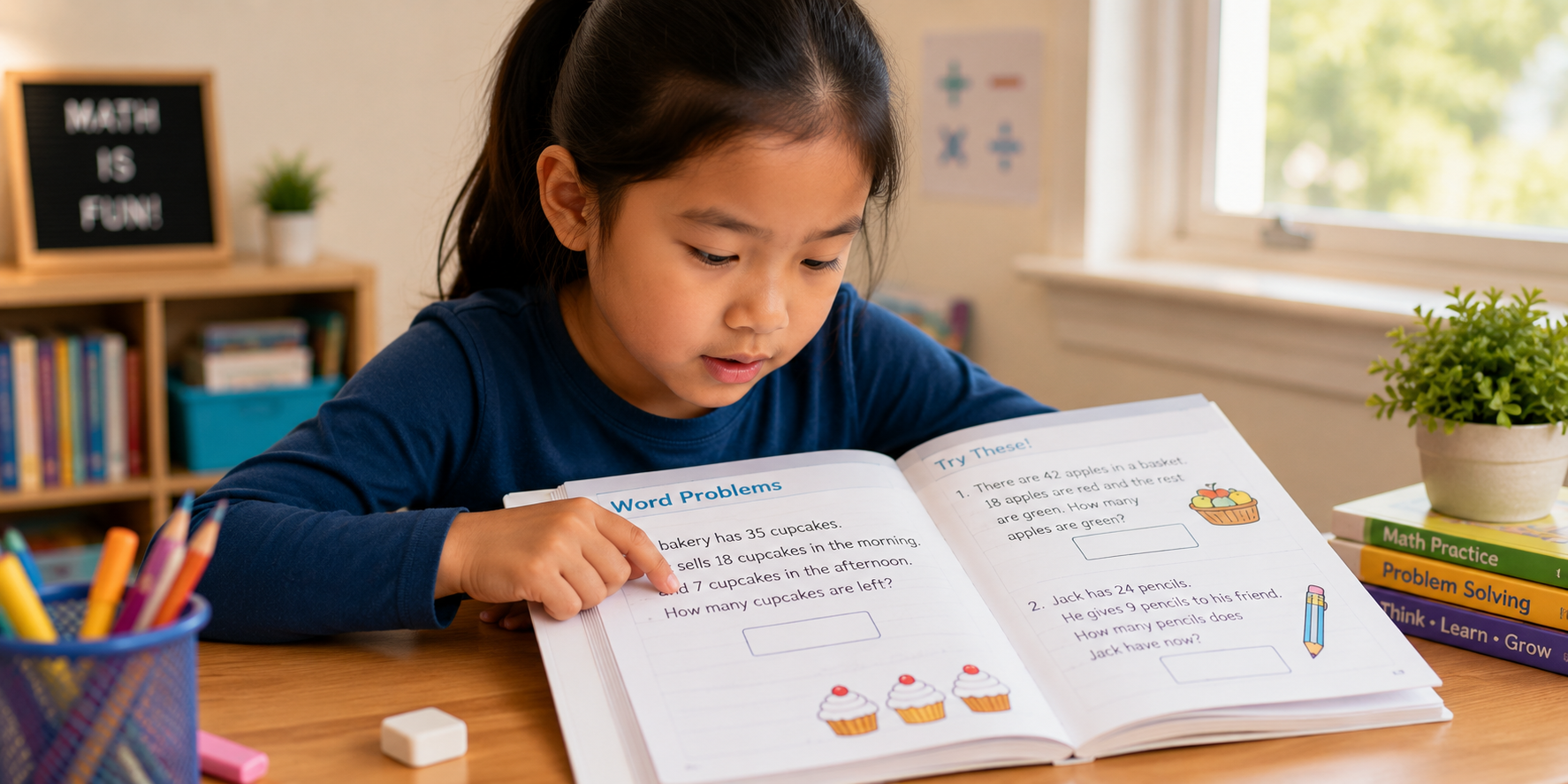
That explains a pattern many Abbotsford parents will recognize: a child who can fly through a page of computation drills, but freezes or guesses wildly the moment the same math shows up wrapped in a story problem. It's rarely that the child forgot how to add or multiply. More often, they lost the thread of what the question was even asking before they got to the math part.
Working memory plays a role here too — a child has to hold onto the setup of a multi-sentence problem, figure out which numbers matter, and only then start calculating. Weak reading comprehension makes that first step shaky, which throws off everything after it.
How Reading Comprehension Affects Science Learning
The same pattern holds in science. Researchers studying science literacy point to three specific reading-dependent skills students need to make sense of a science text: identifying what phenomenon is actually being described, following a written scientific explanation, and evaluating evidence presented in the text.
None of those are "science skills" in the traditional sense — they're reading skills applied to science content. A student who reads a passage about photosynthesis but can't identify the central process being described isn't struggling with biology. They're struggling to extract the main idea from a paragraph, which is a literacy skill, not a science one.
Researchers analyzing international PISA data have found a similar pattern: students with strong reading comprehension consistently outperform peers in both math and science, and reading comprehension contributes meaningfully to results in both subjects — not just language-based ones.
Where the Effect Is Strongest — and Weakest
Not every math domain is affected equally by reading skill. Across the research, the meta-analysis found:
- Strongest connection: word problems, applied math, and conceptual understanding
- Weakest connection: geometry, which relies more on spatial and visual reasoning than on text comprehension
- Most affected groups: elementary-aged students, students with learning disabilities, and English language learners
This matters for how parents interpret a report card. A child who's solid in geometry but weak in word-problem-heavy units isn't inconsistent — that pattern is exactly what the research would predict if reading is the underlying factor.
Signs Your Child's Math or Science Struggle Is Actually a Reading Issue
A few patterns worth watching for:
- They can compute but can't apply. Strong with flashcard-style facts, but stuck the moment the same skill appears in a word problem.
- They misread the question, not the math. Errors trace back to skipping a word, misunderstanding what's being asked, or missing a key detail — not a calculation mistake.
- Science homework takes far longer than the science itself should. Most of the time is spent rereading the passage, not doing the actual task.
- They can't summarize what a paragraph was about, even in subjects that aren't language arts.
- They do better on questions read aloud to them than on the same questions read independently.
None of these prove a reading problem on their own — but a cluster of them is a strong signal to look at reading comprehension, not just math drills, as the next step.
What Helps: Practical Strategies for Home
The good news: because reading comprehension is foundational, strengthening it tends to lift performance in math and science too, not just in language arts.
- Read the question twice, out loud, before solving. Have your child restate the question in their own words before touching a pencil.
- Underline or circle the "ask." In word problems, get them into the habit of finding the actual question first, then working backward to what information they need.
- Read non-fiction and science content for fun, not just fiction. Comprehension built through science-mystery books, nature magazines, or nonfiction chapter books transfers directly to science class reading.
- Talk through the "why," not just the answer. Ask "how did you know that's what the question was asking?" as often as "how did you get that answer?"
- Don't separate reading practice from math and science homework. A child who reads 20 minutes a night for pleasure is also quietly building the comprehension skills their next math unit depends on.
How Best Brains Abbotsford Connects Reading to Every Subject
At Best Brains Abbotsford, Math, English, Abacus, and Coding aren't taught as four unrelated boxes to check — because a student's ability to succeed in one genuinely depends on their strength in another. A student working through multi-step word problems in our Math program is leaning on the same comprehension skills we build directly in our English program.
Every class is taught by the same BC-certified teacher every session, which means we're able to actually notice when a "math problem" is really a reading problem underneath — and adjust instruction accordingly, instead of just assigning more math worksheets at a struggling reader. Our structured, non-repetitive curriculum builds comprehension skills alongside numeracy from the earliest levels, and students have access to free 24/7 online academic support for the nights when a word problem just won't click.
We start every new student with a free placement assessment — which looks at where a child's skills genuinely stand across subjects, not just the one subject a parent called about.
A Note from Best Brains Abbotsford
Parents come to us all the time asking for "extra math help" for a child who's actually a strong mathematician being held back by how a question is worded. It's one of the most common patterns we see, and one of the easiest to miss from the outside, because the report card says "math" even when the real story is reading. Fixing the right problem makes a much bigger difference than fixing the one that's easiest to see.
— Best Brains Abbotsford
Frequently Asked Questions
Can reading really affect math grades, or is that a stretch? Yes — multiple large studies, including one tracking over 355,000 children, found reading ability predicts later math achievement, particularly for applied math and word problems. The effect is well documented, not anecdotal.
My child is good at computation but bad at word problems. Is that a reading issue? It can be. Research shows reading comprehension has the strongest effect on applied and conceptual math — the kind found in word problems — and a much smaller effect on straightforward computation. That split is a common sign.
Does this apply to science too, or just math? Both. Studies of science literacy show students need reading-dependent skills — identifying the topic, following an explanation, evaluating evidence — to succeed with science texts, separate from their actual science knowledge.
Is one type of math more affected than others? Yes. Word problems and applied/conceptual math show the strongest connection to reading skill. Geometry shows the weakest, since it relies more on spatial reasoning than text comprehension.
What's the single best thing I can do at home? Build daily reading habits that include non-fiction, and get your child in the routine of restating a question in their own words before solving it. Both directly build the comprehension skills math and science rely on.
Should I get extra math tutoring or extra reading support? It depends on where the actual gap is. A placement assessment that looks at reading and math together is the most reliable way to tell — which is exactly what we start every new student with.
Looking for Academic Support in Abbotsford?
Best Brains Abbotsford offers BC-curriculum-aligned enrichment in Math, English, Abacus, and Coding for students ages 3–14, taught by the same certified teacher every class in small, personalized groups.
📍 Best Brains Learning Center Abbotsford 3720 Townline Rd, Unit 230, Abbotsford, BC
Book a free placement assessment to see exactly where your child's reading and math skills stand today.
References and Further Reading
- Hübner, N., Merrell, C., Cramman, H., Little, J., Bolden, D., & Nagengast, B. (2022). Co-development of reading and mathematics achievement, ages 5–12.
- Reading comprehension and mathematics skills meta-analysis, International Online Journal of Primary Education (2022).
- Grimm, K. J. (2008). Longitudinal associations between reading and mathematics achievement.
- Research on science text comprehension and science literacy skills (phenomenon identification, explanation, evidence use) in middle school students.
- PISA-based research on the relationship between reading comprehension and math/science performance.
Content note: Educational research is ongoing and individual results vary by child. This article summarizes general research findings and is not a substitute for an individualized academic assessment.