Abbotsford
BC Grade 5 English Curriculum: A Parent's Guide | Best Brains Abbotsford
BC Grade 5 English Curriculum: What Should Your Child Know by the End of Grade 5?
A practical guide for Abbotsford parents to understand reading, writing, grammar, comprehension, and communication expectations in British Columbia schools.
Grade 5 is an important stage in your child's academic journey. Reading is no longer just about understanding the words on a page. Students are increasingly expected to interpret ideas, recognize different perspectives, express opinions, and communicate their thoughts clearly.
For many parents in Abbotsford, this raises an important question:
Is my child developing the English skills expected of a Grade 5 student in British Columbia?
Perhaps your child reads books comfortably but struggles to explain what they have read. Maybe they have wonderful ideas but find it difficult to organize them into paragraphs. Or perhaps their report card says Proficient, yet you're unsure what that means in terms of actual academic skills.
Understanding the BC Grade 5 English Language Arts curriculum can help you recognize your child's strengths, identify areas needing attention, and support their learning with greater confidence.
Let's explore what Grade 5 English looks like in BC classrooms and what parents can do to help.
What Does the BC Grade 5 English Curriculum Cover?
British Columbia's Grade 5 English Language Arts curriculum is designed around developing confident readers, thoughtful writers, effective communicators, and critical thinkers.
Unlike a traditional syllabus focused primarily on grammar rules and spelling lists, BC's curriculum emphasizes how students understand, interpret, and use language in different situations.
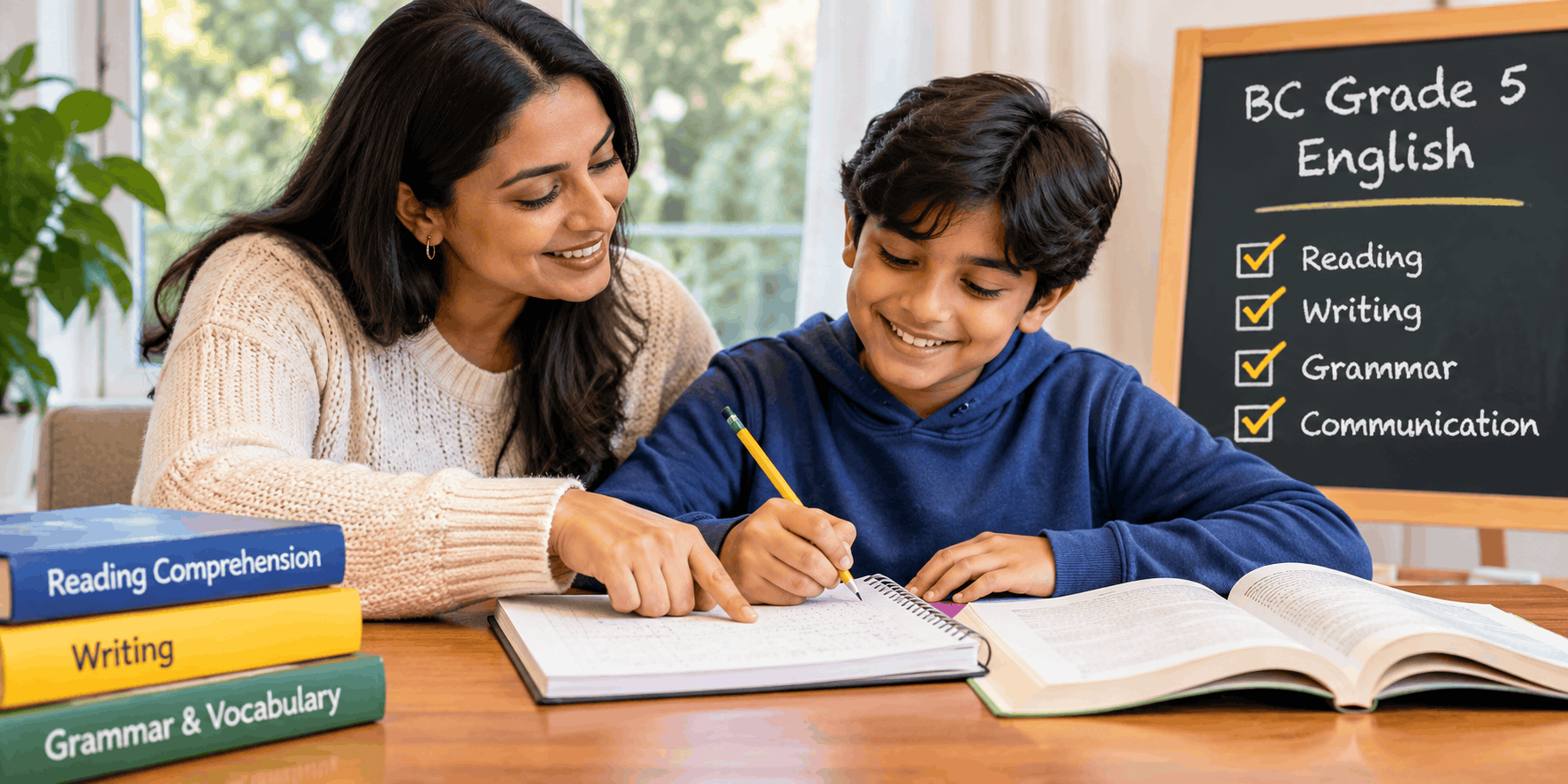
The curriculum can be understood through five interconnected learning areas:
-
Reading comprehension and critical thinking
-
Writing and paragraph development
-
Grammar, vocabulary, and language conventions
-
Speaking, listening, and communication
-
Understanding stories, perspectives, and different types of texts
These areas overlap. For example, a student reading a story may need to understand its message, identify the author's perspective, discuss their interpretation, and write a response supported by evidence.
For parents, the important distinction is that reading accurately and understanding deeply are not necessarily the same thing.
1. Grade 5 Reading Comprehension: Beyond Reading the Words
By Grade 5, students are expected to use increasingly sophisticated strategies to understand fiction, nonfiction, poetry, and other forms of communication.
These strategies include:
-
Identifying main ideas and supporting details
-
Summarizing important information
-
Making predictions and drawing conclusions
-
Understanding information that is implied rather than directly stated
-
Recognizing characters' motivations and different viewpoints
-
Connecting information across different texts
-
Questioning an author's message or purpose
An example parents can try
Imagine your child reads a story about a student who refuses to participate in a school competition, even though they are talented.
Ask three questions:
Question 1: What happened in the story?
This tests basic understanding.
Question 2: Why do you think the character refused to participate?
This tests inference and interpretation.
Question 3: What evidence from the story supports your answer?
This encourages deeper thinking and evidence-based reasoning.
A child might answer the first question easily but struggle with the second and third.
That doesn't automatically mean they are falling behind. However, if interpreting information and explaining reasoning are consistently difficult, those skills deserve attention.
What parents should look for
A developing Grade 5 reader should increasingly be able to explain not only what happened in a text, but also why it happened, what it means, and how the text supports their interpretation.
2. Grade 5 Writing: From Simple Sentences to Organized Ideas
Writing expectations become more complex as students progress through elementary school.
In Grade 5, students work on creating different forms of writing, including stories, opinion pieces, informational reports, poetry, and creative responses.
The focus is not simply on writing more words. Students should learn to organize their ideas and communicate them effectively.
What does a strong Grade 5 paragraph look like?
Consider this topic:
Why should children spend time outdoors?
A developing writer might produce:
"Playing outside is fun. I like parks. We can run and play games."
These sentences communicate an idea, but they provide limited explanation.
A more developed paragraph might read:
"Spending time outdoors is important because it gives children opportunities to stay active and explore their surroundings. Activities such as cycling, playing soccer, and walking in parks encourage physical movement. Outdoor experiences can also help children learn about nature and spend quality time with friends and family."
The second example demonstrates clearer organization, supporting details, and more developed vocabulary.
It is an illustration of stronger writing, not a prescribed provincial writing sample or mandatory Grade 5 standard.
Writing skills parents should watch
By the end of Grade 5, students should be developing the ability to:
-
Organize related ideas into paragraphs
-
Use topic sentences and supporting details
-
Write for different purposes and audiences
-
Use descriptive and precise vocabulary
-
Revise drafts to improve clarity
-
Apply appropriate grammar, punctuation, and Canadian spelling conventions
A useful question for parents is not simply, "How much did my child write?" but "How clearly did my child communicate an idea?"
3. Grammar, Vocabulary, and Sentence Structure in Grade 5
Grammar remains an important part of the BC Grade 5 English curriculum, but it is generally taught in the context of meaningful reading and writing.
Students develop their understanding of:
-
Parts of speech
-
Past, present, and future tenses
-
Subject-verb agreement
-
Sentence construction
-
Paragraphing
-
Commas, apostrophes, and quotation marks
-
Capitalization and spelling conventions
-
Word roots, prefixes, and suffixes
For example, understanding the prefix un- can help a child recognize the meaning of words such as unhappy, unfair, and unpredictable.
Similarly, recognizing the suffix -less can help students understand words such as careless and fearless.
These word-building skills are useful when students encounter unfamiliar vocabulary in novels, science textbooks, and social studies materials.
A simple writing exercise
Give your child this sentence:
"The dog ran."
Ask them to make it more descriptive.
They might write:
"The frightened dog ran quickly across the muddy field."
This activity encourages vocabulary development, sentence expansion, and creative expression.
You can make it more challenging by asking your child to explain why they selected particular words.
4. Speaking and Listening: An Often Overlooked Part of English
English Language Arts is not limited to reading and writing.
BC students are also expected to develop oral communication skills, including listening actively, exchanging ideas, asking clarifying questions, and expressing opinions respectfully.
By Grade 5, children should be developing greater confidence in:
-
Participating in discussions
-
Explaining their reasoning
-
Listening to different perspectives
-
Asking meaningful questions
-
Presenting information clearly
-
Using appropriate tone and expression
-
Sharing stories and ideas with an audience
These abilities support learning across subjects.
For example, a student who understands a Math problem but struggles to explain their reasoning may need additional communication practice rather than more Math instruction.
What parents can do
Try introducing a five-minute family discussion at dinner.
Choose a question such as:
"Should students have homework every day?"
Encourage your child to state an opinion, provide two reasons, and respond respectfully to a different viewpoint.
This builds communication, reasoning, and confidence without feeling like formal homework.
5. Understanding Different Perspectives and Critical Thinking
One of the important features of BC's English curriculum is its emphasis on understanding perspectives.
Students explore how stories and other texts can be interpreted differently depending on the reader's experiences, knowledge, and cultural background.
They also learn about First Peoples storytelling traditions and the relationships between stories, communities, culture, and land.
This encourages children to become more thoughtful readers and listeners.
A practical example
Suppose two characters disagree about whether a forest should be developed into a playground.
Instead of simply asking who is right, encourage your child to consider:
-
Why might each character feel differently?
-
What information supports each viewpoint?
-
Could both characters have reasonable concerns?
-
What additional information would help us decide?
These questions develop critical thinking skills that extend well beyond English class.
How Can Parents Tell Whether Their Grade 5 Child Is Making Progress?
Every child develops at a different pace. However, there are useful indicators parents can observe over time.
| Skill | Encouraging signs | Signs additional support may help |
|---|---|---|
| Reading comprehension | Explains main ideas and makes supported inferences | Reads words correctly but struggles to explain meaning |
| Writing | Organizes ideas into connected paragraphs | Writes disconnected sentences or avoids longer responses |
| Vocabulary | Uses context and word parts to understand new words | Frequently struggles with unfamiliar words |
| Grammar | Increasingly applies conventions when revising | Repeats errors despite instruction and practice |
| Communication | Explains opinions with reasons | Has difficulty organizing or expressing thoughts |
This table is a parent observation guide, not a formal BC assessment rubric.
An occasional difficulty is normal. What matters more is whether challenges persist, affect confidence, or interfere with learning across subjects.
What Does Proficient Mean in a BC Grade 5 English Report Card?
British Columbia uses a four-point Provincial Proficiency Scale for Kindergarten to Grade 9 reporting:
Emerging: The student demonstrates an initial understanding of the expected learning.
Developing: The student demonstrates a partial understanding and is progressing.
Proficient: The student demonstrates the expected learning in relation to the curriculum.
Extending: The student demonstrates a sophisticated understanding and application of the expected learning.
A Proficient assessment is a positive outcome. It means the student is demonstrating the learning expected at that stage.
It does not mean a child has mastered every possible reading or writing skill, nor does it mean there is no room for further growth.
Parents should consider the teacher's descriptive feedback, classroom work, and learning habits alongside the proficiency indicator.
For example, a student may be Proficient overall while still benefiting from additional practice with paragraph organization or reading inferences.
Five Practical Ways to Support Grade 5 English at Home
The good news is that supporting English development does not necessarily require hours of additional homework.
Small, consistent activities can make learning more manageable and enjoyable.
1. Read together and discuss the meaning
Encourage 15–20 minutes of reading on most days, choosing material appropriate to your child's interests and abilities.
Afterward, ask questions about the characters, main ideas, and evidence supporting your child's interpretation.
2. Encourage short, meaningful writing
Ask your child to write a short review of a book, describe a family outing, or explain how to play their favourite game.
Focus on organization and clarity before correcting every spelling mistake.
3. Make vocabulary a family activity
Choose an interesting word from a book or conversation.
Discuss its meaning, identify related words, and challenge your child to use it in a sentence.
4. Practise explaining opinions
Encourage your child to answer questions using the structure:
I think... because... For example...
This helps develop organized reasoning in both speaking and writing.
5. Celebrate progress, not just correctness
Notice when your child improves a paragraph, explains an idea more clearly, or attempts a challenging book.
Recognizing effort and progress can encourage children to continue practising.
When Should Parents Consider Additional English Support?
Not every child who struggles with an assignment needs tutoring.
However, additional support may be useful when difficulties are persistent or begin affecting the child's confidence and participation.
Some situations worth exploring include:
-
Your child regularly avoids reading or writing activities.
-
They can read aloud but struggle to explain what they have read.
-
Their written work contains ideas but lacks organization.
-
They find it difficult to summarize information independently.
-
Teachers consistently identify similar areas for improvement.
-
Your child becomes increasingly frustrated with English assignments.
Before choosing an enrichment program, speak with your child's classroom teacher to understand the specific challenges.
A focused approach should identify the underlying skill that needs development rather than simply assigning more worksheets.
How Best Brains Abbotsford Supports English Learning
At Best Brains Abbotsford, we believe children learn best when they develop strong foundations, experience consistent guidance, and build confidence through meaningful progress.
Our English enrichment program is designed to support essential literacy skills through structured learning activities.
Our approach includes:
BC-certified teachers: Students receive guidance from qualified educators who understand effective teaching practices.
Small-group learning: Our limited student-to-teacher ratios allow teachers to provide individual attention.
Consistent instruction: Students benefit from working with the same teacher regularly, supporting continuity in their learning.
Progressive learning materials: Our non-repetitive curriculum introduces new concepts while reinforcing essential skills.
Personalized placement: We begin with an assessment to help determine an appropriate starting point for each student.
Whether your child needs stronger reading comprehension, better writing organization, or additional confidence with English, the first step is understanding their current abilities.
Our enrichment program complements school learning; it is not a replacement for the BC curriculum or classroom instruction.
Frequently Asked Questions About BC Grade 5 English
1. What should a Grade 5 student know in English in BC?
Grade 5 students should be developing skills in reading comprehension, paragraph writing, vocabulary, grammar, oral communication, and critical thinking. They are expected to interpret different types of texts, express ideas clearly, and support their opinions with reasoning.
2. How long should a Grade 5 child read every day?
There is no single daily reading duration prescribed by the BC Grade 5 English curriculum. A practical family routine is 15–20 minutes on most days, adjusted to the child's interests, reading abilities, and schoolwork.
3. Should Grade 5 students be able to write essays?
Students should be developing organized, multi-paragraph writing and learning to communicate ideas for different purposes. The provincial curriculum does not prescribe one universal essay length or format for every Grade 5 student.
4. What if my child reads fluently but struggles with comprehension?
Reading fluency and reading comprehension are related but different skills. A child may recognize words accurately yet find it difficult to infer meaning, summarize ideas, or explain an author's message. Targeted comprehension practice may help, and persistent concerns should be discussed with the classroom teacher.
5. Is grammar important in the BC Grade 5 curriculum?
Yes. Students develop sentence structure, grammar, punctuation, spelling, and paragraphing skills. These conventions are taught alongside broader reading, writing, and communication competencies.
6. Does a Proficient report card mean my child is doing well?
Yes. Proficient indicates that a student is demonstrating the expected learning. Parents should also review teacher comments and examples of classroom work to understand individual strengths and opportunities for growth.
7. How can I help my Grade 5 child improve writing?
Encourage short, regular writing activities. Help your child organize ideas, add supporting details, and revise their work. Discuss what makes their writing clear and interesting rather than focusing exclusively on errors.
8. Where can I find English enrichment for Grade 5 students in Abbotsford?
Best Brains Abbotsford offers structured English enrichment for elementary students, with BC-certified teachers, small-group instruction, and placement assessments to help identify an appropriate learning level.
Final Thoughts: Building Strong English Skills for the Years Ahead
Grade 5 is about much more than spelling words correctly or finishing a chapter book.
It is a time when children develop the ability to understand increasingly complex ideas, express their thoughts, evaluate information, and communicate confidently.
For parents, the goal should not be perfection. It should be steady progress, growing independence, and a positive relationship with learning.
A child who learns to read thoughtfully, write clearly, and communicate confidently is developing skills that will support them throughout their education.
If you're an Abbotsford parent wondering whether your child is meeting Grade 5 English expectations, understanding their current strengths and learning needs is a valuable place to begin.
Best Brains Abbotsford welcomes families to explore our English enrichment program and book a free placement assessment.
Best Brains Abbotsford
📞 236-622-2074
🌐 https://bestbrains.com/ca-en/abbotsford
References and Further Reading
-
British Columbia Ministry of Education and Child Care — English Language Arts Grade 5 Curriculum
-
BC Curriculum — English Language Arts Introduction
-
BC Curriculum — English Language Arts Goals and Rationale
-
Government of British Columbia — Student Reporting
-
BC Curriculum — English Language Arts K–9 Curriculum