Abbotsford
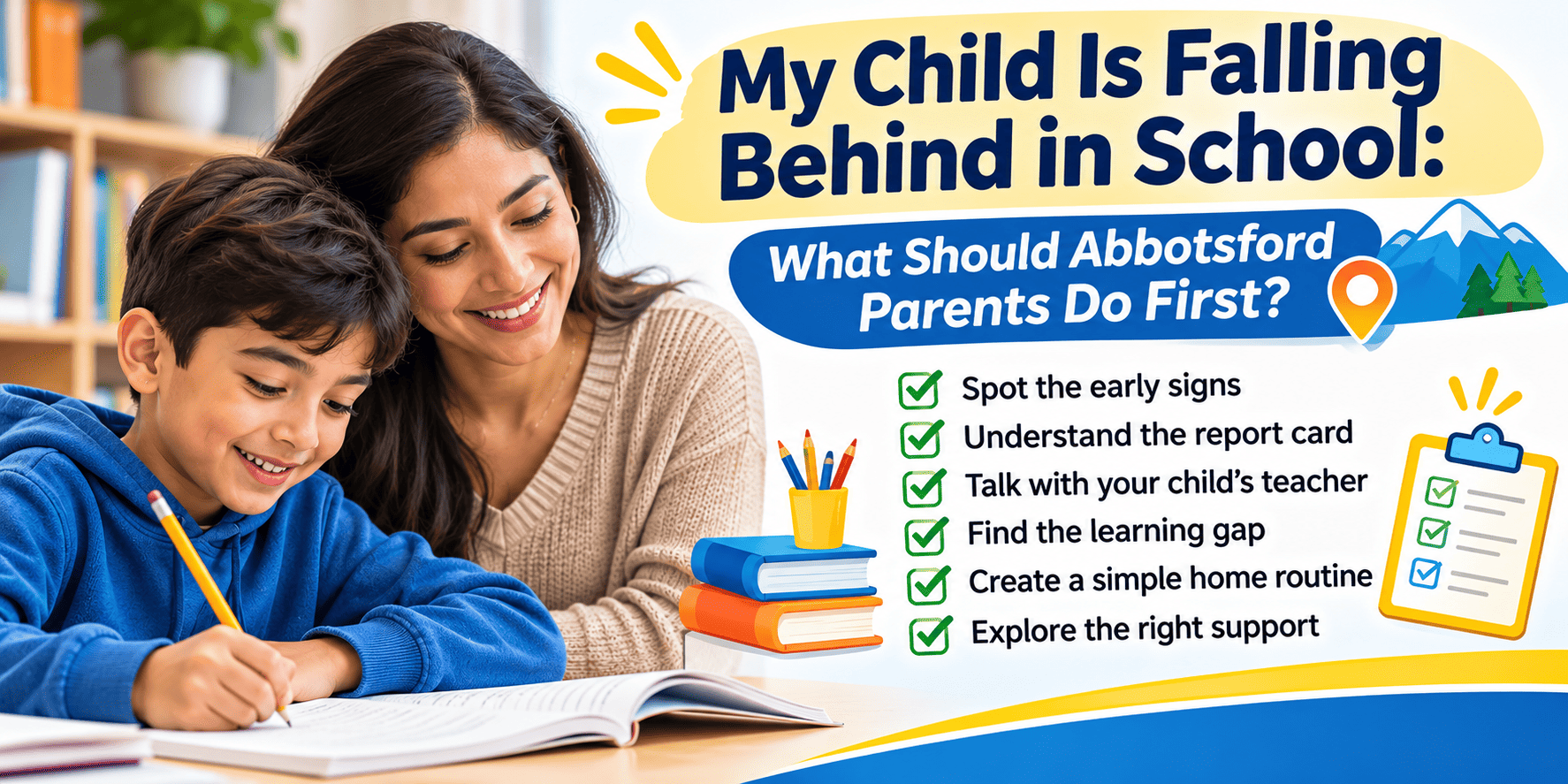
My Child Is Falling Behind in School: What Should Abbotsford Parents Do First?
My Child Is Falling Behind in School: What Should Abbotsford Parents Do First?
A practical guide for Abbotsford parents to recognize learning gaps, understand school feedback, and help children regain academic confidence.
Every parent wants to see their child succeed in school. But what happens when homework becomes a daily struggle, report cards raise concerns, or your once-enthusiastic learner suddenly starts saying, "I'm just not good at Math"?
If you're an Abbotsford parent wondering whether your child is falling behind academically, you're not alone in facing these questions.
The encouraging news? Learning difficulties do not automatically mean a child lacks ability or potential. Sometimes, a student simply needs additional time, a different explanation, stronger foundational skills, or a more suitable learning environment.
The most important first step isn't signing up for tutoring or assigning extra homework.
It's understanding why your child is struggling and what kind of support would actually help.
In this guide, we'll explore seven practical steps parents in Abbotsford can take to identify academic challenges, work with their child's school, and create a positive plan for progress.
Quick Answer: What Should Parents Do When Their Child Falls Behind in School?
If your child is struggling academically, begin with these seven steps:
-
Identify the specific subjects or skills causing difficulty.
-
Review report cards, classroom work, and teacher feedback.
-
Speak with your child's classroom teacher.
-
Identify possible gaps in foundational learning.
-
Establish a manageable learning routine at home.
-
Explore appropriate school-based or additional academic support.
-
Monitor progress while protecting your child's confidence.
Remember: The goal isn't to make your child catch up overnight. It's to help them develop the skills, understanding, and confidence needed for continued learning.
1. Recognize the Early Signs Your Child May Be Falling Behind
Academic challenges don't always show up as poor grades.
Sometimes the earliest signs appear in everyday activities.
Seven signs worth paying attention to
1. Homework takes much longer than expected
Your child spends an hour on work that previously took 20 minutes, or repeatedly needs help understanding instructions.
2. They avoid Reading or Math
They may complain, become frustrated, or find excuses to postpone certain assignments.
3. Previously learned concepts seem forgotten
For example, a Grade 4 student may struggle with multiplication because basic addition and number relationships are not yet secure.
4. Reading comprehension is weaker than reading fluency
Your child can read words aloud but struggles to explain what a paragraph means.
5. Confidence is declining
Statements such as "I'm stupid" or "Everyone else is better than me" deserve attention, even when academic results appear acceptable.
6. Teacher feedback repeatedly identifies similar difficulties
Comments about number sense, writing organization, reading comprehension, or completing tasks may indicate areas needing additional support.
7. Your child relies heavily on adult assistance
They may complete assignments successfully with help but struggle to apply the same concepts independently.
What these signs do—and don't—mean
One difficult assignment or an occasional frustrating evening does not establish that a child is academically behind.
Look for patterns across several weeks, different assignments, and feedback from teachers.
If difficulties are persistent, it's worth investigating rather than assuming your child will simply outgrow them.
2. Understand What Your Child's BC Report Card Is Telling You
For families attending elementary and middle schools in Abbotsford, British Columbia's student reporting system provides useful information about learning progress.
Students in Kindergarten through Grade 9 are generally assessed using the Provincial Proficiency Scale.
| Proficiency level | What it means |
|---|---|
| Emerging | The student is demonstrating an initial understanding of the expected learning. |
| Developing | The student is demonstrating partial understanding and is progressing toward proficiency. |
| Proficient | The student is demonstrating the expected learning in relation to curriculum standards. |
| Extending | The student is demonstrating sophisticated understanding and application of learning. |
Important: Proficient is a positive outcome. It means your child is demonstrating the expected learning standards, not that they are merely average or falling short.
Likewise, Developing is not automatically a failing grade.
Look beyond the proficiency scale
Consider a Grade 3 student whose report card indicates Developing in Mathematics.
The most useful information may be in the teacher's comments:
-
Does the student understand addition and subtraction?
-
Are multiplication concepts developing appropriately?
-
Is the difficulty with word problems or calculation?
-
Can the student explain their reasoning?
-
Does the student need support working independently?
These details help distinguish a specific learning gap from a broader academic concern.
Parent tip: Read the teacher's descriptive feedback before deciding whether your child needs additional tutoring.
For a more detailed explanation, read our BC Report Card Guide for Abbotsford Parents.
3. Speak With Your Child's Teacher Before Making Major Changes
One of the most valuable actions a parent can take is scheduling a conversation with their child's classroom teacher.
Teachers observe students in situations that parents may not see at home.
They can provide insight into classroom participation, learning habits, independent work, and progress relative to curriculum expectations.
Five useful questions to ask
-
Which specific skills is my child finding difficult?
-
Are these challenges occasional or consistent?
-
What strengths can we build upon?
-
What strategies are already being used in class?
-
What can we practise at home without overwhelming my child?
Try to leave the conversation with one or two clear learning priorities.
For example:
"Over the next month, we'll focus on multiplication facts and understanding two-step word problems."
That's much more actionable than a general goal such as "improve Math."
What support is available through Abbotsford schools?
Abbotsford School District has Learning Support Services and school-based processes to identify and address student learning needs.
When challenges interfere with educational progress, parents and school staff can discuss appropriate supports and whether a referral to the School Based Team is needed.
Not every child who struggles requires specialized services. However, parents should feel comfortable asking what school-based assistance is available.
4. Find the Learning Gap Before Adding More Work
This is one of the most overlooked aspects of academic support.
A child struggling with today's lesson may actually be struggling with a concept introduced months or years earlier.
Consider these examples.
Example A: A Grade 5 student struggles with fractions
The immediate assumption might be that the student needs more Grade 5 fraction worksheets.
But the underlying difficulty could be:
-
Weak multiplication and division fluency.
-
Limited understanding of equivalent fractions.
-
Difficulty visualizing parts of a whole.
-
Confusion about numerators and denominators.
Simply assigning more advanced worksheets may not resolve the underlying problem.
Example B: A Grade 3 student struggles with Reading comprehension
The issue might involve:
-
Difficulty decoding unfamiliar words.
-
Limited vocabulary.
-
Reading fluency.
-
Understanding sentence structure.
-
Identifying main ideas and supporting details.
Each challenge requires a somewhat different instructional response.
Why academic assessments can help
A thoughtfully designed academic assessment can help identify which concepts a student understands and where further instruction may be useful.
At Best Brains Abbotsford, our free placement assessment helps identify an appropriate starting level in our structured academic curriculum.
However, a tutoring placement assessment is not a medical, psychological, or formal learning-disability diagnosis.
If a child has persistent or significant difficulties despite appropriate instruction, parents should discuss further evaluation and school-based supports with their teacher and relevant professionals.
5. Create a Simple Learning Routine at Home
When parents discover their child is struggling, the natural response is often to increase study time.
But more homework isn't always the answer.
A manageable routine built around clear goals, consistent practice, and encouragement may be more sustainable.
Try this 20-minute learning routine
<escape>Minutes 1–5: Review something familiar</escape>
Start with a skill your child already understands. This creates an opportunity for early success.
<escape>Minutes 6–15: Focus on one challenging concept</escape>
Work through a small number of examples. Encourage your child to explain their thinking.
<escape>Minutes 16–20: Finish with a positive challenge</escape>
Use a short game, reading discussion, or real-world activity that applies the skill.
This is an example routine, not a required amount of study time. Younger children or those already overwhelmed may benefit from shorter sessions.
Make learning part of everyday life
Academic development doesn't have to happen exclusively at a desk.
For Math:
-
Calculate grocery totals.
-
Compare prices while shopping.
-
Measure ingredients when cooking.
-
Practise telling time and calculating elapsed time.
For English:
-
Read together and discuss the story.
-
Ask your child to predict what happens next.
-
Encourage short journal entries.
-
Play vocabulary and word games.
These activities can reinforce classroom learning while keeping the experience enjoyable.
6. Know When Additional Tutoring May Help
Not every academic difficulty requires paid tutoring.
Some children improve with classroom adjustments, additional teacher guidance, or a consistent home routine.
However, structured academic support may be worth considering when:
-
Your child repeatedly struggles with the same foundational skills.
-
Homework regularly leads to frustration.
-
Progress remains limited despite appropriate support.
-
Your child needs more guided practice than can reasonably be provided at home.
-
They benefit from concepts being explained in smaller steps.
-
They need academic enrichment to build confidence and strengthen skills.
What should parents look for in a tutoring program?
Consider these factors before enrolling:
| Factor | Why it matters |
|---|---|
| Instructor qualifications | Teachers and tutors should have the skills to explain concepts clearly. |
| Learning assessment | Instruction should begin at an appropriate level. |
| Individual attention | Children need opportunities to ask questions and receive feedback. |
| Curriculum structure | Learning should progress logically from foundational to advanced concepts. |
| Progress monitoring | Parents should understand what their child is learning and improving. |
| Child's comfort | A supportive environment can help reduce academic frustration. |
How Best Brains Abbotsford approaches academic support
Best Brains Abbotsford offers structured academic enrichment for children ages 3–14.
Our approach includes:
BC-certified teachers
Our core academic classes are taught by qualified teachers who help students understand concepts and develop stronger learning skills.
Small-group instruction
With a maximum of five students per teacher, students receive guided instruction while learning in a supportive group environment.
Structured, non-repetitive curriculum
Our curriculum introduces new concepts through progressive weekly lessons, helping children build upon existing knowledge.
Consistent teaching relationships
Students learn with a consistent teacher who becomes familiar with their progress and learning needs.
Multiple learning opportunities
Families can explore Math, English, Abacus, and Coding programs under one roof.
Best Brains is designed to complement school learning, not replace classroom instruction or specialized educational services.
7. Monitor Progress Without Putting Your Child Under Pressure
Once you've identified a learning gap and introduced support, how do you know whether it's working?
Progress is not always immediately reflected in report cards.
Look for smaller, meaningful improvements.
Five indicators of positive progress
-
Your child approaches assignments with less hesitation.
-
They can explain a concept in their own words.
-
They make fewer repeated mistakes.
-
They complete familiar tasks more independently.
-
They demonstrate greater confidence when facing challenges.
Use a simple four-week progress check
| Week | Parent's focus |
|---|---|
| Week 1 | Identify one or two specific learning goals. |
| Week 2 | Observe understanding and confidence during practice. |
| Week 3 | Check whether your child can apply the skill independently. |
| Week 4 | Review progress and discuss next steps with the teacher or tutor. |
Four weeks is a useful initial check-in, not a guaranteed timeframe for academic improvement.
Some skills develop quickly, while others require considerably more time and support.
Celebrate effort, strategies, and improvement—not just correct answers.
What If Your Child Is Falling Behind Despite Extra Help?
If your child continues to struggle, don't automatically assume they need longer tutoring sessions or more worksheets.
Consider whether something else may be affecting learning.
Possibilities include:
-
Gaps in previous instruction.
-
Language barriers.
-
Difficulty sustaining attention.
-
Vision or hearing concerns.
-
Emotional stress or anxiety.
-
Learning differences requiring specialized support.
These are possibilities, not diagnoses.
A conversation with your child's teacher, school learning-support team, or healthcare professional may help determine appropriate next steps.
A quality tutoring centre should recognize when a child's needs extend beyond its services and encourage families to seek additional professional guidance.
A Practical Checklist for Abbotsford Parents
If you're concerned about your child's academic progress, use this checklist to organize your next steps.
-
Review recent report cards and teacher comments.
-
Identify the subjects or concepts causing difficulty.
-
Ask your child how they feel about school and learning.
-
Schedule a conversation with their teacher.
-
Ask about available school-based learning supports.
-
Set one or two realistic academic goals.
-
Establish a manageable home-learning routine.
-
Consider an academic assessment if appropriate.
-
Review progress after a few weeks.
-
Celebrate improvements, even when they're small.
Final Thoughts: Falling Behind Today Doesn't Define Tomorrow
If your child is having difficulty at school, the most important thing you can do is respond with curiosity, patience, and a clear plan.
Academic progress isn't always a straight line.
Some children grasp new concepts immediately. Others need more time, different explanations, or opportunities to revisit earlier skills.
Neither situation determines a child's long-term potential.
The objective isn't simply to help your child catch up. It's to help them become a more capable, confident, and independent learner.
For families in Abbotsford, the first step is often as simple as having a constructive conversation with your child's teacher and identifying the skills that deserve attention.
From there, you can decide what support will make the greatest difference.
Frequently Asked Questions
1. How do I know if my child is falling behind in school?
Look for persistent difficulties with grade-appropriate skills, repeated concerns in teacher feedback, increased homework frustration, or reduced academic confidence. A single assignment or report card result is not enough to determine whether a child is falling behind.
2. Is Developing on a BC report card a bad result?
Not necessarily. Developing means the student is demonstrating partial understanding of expected learning standards and is progressing toward proficiency. Parents should review descriptive feedback and speak with the teacher to understand the specific learning needs.
3. Should I hire a tutor immediately if my child is struggling?
Not always. Begin by discussing the concern with your child's teacher and identifying the specific difficulty. Tutoring may help when a child needs additional guided instruction or structured practice.
4. What subjects do elementary students commonly need help with?
Parents often seek support with foundational Math, reading fluency, reading comprehension, spelling, grammar, and writing. However, each child's needs should be assessed individually.
5. Can a child catch up academically after falling behind?
Many children can make meaningful progress with appropriate instruction, practice, and support. The amount of improvement and time required depend on the nature of the learning difficulty and the child's individual circumstances.
6. How much should my child study at home?
There is no universal ideal amount. Short, focused practice may be more manageable than lengthy sessions, particularly for younger children. Parents should consider the child's age, existing school workload, and teacher recommendations.
7. What if my child hates homework?
Try to understand the reason. The work may be too difficult, too repetitive, confusing, or emotionally frustrating. Discuss persistent difficulties with the teacher rather than assuming the child is unmotivated.
8. Are there learning-support services available in Abbotsford schools?
Yes. Abbotsford School District provides Learning Support Services and school-based support processes. Parents can speak with their child's classroom teacher about available assistance and whether additional assessment or referral is appropriate.
9. How is Best Brains different from traditional tutoring?
Best Brains Abbotsford emphasizes structured academic enrichment, consistent teachers, small-group instruction, and progressive weekly learning. Traditional tutoring may focus more directly on immediate homework assistance or specific academic gaps, although approaches vary by provider.
10. Does Best Brains Abbotsford offer a free academic assessment?
Yes. Best Brains Abbotsford offers a free placement assessment to help determine an appropriate starting point in its curriculum.
11. Can tutoring help a child with a learning disability?
Tutoring may support academic skill development, but it does not replace specialized assessments, accommodations, or services recommended by qualified professionals. Parents should coordinate with their child's school and relevant specialists.
12. Where can I find Math and English tutoring in Abbotsford?
Families can explore school-based supports, independent tutors, and structured learning centres such as Best Brains Abbotsford. Comparing instructor qualifications, curriculum, learning format, and progress monitoring can help identify an appropriate fit.
Looking for Academic Support in Abbotsford?
At Best Brains Abbotsford, we believe every child deserves the opportunity to learn with confidence.
Whether your child needs stronger Math foundations, improved English skills, or additional academic enrichment, our team can help you explore a suitable learning path.
Our programs:
Math | English | Abacus | Coding
Ages: 3–14
Free placement assessment available
Best Brains Abbotsford
Phone: 236-622-2074
Website: https://bestbrains.com/ca-en/abbotsford
Contact us to schedule your child's FREE placement assessment and take the first step toward stronger learning foundations.
References and Further Reading
-
Government of British Columbia — K–12 Student Reporting Policy
https://www2.gov.bc.ca/gov/content/education-training/k-12/administration/legislation-policy/public-schools/student-reporting -
BC Curriculum — Student Reporting Information for Parents and Caregivers
https://curriculum.gov.bc.ca/reporting/resources-for-parents-and-caregivers -
Abbotsford School District — Communicating Student Learning
https://curriculum.abbyschools.ca/instructionassessment/instructionassessment -
Abbotsford School District — Accessing Learning Support Services (AP 206)
https://schoolkit.abbyschools.ca/administrative-procedures/AP206 -
Abbotsford School District — Learning Support Services
https://lss.abbyschools.ca/ -
Abbotsford School District — Communicating With Your School
https://aboriginal.abbyschools.ca/communicating-with-your-school -
Government of British Columbia — Assessing Student Skills and Curriculum Performance
https://www2.gov.bc.ca/gov/content/education-training/k-12/administration/program-management/assessment -
Best Brains Learning Center — Abbotsford
https://bestbrains.com/ca-en/abbotsford
Editorial note: This article provides general educational guidance and is not a substitute for individualized advice from classroom teachers, school learning-support teams, or qualified healthcare professionals.