Abbotsford
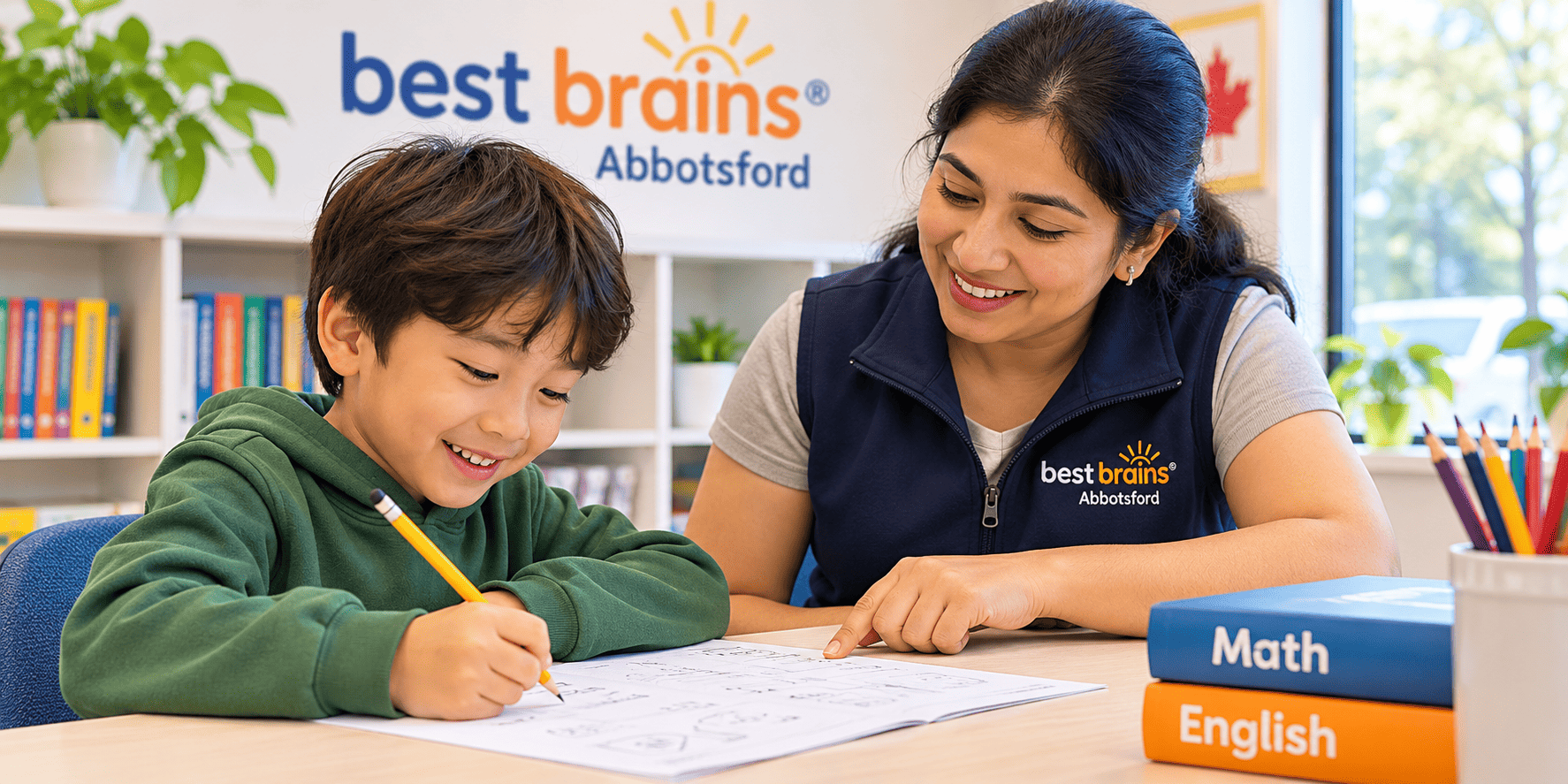
What Happens During a Best Brains Placement Test? An Abbotsford Parent's Guide
What Happens During a Best Brains Placement Test? An Abbotsford Parent's Guide
A closer look at how Best Brains Abbotsford understands your child's current skills before recommending a learning level.
When parents consider an after-school learning program, one of the first questions they often ask is:
"How will you know what my child needs to learn?"
It's a fair question. Two children attending the same grade at school may have very different strengths, learning experiences, and areas where they need support.
At Best Brains Abbotsford, we don't begin by assuming that a child's school grade tells us everything about their abilities.
Instead, we begin with a conversation.
Our free placement assessment helps us understand what a child already knows, what they are currently learning at school, and which concepts they may be ready to explore next.
Here's how the process works.
1. We start by talking to your child
Before presenting questions, we spend time getting to know the student.
We may ask:
-
What grade are you in?
-
What are you learning in Math or English at school right now?
-
Which topics do you enjoy?
-
Can you tell us about something you've learned recently?
-
Are there any topics you find difficult?
These conversations help us understand the child's learning experiences and give us an initial indication of where to begin.
For younger children, the conversation may be simpler and more informal. Older students may be able to explain the concepts they are studying in greater detail.
The purpose is to understand the learner before evaluating their work.
2. We select questions based on their grade and responses
There isn't one identical set of questions that every student must complete.
The student's grade level, current school topics, and responses during the introductory conversation help guide our initial selection of assessment questions.
For example, a Grade 2 student and a Grade 5 student will generally encounter different concepts.
Even two students in Grade 5 may begin with different questions depending on what they tell us about their current learning.
This approach helps us explore the student's knowledge rather than simply asking them to complete a generic worksheet.
3. Why do we sometimes start with difficult questions?
This is perhaps the most interesting part of our assessment process.
At Best Brains Abbotsford, we generally begin with more challenging questions and gradually work backwards toward easier ones.
Parents might naturally wonder:
"Why would you start with difficult questions? Wouldn't that discourage my child?"
The reason is that we want to explore the upper boundary of what a student can currently do.
Imagine a Grade 5 student who has already developed strong skills in several areas of mathematics.
If we begin with very basic questions, we may spend considerable time confirming knowledge the child already possesses.
Instead, we explore more challenging material first.
If the child finds those questions difficult, we gradually introduce earlier or simpler concepts.
This helps us understand where the student demonstrates confidence and where additional instruction may be useful.
A simple example
Consider a hypothetical Grade 5 student being assessed in Math.
Illustrative assessment progression
-
More challenging: Solve a multi-step problem involving fractions.
Student has difficulty completing the problem.
-
Step backwards: Compare fractions and identify equivalent fractions.
Student demonstrates partial understanding.
-
Explore foundations: Identify fractions using visual representations.
Student answers confidently.
This progression may help us identify a suitable starting point for instruction.
The goal isn't to count how many difficult questions a child gets wrong. It's to understand the concepts on which future learning can be built.
4. What skills do we look at in different grades?
The skills explored vary according to a child's age, grade, and subject.
Here are examples of learning areas that may be relevant at different stages.
|
School stage |
Math examples |
English examples |
|---|---|---|
|
Kindergarten–Grade 1 |
Counting, number recognition, basic operations, patterns |
Letter recognition, sounds, early reading, vocabulary |
|
Grades 2–3 |
Place value, addition, subtraction, early multiplication, problem-solving |
Phonics, reading fluency, sentence construction, comprehension |
|
Grades 4–5 |
Multiplication, division, fractions, decimals, multi-step problems |
Reading comprehension, grammar, vocabulary, paragraph writing |
|
Grades 6–8 |
Fractions, ratios, percentages, algebraic thinking, problem-solving |
Complex texts, grammar, written expression, critical reading |
These are examples of skills that may be explored, not a guaranteed checklist for every student.
British Columbia's curriculum outlines a progression of knowledge and competencies across grades. Understanding that progression can help educators interpret students' current learning needs.
5. Does the placement test tell us if a child is ahead or behind?
A placement assessment can offer useful insight into a child's current understanding of selected concepts.
However, it is important to distinguish between a curriculum placement assessment and a comprehensive evaluation of school achievement.
The Best Brains assessment is designed primarily to help determine where a student should begin within the Best Brains learning program.
It is not a replacement for a school report card, a comprehensive educational evaluation, or a formal diagnosis of learning difficulties.
A child's placement within Best Brains also should not automatically be interpreted as an exact equivalent of their BC school grade.
For example, a Grade 5 student may be ready for more advanced work in one mathematical skill while needing reinforcement in another.
Learning is rarely identical across every topic.
6. What happens after the assessment?
Once we have reviewed the child's responses, we use the information to recommend an appropriate starting level within the Best Brains curriculum.
Our Math and English programs follow a structured, progressive approach.
The objective is to begin with material suited to the student's demonstrated understanding and then introduce new concepts as their skills develop.
This does not mean creating an entirely new curriculum for every child. Rather, it means selecting an appropriate entry point within an established curriculum.
At Best Brains Abbotsford, our BC-certified teachers guide students through lessons in small groups, with ongoing opportunities to observe their progress and understanding.
7. What should parents ask after the placement test?
We encourage parents to be curious about their child's learning.
Here are five useful questions to discuss after an assessment:
-
Which concepts did my child demonstrate confidence in?
-
Which topics appeared more challenging?
-
Why are you recommending this particular starting level?
-
How does the recommended curriculum build on what my child already knows?
-
How will we know when my child is ready to move forward?
A good discussion should help parents understand the reasoning behind the recommendation, rather than simply receiving a level number.
8. How can parents prepare their child?
The best preparation is usually very simple.
Tell your child that the assessment is an opportunity to show what they already know and explore some questions they may not have encountered before.
There's no need to spend hours preparing or memorizing answers.
You can reassure your child that encountering an unfamiliar question is a normal part of the process.
The purpose is not to achieve a perfect score.
It's to find a useful starting point for learning.
Frequently asked questions
Is the Best Brains placement test free?
Yes. Best Brains Abbotsford offers a free initial placement assessment, with no obligation to enrol.
What happens during the Best Brains placement test?
We begin with a short conversation about the child's grade, current school topics, and existing knowledge. We then introduce subject-specific questions, generally starting with more challenging material and working backwards toward easier concepts to understand their current skill level.
Why does Best Brains start with difficult questions?
Starting with more challenging questions helps us explore what a student may already be capable of doing. Moving toward simpler concepts can then help us identify an appropriate starting point without spending unnecessary time on material the student has already mastered.
Is the placement test the same for every student?
No. The initial questions are selected with consideration for the child's grade level and introductory conversation. The assessment can then explore different levels of difficulty based on the student's responses.
Does my child need to study before the placement test?
No special preparation is necessary. We want to understand the child's current knowledge, not how well they can prepare for a particular test.
What if my child cannot answer some questions?
That's perfectly normal. Challenging questions are part of the process. An unanswered question provides information about what the student may not yet have learned or mastered.
Is the Best Brains placement test aligned with the BC curriculum?
The assessment considers school grade levels and relevant academic skills, while its primary purpose is to determine placement within the Best Brains curriculum. It should not be treated as a formal BC provincial assessment.
Can the assessment identify dyslexia, ADHD, or learning disabilities?
No. The placement assessment is an educational tool for curriculum placement, not a clinical or psychoeducational diagnostic assessment. Families with concerns about learning disabilities should consult appropriately qualified professionals.
Can parents ask questions about the assessment results?
Absolutely. Parents are encouraged to discuss their child's strengths, areas for development, and recommended starting level.
Start with understanding, then build confidence
Every child brings a different combination of knowledge, experience, strengths, and questions into the classroom.
At Best Brains Abbotsford, we believe the first step toward meaningful academic enrichment is understanding what that child already knows.
That's why our placement process begins with a conversation, explores different levels of difficulty, and helps us recommend a suitable starting point.
Because the goal isn't simply to give children more work.
It's to give them the right work, at the right starting level, with the right guidance.
Book a free placement assessment in Abbotsford
Best Brains Abbotsford
3720 Townline Road, Unit 230, Abbotsford, BC
Phone: 236-622-2074
Website: Best Brains Abbotsford
Explore our Math and English enrichment programs or contact us to arrange a free placement assessment.