Abbotsford
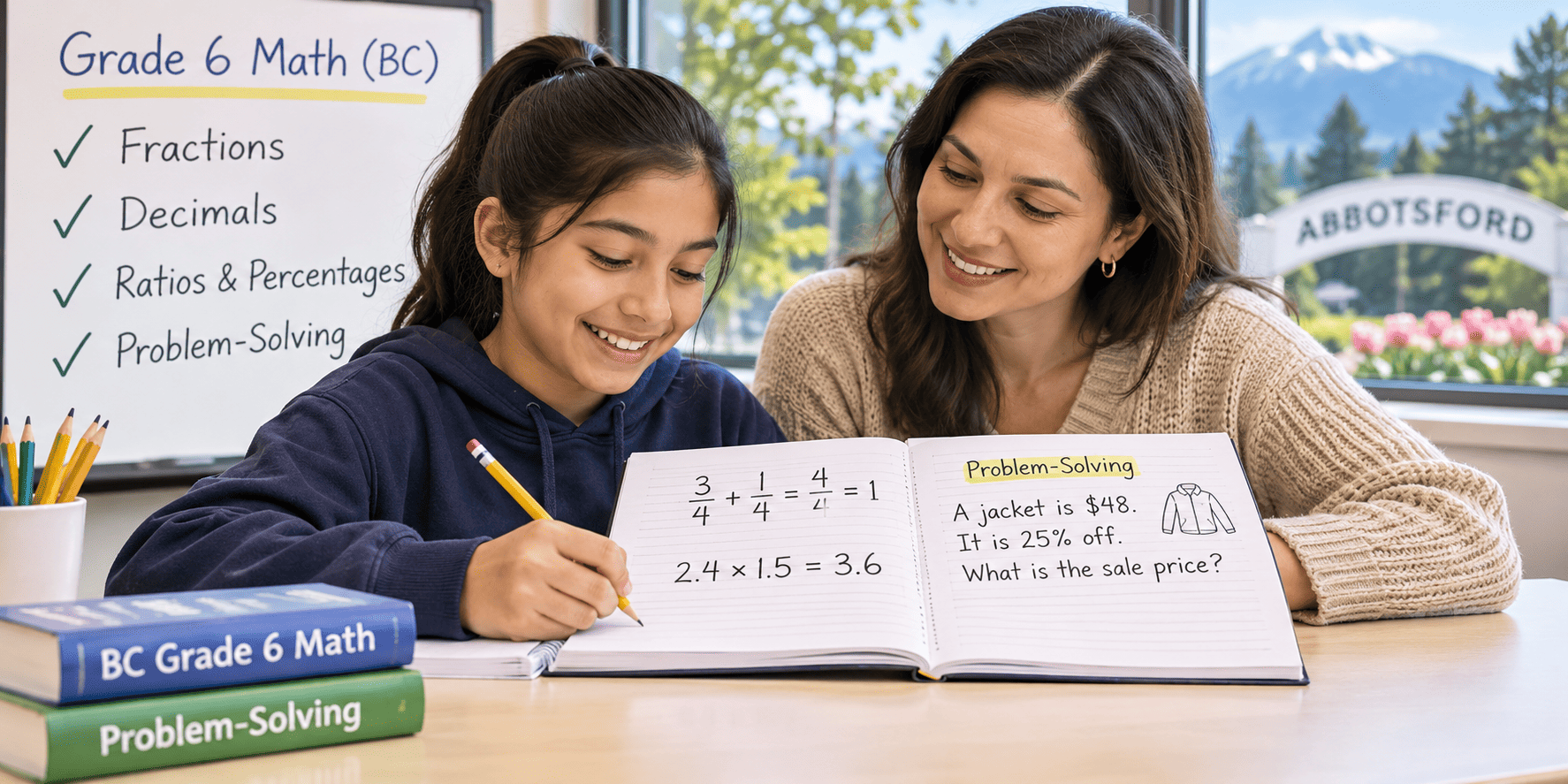
BC Grade 6 Math Curriculum Guide | Best Brains Abbotsford
BC Grade 6 Math Curriculum: What Changes, and Is Your Child Ready?
Grade 6 is an important transition in a child's mathematical education. For many students across British Columbia, including those attending schools in Abbotsford, mathematics begins to feel noticeably different.
Numbers become larger. Fractions become more complex. Decimal calculations require greater accuracy. Students begin working with variables, exploring probability, and applying mathematics to real-life financial decisions.
But the biggest change isn't necessarily the difficulty of the numbers.
It's the growing expectation that students understand why mathematical methods work, explain their reasoning, and apply their knowledge to unfamiliar problems.
If your child is entering Grade 6, or already finding Grade 6 Math challenging, this guide explains what the BC curriculum covers, how it builds on Grade 5, and what you can do to support learning at home.
What does the BC Grade 6 Math curriculum include?
According to the British Columbia Ministry of Education and Child Care's Mathematics 6 curriculum, students develop knowledge across five interconnected areas:
-
Number sense and computational fluency
-
Patterns, relationships, and early algebra
-
Geometry and measurement
-
Data analysis and probability
-
Financial literacy and mathematical problem-solving
These areas are not entirely new. Most build on concepts introduced in earlier grades, but Grade 6 expects students to make deeper connections and apply more sophisticated strategies.
The curriculum also emphasizes mathematical communication, reasoning, and connecting learning to everyday experiences.
Grade 5 vs. Grade 6 Math: What's different?
Understanding the progression between grades can help parents identify why a previously confident student may suddenly need more support.
|
Math area |
Grade 5 |
Grade 6 |
|---|---|---|
|
Number sense |
Whole numbers up to 1 million |
Numbers from thousandths to billions |
|
Fractions |
Equivalent fractions and comparisons |
Improper fractions, mixed numbers and fraction operations |
|
Decimals |
Addition and subtraction to thousandths |
Multiplication and division involving decimals |
|
Operations |
Whole-number calculations and flexible strategies |
Order of operations, including brackets |
|
Number properties |
Multiples and number patterns |
Prime factorization, greatest common factor and least common multiple |
|
Algebra |
One-step equations and patterns |
Expressions with variables, preservation of equality and linear relationships |
|
Geometry |
Area, perimeter and shape properties |
Angles, volume and combinations of transformations |
|
Data |
Graphs and interpreting data |
Line graphs and theoretical versus experimental probability |
|
Financial literacy |
Money calculations and financial planning |
Simple budgeting and consumer math |
This is a parent-friendly summary of the official learning standards, not a complete list of every curricular expectation.
1. Fractions become more demanding
Fractions are one of the most significant areas of development in Grade 6.
In Grade 5, students work with equivalent fractions and comparisons. In Grade 6, they extend this understanding to improper fractions, mixed numbers, and fraction calculations.
For example, students may encounter:
They should understand that both expressions represent the same quantity.
Students also work with adding and subtracting fractions, including situations where equivalent fractions are needed.
Consider:
A student who understands equivalent fractions can recognize that:
Why parents should pay attention: Students who rely only on memorized fraction procedures may struggle when problems require them to compare, represent, or explain fractional quantities.
Try this at home: Use recipes, measuring cups, or drawings to explore fractions. Ask your child to explain why two fractions are equivalent instead of simply calculating an answer.
2. Decimals move beyond addition and subtraction
By Grade 5, students have worked with adding and subtracting decimals. Grade 6 extends this understanding to multiplication and division involving decimal numbers.
For example:
Students need to understand place value and estimate whether their answers are reasonable.
Imagine purchasing 1.5 kilograms of fruit at $2.40 per kilogram. The total cost is $3.60.
This kind of practical problem connects arithmetic with everyday decisions.
Common challenge: Students sometimes apply whole-number rules without considering decimal place value.
Parent tip: Before your child calculates, ask them to estimate. If 2.4 multiplied by 1.5 produces an answer of 36, does that make sense?
Estimation helps students recognize unreasonable results.
3. Order of operations becomes important
Grade 6 introduces more explicit work with the order of operations involving whole numbers and brackets.
Consider:
The correct answer is 20, not 36, because multiplication is completed before addition.
Now compare:
Students must recognize how brackets change the calculation.
This is a foundational skill for more advanced mathematics.
The BC Grade 6 curriculum includes brackets but does not require exponents as part of this order-of-operations learning standard.
Parent tip: Ask your child to explain the sequence of operations before solving the problem.
4. Students explore factors, multiples, and prime numbers
Grade 6 places greater emphasis on number properties, including:
-
Prime and composite numbers
-
Divisibility rules
-
Greatest common factor (GCF)
-
Least common multiple (LCM)
-
Prime factorization
For example, consider 12 and 18.
The greatest common factor is 6.
The least common multiple is 36.
These concepts help students develop stronger number sense and support later work with fractions and algebra.
Try this at home: Ask your child to find two numbers that have a greatest common factor of 4, then explain their reasoning.
5. Algebra becomes more visible
Grade 6 is an important stage in the development of algebraic thinking.
Students move beyond recognizing patterns and solving simple missing-number problems toward working with variables and understanding mathematical relationships.
For example:
The solution is \(x=5\).
More important than obtaining the answer is understanding that both sides of the equation must remain equal.
Students also explore linear relationships and how patterns can be represented through expressions, tables, and graphs.
Why this matters: Algebra is not simply a new collection of rules. It is a different way of describing relationships between quantities.
Students who understand the underlying concepts are generally better positioned to tackle increasingly abstract mathematics in later grades.
6. Geometry includes more measurement and spatial reasoning
In Grade 6, students extend their understanding of shapes and measurement.
Important concepts include angles, area, perimeter, volume, and combinations of transformations.
For example, a rectangular prism measuring 5 cm by 3 cm by 2 cm has a volume of:
Students should understand why volume is measured in cubic units, rather than simply memorizing the formula.
Transformations also become more sophisticated as students investigate how shapes move through translations, reflections, and rotations.
Parent tip: Use everyday objects such as boxes, containers, and building blocks to make geometry more tangible.
7. Probability goes beyond guessing
Grade 6 students explore the difference between theoretical and experimental probability.
Imagine rolling a fair six-sided die.
The theoretical probability of rolling a 4 is:
But if a student rolls the die 30 times, they may not obtain exactly five 4s.
This provides an opportunity to discuss why actual experimental results can differ from mathematical predictions.
Students learn to collect information, interpret results, and make reasonable conclusions.
Try this at home: Roll a die 30 times, record the results, and compare the experimental outcomes with the theoretical probabilities.
8. Financial literacy becomes more practical
One particularly useful part of Grade 6 Mathematics is its connection to everyday financial decisions.
The BC curriculum includes simple budgeting and consumer mathematics.
Students may explore situations involving spending, saving, comparing prices, and planning within a budget.
For example:
A student has $50 and wants to purchase:
-
A book for $18
-
A game for $24
-
A notebook for $6
The total is $48, leaving $2.
Now ask: What if sales tax applies to the purchases? Will the same budget still be enough?
This introduces students to real-world financial decision-making and the importance of considering all costs.
What makes Grade 6 Math challenging for some students?
Not every child experiences Grade 6 in the same way. Some adapt quickly, while others need additional time to strengthen their foundations.
A common issue is that earlier learning gaps become more noticeable.
For example, a student may understand how to multiply whole numbers but struggle with decimal multiplication because their place-value understanding is incomplete.
Another student may remember how to simplify a fraction but find it difficult to explain what the fraction represents.
Here are five signs that a child may benefit from additional mathematical support:
-
They regularly struggle to recall or apply multiplication and division facts.
-
They find fractions, decimals, or multi-step calculations confusing.
-
They can complete familiar examples but struggle when a problem is presented differently.
-
They have difficulty explaining how they reached an answer.
-
They become increasingly frustrated or avoid mathematics homework.
These signs do not automatically mean a student is falling behind. They suggest that parents and teachers may want to investigate which concepts need further reinforcement.
How can parents help their Grade 6 child succeed in Math?
The most effective support does not always involve longer homework sessions.
Often, small changes in how mathematics is discussed and practised can make a meaningful difference.
Focus on understanding, not just correct answers
Instead of asking only, “Did you get it right?”, try asking:
“How did you work that out?”
“Can you solve it another way?”
“How do you know your answer makes sense?”
These questions encourage reasoning and mathematical communication.
Strengthen earlier concepts
If your child struggles with fraction calculations, revisit equivalent fractions.
If decimal multiplication is difficult, review place value and whole-number multiplication.
Building on secure foundations is often more productive than repeatedly practising a procedure that the child does not yet understand.
Make mathematics part of everyday life
Shopping, cooking, planning a family outing, and measuring furniture can all provide useful mathematical experiences.
For example, ask your child to compare the cost of two grocery packages or calculate how much time remains before an activity begins.
Encourage mistakes as learning opportunities
A wrong answer can reveal something valuable about a child's thinking.
Instead of immediately correcting the answer, ask your child to review their steps and identify where their reasoning may have changed.
Maintain communication with the classroom teacher
If your child is struggling consistently, ask which specific learning standards need attention.
Understanding whether the difficulty involves number sense, calculations, reasoning, or problem-solving can help you choose appropriate practice activities.
How does BC assess Grade 6 Math learning?
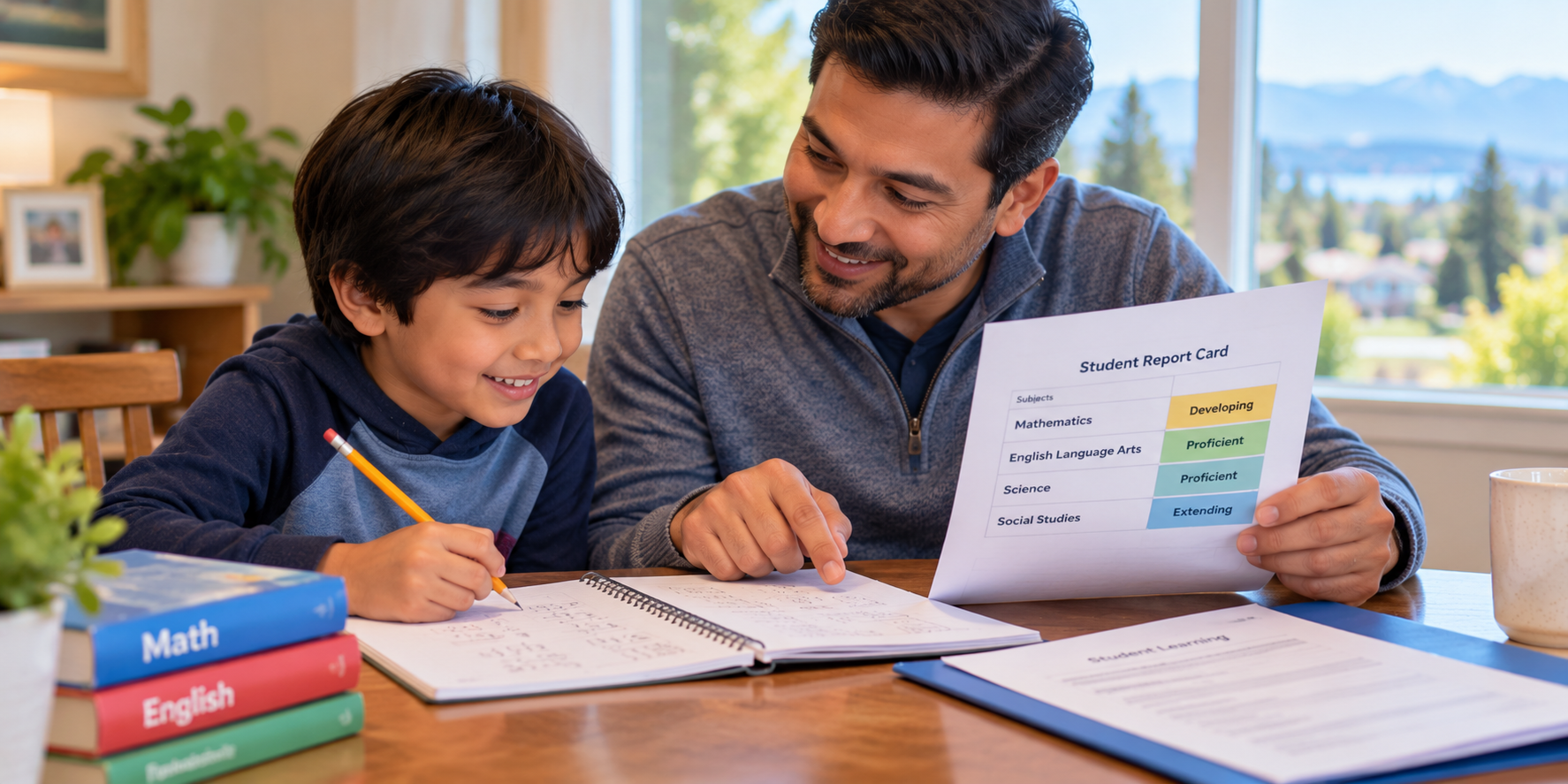
British Columbia uses a four-point Provincial Proficiency Scale in K–9 student reporting:
|
Proficiency |
What it means |
|---|---|
|
Emerging |
The student demonstrates an initial understanding of expected learning |
|
Developing |
The student demonstrates a partial understanding |
|
Proficient |
The student demonstrates the expected learning |
|
Extending |
The student demonstrates a sophisticated understanding |
Parents should understand that Proficient is a positive achievement. It indicates that a student is demonstrating the learning expected for the grade.
Extending does not simply mean completing more advanced worksheets or working at a higher grade level. It reflects greater sophistication in applying and demonstrating learning.
When reviewing a report card, look beyond the proficiency designation and read the teacher's descriptive feedback.
How Best Brains Abbotsford supports Math learning
At Best Brains Abbotsford, we recognize that children develop mathematical understanding at different rates.
Our Math enrichment program is designed to help students strengthen foundational skills, build confidence, and develop mathematical thinking through structured, progressive learning.
Our approach includes:
-
BC-certified teachers who support students through guided instruction.
-
Small-group learning, allowing more individualized attention.
-
A non-repetitive curriculum that introduces new concepts progressively.
-
Personalized placement assessments to help identify a suitable starting level.
-
An emphasis on understanding, rather than simply memorizing procedures.
Best Brains is an academic enrichment program, not a replacement for classroom instruction. Our curriculum is independently structured and should not be understood as an exact replication of the BC school curriculum.
For families in Abbotsford, the objective is to help children build the mathematical foundations and confidence that support their broader academic development.
Frequently Asked Questions about BC Grade 6 Math
What do students learn in Grade 6 Math in British Columbia?
Students learn about large numbers, improper fractions, mixed numbers, decimal operations, order of operations, factors and multiples, variables, geometry, line graphs, probability, and financial literacy. They also develop mathematical reasoning and communication skills.
Is Grade 6 Math much harder than Grade 5?
Grade 6 introduces more complex calculations and deeper mathematical relationships. Students are increasingly expected to explain their reasoning and apply concepts to unfamiliar problems. The difficulty varies depending on each child's prior understanding.
Do Grade 6 students learn algebra in BC?
Yes. Students explore variables, expressions, equations, and linear relationships. These concepts prepare them for more advanced algebra in subsequent grades.
Are fractions important in Grade 6?
Yes. Students extend their knowledge of equivalent fractions to improper fractions, mixed numbers, comparisons, and fraction operations. A solid understanding of fractions supports later learning in algebra and proportional reasoning.
Do Grade 6 students learn percentages?
Percentage concepts may be explored through classroom examples and enrichment activities, but percentages become a more explicit part of the Grade 7 number curriculum. Parents should not assume that advanced percentage calculations are a required Grade 6 learning outcome.
Does Grade 6 Math include probability?
Yes. Students explore single-outcome probability, including theoretical and experimental probability, and compare mathematical expectations with observed results.
How can I tell whether my child is meeting Grade 6 Math expectations?
Review classroom work, teacher feedback, and the BC Provincial Proficiency Scale. A student demonstrating Proficient learning is meeting grade-level expectations. Discuss specific areas of difficulty with the classroom teacher.
How much Math practice should a Grade 6 student do at home?
There is no single daily practice duration prescribed by the BC Grade 6 Mathematics curriculum. Short, focused sessions that address actual learning needs can be more helpful than lengthy repetitive exercises.
Where can I find Grade 6 Math support in Abbotsford?
Families can speak with their child's classroom teacher, explore school-based resources, or consider additional academic support. Best Brains Abbotsford offers Math enrichment and placement assessments to help determine an appropriate learning level.
Final thoughts: Grade 6 is about building mathematical independence
The transition from Grade 5 to Grade 6 is about much more than learning larger numbers or harder calculations.
Students are developing the ability to reason, recognize patterns, explain mathematical relationships, and use numbers to solve meaningful problems.
For parents, the most valuable approach is to remain curious, supportive, and involved.
Ask questions. Encourage explanations. Celebrate progress. And when your child struggles, focus on understanding the underlying concept rather than simply completing another worksheet.
A strong mathematical foundation today can make future learning more accessible.
Looking for Math enrichment in Abbotsford?
Best Brains Abbotsford offers structured Math, English, Abacus, and Coding programs for children ages 3–14.
Whether your child needs to strengthen foundational concepts or is ready for additional academic challenges, a placement assessment can help identify an appropriate starting point.
Best Brains Abbotsford
Phone: 236-622-2074
Website: Best Brains Abbotsford
Help your child approach Math with greater confidence. Contact us to arrange a free placement assessment.
Official sources and further reading
The educational content in this article is based primarily on British Columbia's official curriculum documentation.
-
BC Ministry of Education and Child Care — Mathematics 6 Curriculum. Official Grade 6 Mathematics learning standards
-
BC Ministry of Education and Child Care — Mathematics 5 Curriculum. Official Grade 5 Mathematics learning standards
-
BC Ministry of Education and Child Care — Mathematics Curriculum Introduction. Curriculum structure, competencies and learning goals
-
BC Ministry of Education and Child Care — Mathematics K–9 Elaborations. Detailed curriculum elaborations
-
BC Ministry of Education and Child Care — Cross-Curricular Numeracy. Numeracy learning pathways and examples
Editorial note: This is an independent parent information guide prepared for Best Brains Abbotsford. It is not an official publication or endorsement of the BC Ministry of Education and Child Care. Curriculum requirements should always be verified against the province's published learning standards.