Abbotsford
AI Is Coming — Why Middle School Is the Perfect Time to Learn Scratch, Python and Web Development Before the Window Closes
Here is a number that should stop every Abbotsford parent of a middle schooler in their tracks.
By 2026, more than 250,000 Canadian jobs will require AI-related knowledge — according to the Information and Communications Technology Council of Canada. Not "tech jobs." Not "engineering jobs." Jobs across healthcare, finance, logistics, agriculture, design, and education. Fields that today's Grade 6, 7, and 8 students will be entering within a decade.
The children who arrive at those jobs with computational thinking skills, coding foundations, and the ability to work alongside AI systems will not just be employable. They will be indispensable. The children who arrive without those skills will find themselves competing for a shrinking share of roles that AI has not yet automated — and that share is getting smaller every year.
This is not alarmism. It is arithmetic. And middle school — ages 10 to 14 — is precisely the window when the investment in coding education produces the highest, most durable return.
Here is why. And here is what Abbotsford families can do about it right now.
The AI Revolution Is Not Coming for Engineers Only — It Is Coming for Everyone
The conversation about AI and jobs often centres on programmers, data scientists, and software engineers. That framing misses the broader reality.
The Information and Communications Technology Council predicts that by 2026, more than a quarter million Canadian jobs will require AI-related knowledge. Digital literacy and AI literacy are becoming as important as formal credentials, and the ability to work alongside technology rather than compete with it will define career success.
Read that last phrase again: the ability to work alongside technology rather than compete with it.
The children who learn to code are not learning to compete with AI. They are learning to direct it, build on top of it, and use it as a tool — the way today's professionals use spreadsheets or word processors. The children who do not learn these skills are the ones who will find themselves on the wrong side of that equation.
In 2026, companies are increasingly investing in AI integration, Web3 technologies, and enhanced mobile platforms. Developers and programmers with in-demand coding languages and strong problem-solving and analytical skills are among the most sought-after candidates in the Canadian job market.
The most demanded programming language by recruiters worldwide right now is Python — a language that is approachable, powerful, and directly relevant to AI and machine learning applications. The coding pathway that produces the most capable young developers starts with Scratch for visual logic, advances to Python for text-based programming and AI applications, and builds toward Web Development for real-world project creation. Canadian employers expect production-ready skills in Python, machine learning fundamentals, and deployment — and starting salaries for ML engineers commonly range from $110,000 to $140,000 CAD in Canadian tech hubs.
A child who begins building Python foundations at age 11 or 12 has a six-year runway to develop genuine proficiency before university. A child who starts at 18, in first-year computer science, is competing from scratch against peers who have been building for years.
Why Middle School Is the Optimal Coding Window — The Brain Science
This is not a matter of opinion. The developmental research is consistent and clear: middle school — roughly ages 10 to 14 — is the single most powerful window for introducing structured coding education.
According to research from Harvard, like learning any language, coding is picked up and integrated with the greatest ease and fluency at an early age. The brain develops the most in the first 12 years of life, and brains build increasingly complex structures on top of existing, simpler structures. Exposure to programming at an early age builds these first structures, and continued exposure strengthens them.
The middle school years sit at the intersection of two developmental realities. The brain's foundational architecture — built in early childhood — is now sophisticated enough to handle abstract logical thinking, sequencing, and algorithmic reasoning. At the same time, the neural plasticity that makes new skill acquisition efficient has not yet declined. It is the sweet spot.
As children transition into middle childhood, coding activities start to include learning actual programming languages. As the complexity of coding projects increases, it fosters deeper engagement with computational thinking — including logical reasoning, problem decomposition, sequencing, and cause-and-effect understanding.
Research shows that learning to code fuels the brain in powerful ways. A study reported in Frontiers for Physiology shows that executive functioning in young children is significantly improved with only a limited amount of coding practice. Not only is computational problem solving enhanced, but supporting executive functions such as planning and response inhibition are improved as well — allowing children to practice self-control and focus on complex tasks.
And critically — the benefits are not confined to coding itself. Thompson and Childers (2021) found that coding using Google's CS First lessons improved students' writing assessments and writing stamina — demonstrating that coding skills transfer meaningfully into language arts performance.
This is the point that most parents miss: coding education does not just prepare children for tech careers. It rewires how they think — improving mathematical reasoning, reading comprehension, written expression, and problem-solving across every subject they study. The middle schooler who learns to code is building a cognitive architecture that makes every other subject easier.
What Happens to Children Who Miss This Window
The question of when to start matters more than most parents realise — because the skills built in the middle school window compound forward, and the absence of those skills compounds in the other direction.
A child who enters high school without computational thinking foundations faces three compounding disadvantages:
First, the curriculum gap. BC high school computer science and digital literacy courses assume foundational thinking skills that are significantly easier to develop at 11 or 12 than at 15 or 16. Students who have not built those foundations struggle with abstraction, debugging, and logical sequencing in ways that feel like ability gaps but are actually preparation gaps.
Second, the confidence gap. Research on academic self-efficacy consistently shows that children's beliefs about their own capability in a subject are largely formed by their early experiences with it. A child who has never written a program, never debugged a function, and never built anything with code arrives in a high school coding class already feeling like an outsider. That feeling is hard to shake — and it shapes whether they pursue the subject further.
Third, the career pipeline gap. The time to prepare young people for a future shaped by computer science is during middle school — not high school, not university. Schools and programs that introduce computer science concepts at the middle school level invite students to customise solutions, simulate systems, and design coded responses to real-world problems in ways that make both science and computer science feel applicable and relevant to their lives.
The window does not close permanently at 14. But it does narrow significantly. The child who begins at 10 or 11 has years of compounding development ahead of them. The child who begins at 15 or 16 is starting later in a faster-moving field, with less time and less neural efficiency.
The Industry Standard Your Child Should Be Building Toward
Parents often ask: what specifically should my middle schooler be learning in coding? The answer in 2026 is more concrete than it has ever been.
In 2026, the coding landscape is evolving rapidly, and the skills kids need to master include next-generation programming languages like Python, visual programming tools, and computational thinking skills that help them adapt to the ever-changing tech landscape. For children aged 11 to 14, engaging with practical projects using recommended tools and platforms is the most effective approach.
The industry-standard skill progression for a middle school student entering the field in 2025–2026 looks like this:
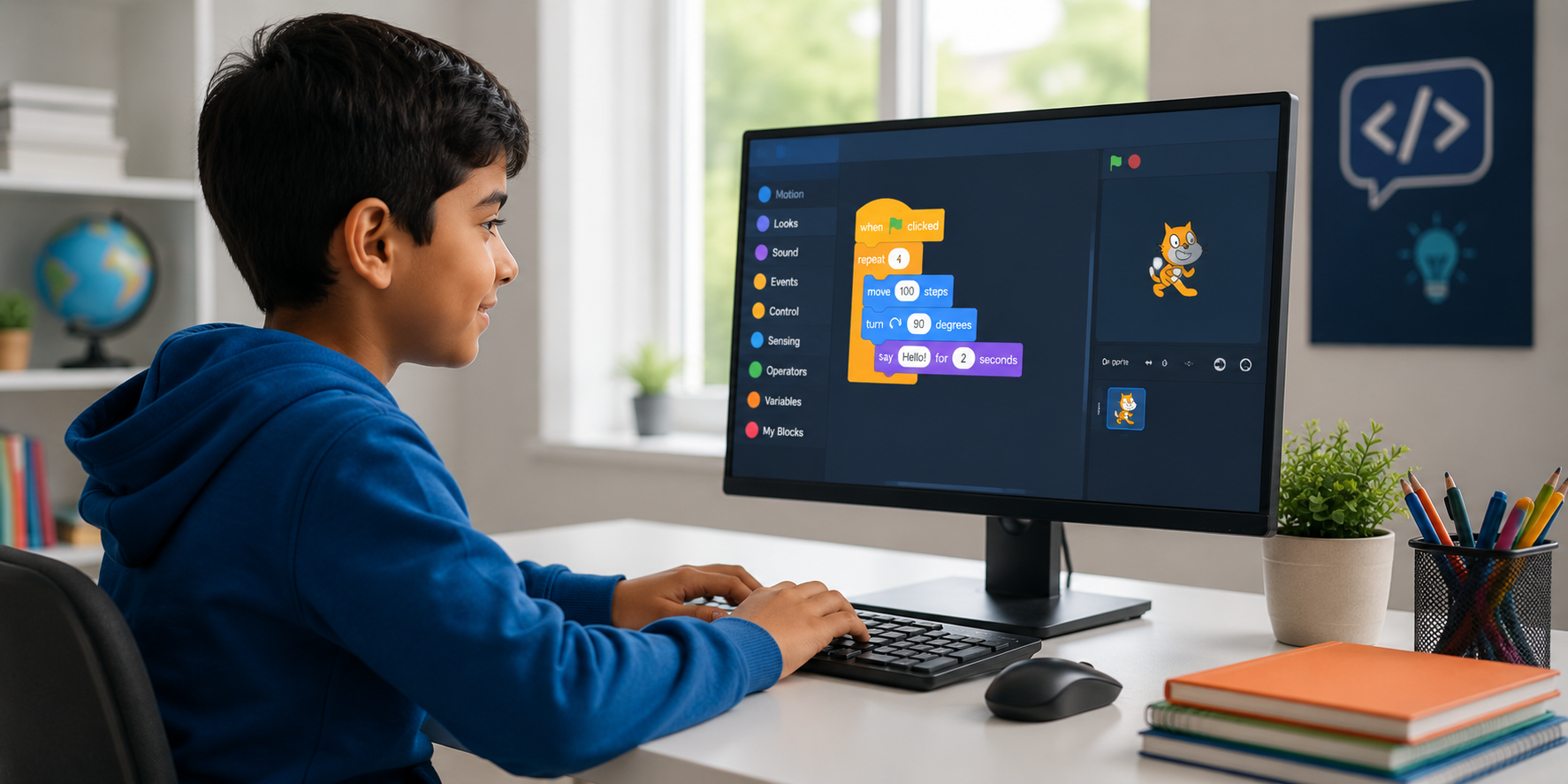
Foundation level (ages 10–11) — Scratch: Block-based visual programming using Scratch — the globally recognised entry point for computational thinking developed by MIT. Children build interactive stories, animations, and simple games using drag-and-drop code blocks, learning algorithmic thinking, sequencing, loops, and conditionals without the syntax barrier of written code. Scratch is not a toy — it is the foundational environment used in computer science education programmes worldwide, and the logical reasoning it builds transfers directly into text-based languages.
Intermediate level (ages 11–13) — Python: Transition from Scratch to Python — the most demanded programming language by recruiters worldwide in 2026 and the primary language of AI, machine learning, and data science. Children learn Python fundamentals: variables, functions, data types, conditionals, loops, and basic input/output. Project-based learning brings concepts to life — building a calculator, a quiz game, a number guessing program. This is where conceptual understanding becomes genuine technical skill that has direct, measurable career relevance.
Applied level (ages 12–14) — Web Development: Real-world application through Web Development — HTML, CSS, and introductory JavaScript, giving children the skills to build functional websites and interactive web pages from scratch. At this level, students understand how the internet works at a structural level, how front-end and back-end systems communicate, and how to present their ideas digitally in a format that every employer and university admissions officer recognises as a concrete, demonstrable skill. A student who completes this level before entering Grade 9 has a genuinely competitive portfolio foundation.
This is the progression that Best Brains Abbotsford's coding curriculum is built around — structured, sequential, and aligned with exactly what Canadian employers and post-secondary institutions are looking for from students entering the technology pipeline.
Why Coding Alone Is Not Enough — The Academic Foundation Matters
Here is the insight that separates Best Brains' approach from standalone coding programs, and it is one that parents researching middle school coding options often overlook.
Coding does not exist in isolation. The most capable coders — the ones who will build the AI tools rather than just use them — are the ones with strong mathematical reasoning, strong reading comprehension, and strong analytical thinking. These are not soft prerequisites. They are structural requirements.
Math is the language of code. Variables, functions, loops, algorithms, data structures — every one of these concepts is rooted in mathematical logic. A child who has gaps in number sense, fractions, algebra foundations, or pattern recognition will encounter those gaps as barriers in their coding work. A child with strong, fluent mathematical reasoning moves through coding concepts significantly faster and with significantly more confidence.
English is the logic of code. Code is precise, sequential communication — every instruction must be clear, unambiguous, and correctly ordered. Children with strong reading comprehension and writing skills structure their code more clearly, debug their errors more effectively, and communicate their solutions better. Research confirms this directly: the Thompson and Childers study found that coding improved writing performance, but the reverse is also true — strong literacy skills accelerate coding development.
Abacus mental math is the cognitive engine behind both. Best Brains' abacus program — perhaps the most underappreciated component of the curriculum — builds the working memory, concentration, and mental calculation speed that coding and mathematics both require at a deep level. A child who has developed strong abacus foundations approaches computational problem-solving with a mental agility that cannot be replicated by any other single intervention.
This is why Best Brains is uniquely positioned for middle school students in Abbotsford. Not just because of the coding program — but because the coding program runs alongside math enrichment, English enrichment, and abacus training, creating the complete academic foundation that makes coding development faster, deeper, and more durable.
Best Brains Abbotsford — Where Coding Meets Complete Academic Enrichment
Best Brains Learning Center is not a standalone coding club. It is a comprehensive academic enrichment program where coding is deliberately integrated with the foundational skills that make it most effective. Here is what that means in practice:
A Coding Curriculum Aligned With Industry Standards — Scratch, Python, and Web Development
Best Brains' coding program is structured and progressive — built around the exact three-language skill sequence that leads from foundational computational thinking to applied programming competency.
Scratch introduces the logic of coding visually and playfully — the MIT-developed environment that gives children a safe, engaging entry point into algorithmic thinking without the intimidation of written syntax. Children build real projects — animations, games, interactive stories — while learning the foundational concepts that every programming language is built on.
Python is where Scratch thinking becomes career-relevant technical skill. The world's most demanded programming language by recruiters, Python is the primary language of AI, machine learning, data analysis, and automation. A child who develops genuine Python proficiency before high school is not ahead of the curve — they are building the curve. Best Brains introduces Python through project-based learning that makes the language feel purposeful and powerful from day one.
Web Development — HTML, CSS, and introductory JavaScript — translates coding skills into the visible, shareable, real-world format of websites and interactive web applications. Every child who completes the web development level has a portfolio they can show — not a certificate, not a grade, but something they actually built. That tangibility is motivating for students and impressive for every future opportunity ahead of them.
The curriculum is level-based — every concept is genuinely mastered before the next is introduced. There is no skipping the foundations because they feel basic. The foundations are where fluency is built, and fluency is what separates a child who can write code under guidance from a child who can build something independently.
Math Enrichment That Makes Coding Click
Best Brains' math program covers number sense, arithmetic, fractions, ratios, algebra foundations, pattern recognition, and problem-solving — every mathematical concept that coding draws on. Students in the math enrichment program who also take coding consistently find that the two subjects reinforce each other in real time. A concept introduced in coding practice — variables, functions, iteration — is reinforced by the mathematical reasoning already being built in the math program.
For Abbotsford students, where the district's own 2024-25 Measuring Up report shows only 62% of Grade 4 students meeting provincial numeracy standards, the math enrichment component is not an optional add-on. It is the foundation that everything else is built on.
English Enrichment That Builds the Communication Skills Coders Need
Code is communication. The Best Brains English program builds reading comprehension, vocabulary, grammar, writing structure, and analytical thinking — skills that directly translate into more organised, more readable, and more effective code. Students who develop strong English foundations alongside coding consistently produce better-structured projects and communicate their technical ideas more clearly — a skill that employers consistently rank among the most important qualities in junior developers.
Abacus Mental Math — The Cognitive Advantage No Other Program Combines With Coding
This is the combination that is genuinely unique to Best Brains. Learning to code improves a unique set of skills that support emotional health, learning abilities, social skills, and executive functioning — and just as learning any new language fosters the development of new areas of the brain, abacus training similarly builds working memory and cognitive processing speed.
When a child develops abacus mental math skills alongside coding skills, the cognitive benefits are compounding — working memory, concentration, pattern recognition, and mental agility are all being strengthened simultaneously. The result is a middle schooler who not only codes, but thinks faster, focuses longer, and solves problems more creatively than peers who only code.
BC Certified Teachers — Instruction That Matches the Ambition
Every session at Best Brains Abbotsford is led by a BC-certified teacher. In the coding context, this means your child is not following a self-directed tutorial and hoping they understood it correctly. They are being taught by a credentialed educator who knows when a concept has been genuinely understood and when it looks understood but is not — and who can adjust explanation, add context, and provide the kind of real-time feedback that accelerates learning in ways no video tutorial ever can.
Free 24/7 Online Support — Because Debugging Happens at 9 PM
Any parent who has watched a child try to debug a program knows that the frustration does not observe session schedules. Best Brains Abbotsford offers free online academic support available 24 hours a day, seven days a week to every enrolled student — including support for coding work between sessions. No other major enrichment provider in Abbotsford or the Fraser Valley offers this. When your child is stuck on a function at 9 PM on a Wednesday, they are not alone.
The Honest Answer to "Should My Middle Schooler Learn to Code?"
Yes. Not because every child will become a software engineer. Not because coding is a guaranteed path to a high salary. But because the cognitive skills built through structured coding education — logical thinking, problem decomposition, algorithmic reasoning, debugging, persistence through complexity — are the most transferable skills a child can develop in the middle school years. They apply in math. They apply in science. They apply in writing. They apply in every career path that involves thinking clearly under pressure, which is virtually all of them.
The children who will thrive in the AI-shaped economy of 2035 are not necessarily the ones who code the best. They are the ones who think the most clearly, communicate the most precisely, reason the most logically, and adapt the most effectively. Coding education — particularly when combined with strong math enrichment, English development, and abacus cognitive training — builds every one of those capabilities.
Middle school is the window. It is open right now. The question is whether you use it.
Book Your Child's Free Assessment Today
Find out exactly where your child stands in math and English — and find out how Best Brains Abbotsford's coding program can be added to their enrichment pathway starting this month.
One session. No obligation. A clear picture of where your child is, and a structured plan for where they can go.
Best Brains Learning Center — Abbotsford, BC 📍 Serving Abbotsford, Langley, Chilliwack, Mission and the Fraser Valley 📞 236-622-2074 🌐 bestbrains.com/ca-en/abbotsford 📧 abbotsford@bestbrains.com
The window is open. The question is whether you use it.
Frequently Asked Questions
What age should my child start coding at Best Brains Abbotsford? Best Brains' coding program is designed for children from approximately age 7 upward, with the middle school years — ages 10 to 14 — being the most academically and developmentally productive window. Children who begin coding during this period have the foundational cognitive architecture to handle increasingly complex programming concepts while still benefiting from the neural plasticity that makes new skills easier to acquire and retain.
Does my child need to be good at math before starting coding? A strong math foundation helps enormously — which is one of the reasons Best Brains recommends the coding program alongside the math enrichment curriculum rather than as a standalone. If your child has gaps in math, the combined math and coding program addresses both simultaneously, with each reinforcing the other. A free academic assessment will identify exactly where your child stands.
What programming languages and tools does Best Brains teach? Best Brains Abbotsford's coding curriculum follows a three-stage industry-aligned progression. It begins with Scratch — the MIT-developed visual block-based environment that builds computational thinking, algorithmic logic, and sequencing skills without syntax barriers. Students then transition to Python — the most in-demand programming language worldwide and the primary language of AI and machine learning — where foundational concepts become genuine technical skills through project-based learning. The advanced level introduces Web Development using HTML, CSS, and introductory JavaScript, giving students the ability to build real, functional websites and interactive web applications. Each stage is taught by BC-certified teachers using a structured, level-based curriculum.
My child is already in Grade 8 — is it too late to start? No. Grade 8 is actually an excellent entry point — your child has the mathematical and logical foundation to move through foundational concepts quickly, and there is still meaningful time before high school introduces more demanding computer science coursework. Starting at Grade 8 with structured coding instruction is significantly better than starting at Grade 10 without it.
How does coding alongside math and English enrichment work practically? Enrolled students attend Best Brains sessions covering their chosen combination of subjects — math, English, abacus, and coding — within the weekly schedule. The programs are designed to complement each other, with concepts from one subject reinforcing the others. Your child's tailored learning plan identifies the right levels for each subject and ensures that no component is introduced faster than the foundational skills that support it.
Sources: Information and Communications Technology Council (ICTC) — Future of Work 2024 · Agilus Work Solutions — In-Demand Skills for Canada's 2026 Workforce · Randstad Canada — Best IT and Tech Jobs for 2026 · NuCamp — Learn to Code in Canada 2026 · JetLearn — 2026 Coding Trends Kids Must Know Now · Psychology Today / Fielding University — AI Doesn't Change Why Kids Should Learn to Code (2024) · NCBI — Cognitive Benefits of Learning to Code (PMC8458729) · NCBI — Coding in Primary Grades Boosts Children's Executive Functions (PMC6917597) · CodeWizardsHQ — 4 Ways Coding Fuels Cognitive Development · Hechinger Report — The Time to Prepare Young People for Computer Science Is During Middle School (January 2026) · Harvard / Bitsbox — 3 Reasons to Start Coding Young · Abbotsford School District Measuring Up Report 2024–25 · BC Ministry of Education Foundation Skills Assessment data