Abbotsford
Why Grade 4 and 5 Math Matters More Than Most Abbotsford Parents Realize
Most parents pay close attention to math in the early grades. They notice when their child is struggling with addition in Grade 2 or is slow to grasp multiplication tables in Grade 3. They act early and they act appropriately.
Then something changes. By the time a child reaches Grade 4 and 5, parents often relax. The child seems to be managing. The homework is getting done. The report card comes back without red flags. Everything appears to be fine.
This is precisely when the most consequential math development of a child's school life is happening — and it is happening largely out of sight.
Grade 4 and Grade 5 are not the middle of the math journey. They are the hinge. What a child builds in these two years determines how they will perform in every math-related subject for the rest of their schooling. And for Abbotsford families specifically, the FSA data tells a story that makes this window even more urgent than most parents realise.
WHAT ACTUALLY CHANGES IN GRADE 4 AND 5 MATH
The BC curriculum for Grade 4 and 5 math is significantly more demanding than most parents expect — not because the topics are exotic, but because the nature of what is expected changes fundamentally.
In the early grades, math is largely procedural. A child learns to count, to add, to subtract, to recognise shapes. The answers are usually one step away from the question.
In Grade 4 and 5, math becomes conceptual, multi-step, and language-dependent — all at the same time.
Here is what the BC Grade 4 curriculum introduces, according to the BC Learning Standards:
Number concepts to 10,000 — children are no longer working with small numbers they can visualise easily. They are working with large quantities, place value across multiple columns, and number relationships they cannot count on their fingers.
Decimals to hundredths — for the first time, children must understand that numbers exist between whole numbers, and that 0.7 and 0.70 are the same thing. This is conceptually demanding and is one of the most common points where understanding breaks down.
Multiplication and division of two- and three-digit numbers by one-digit numbers — using area models, arrays, expanded form, and the distributive property. This is not just knowing the times tables. It is understanding why multiplication works the way it does.
Fractions — ordering, comparing, and representing fractions on number lines. A concept that confuses children all the way into high school if the foundation is not properly laid at this stage.
Algebraic relationships — variables, equations with unknown values, and patterns expressed using rules. This is the earliest introduction to algebra, and it is introduced in Grade 4.
Financial literacy — making change, comparing money amounts, and simple financial decisions. Real-world numeracy that requires applying all previous skills.
Grade 5 builds directly on every one of these foundations — adding multiplication and division of multi-digit numbers by two-digit numbers, expanding fractions and decimals further, introducing ratios and volume, and deepening the algebraic thinking that began in Grade 4.
Fourth-grade math brings a noticeable rise in reading demands. Students are expected to interpret instructions, apply academic vocabulary, and explain their reasoning in full sentences. This often adds complexity that has little to do with numbers. A student may know how to solve a problem but struggle to understand what is being asked or how to justify their answer.
This is a point worth pausing on. A child who is strong in number sense but weak in reading comprehension will begin to appear weaker in math in Grade 4 — not because their math understanding has declined, but because the language demands of math questions have increased. This is one of the most common and most misunderstood reasons why children who seemed fine in Grade 3 begin to struggle in Grade 4.
THE HINGE POINT — WHY THESE GRADES DETERMINE WHAT FOLLOWS
There is a phrase used by mathematics educators that every Abbotsford parent should know: the fourth grade wall.
Proficiency at the Grade 4 stage predicts future academic achievement in STEM fields, influencing career opportunities and economic prospects. Conversely, failure to master Grade 4 math concepts can lead to cumulative learning deficits.</cite>
Children who perform poorly in mathematics early on in their academic careers tend to have lower performance in mathematics in later elementary, middle, and high school, which in turn creates barriers to their success in STEM coursework and decisions to pursue careers in STEM fields.
The reason is structural. Mathematics is a cumulative subject in a way that few other disciplines are. A child who does not understand fractions in Grade 4 will not be able to understand ratios in Grade 6. A child who does not understand decimals in Grade 4 will struggle with percentages in Grade 7. A child who does not understand the distributive property in Grade 4 will find algebra in Grade 8 almost impenetrable.
These are not independent gaps. They are a cascade. Each missed concept in Grade 4 and 5 removes a building block that everything above it depends on. And the higher up the curriculum goes, the harder it becomes to go back and fill the gap without losing ground in the current grade level simultaneously.
This is why Grade 4 and 5 are the hinge. Not because they are the hardest years — they are not. But because they are the last years in which the gaps are still accessible, still correctable, and still manageable before the pace and complexity of middle school mathematics makes remediation genuinely difficult.
WHAT ABBOTSFORD'S FSA DATA SHOWS ABOUT THIS WINDOW
The Abbotsford School District administers the BC Foundation Skills Assessment to every Grade 4 student in the district each fall. This assessment measures exactly the numeracy skills described above — multi-step problem solving, conceptual understanding, and applied reasoning across all mathematical domains introduced in Grades 3 and 4.
The results from the Abbotsford School District's 2024-25 Measuring Up report show that numeracy proficiency rates have declined across Grade 4 students district-wide during a period of rapid growth. The district served 21,160 students in 2024-25 — a four percent year-over-year increase — and English Language Learner students, who face additional challenges with the language-heavy question formats of the FSA numeracy assessment, now make up 17.6 percent of total enrolment.
The FSA is administered in Grade 4 specifically because that is the point at which the BC Ministry of Education considers a child's foundational numeracy development to be assessable at a meaningful level. If your child's Grade 4 FSA result shows an Emerging proficiency in numeracy, it is not a comment on your child's intelligence or potential. It is a signal — arriving at exactly the right moment — that the conceptual foundations being built this year need reinforcement before the Grade 5 curriculum begins stacking more complexity on top of them.
Acting on that signal in Grade 4 or 5 is infinitely easier than addressing the same gaps in Grade 7 or 8.
THE SPECIFIC CONCEPTS THAT MOST OFTEN CREATE GAPS AT THIS STAGE
After working with hundreds of Abbotsford children through our Grade 4 and 5 math programs, the Best Brains teaching team has identified the concepts that most consistently create gaps at this stage when not mastered fully.
Fractions — especially comparing fractions with unlike denominators, and understanding that a larger denominator means smaller pieces. This is counter-intuitive and children who do not build a visual and conceptual understanding of fractions at this stage often carry fraction anxiety all the way into high school.
Multiplication fluency — specifically, the shift from knowing facts to applying the distributive property and area models to multi-digit problems. Children who have memorised multiplication facts without understanding what multiplication means struggle significantly when the numbers become too large to memorise.
Decimals and place value — understanding that 0.3 is greater than 0.09 despite having fewer digits, and that place value extends to the right of the decimal point by the same logic as it extends to the left. This concept is introduced in Grade 4 and is foundational for everything involving money, measurement, and percentages.
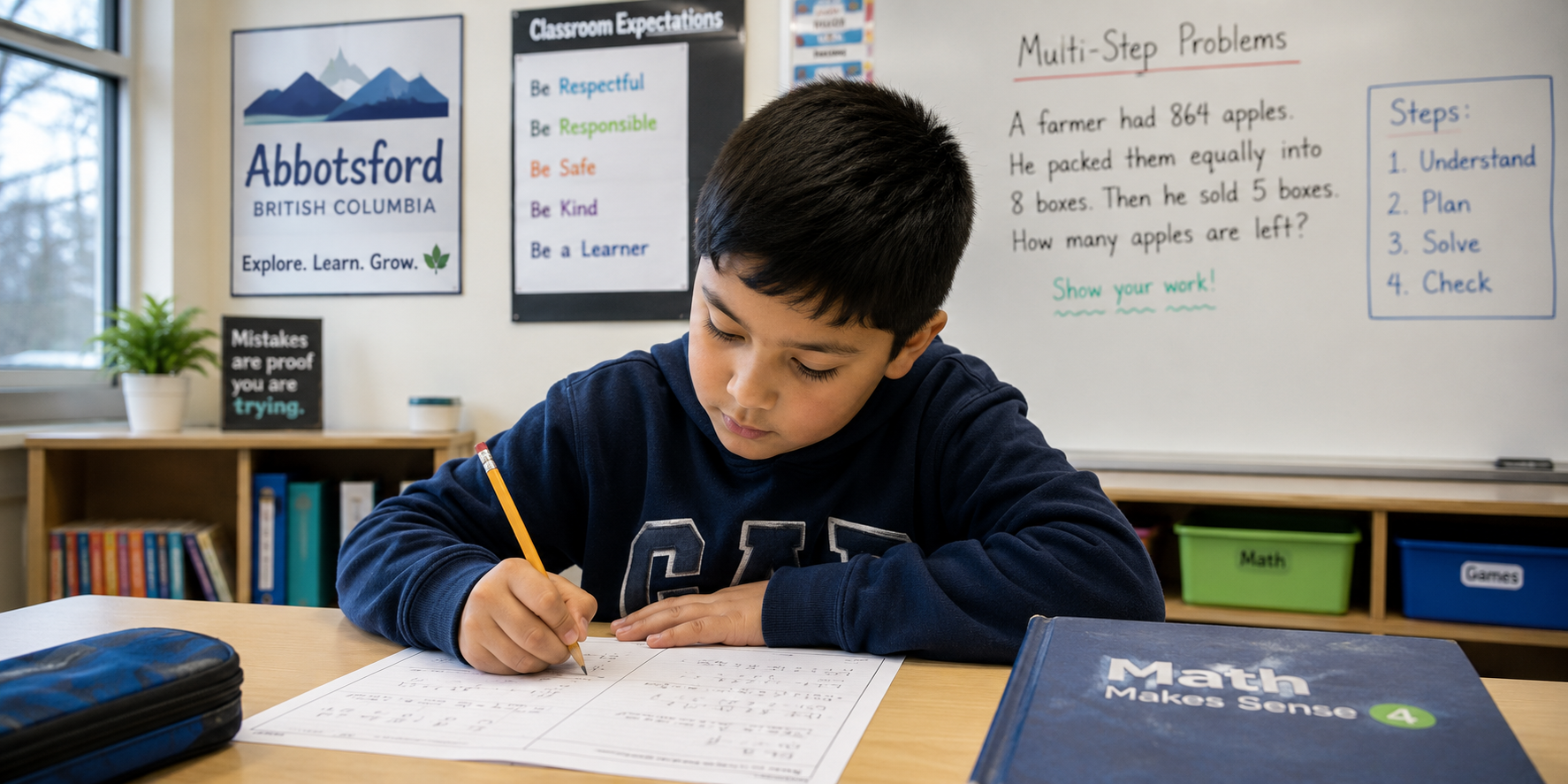
Multi-step word problems — the ability to read a problem, identify what is being asked, select the right operation, execute it correctly, and interpret the answer in context. This is where reading comprehension and mathematical reasoning intersect — and where children who are strong in one but weaker in the other most visibly struggle.
Variables and algebraic thinking — understanding that a letter can stand for a missing number, and that equations can be solved by thinking about relationships rather than just calculating. This is introduced in Grade 4 and forms the entire foundation of the algebra strand that runs through Grades 6 to 10.
WHAT THE RESEARCH SAYS ABOUT INTERVENTION AT THIS STAGE
The research on when to intervene in children's mathematical development is consistent across studies.
Longitudinal findings suggest that prior knowledge is relevant not only for strategy acquisition, but also for further development of strategy use. Since many strategies are based on a profound understanding of numbers, operations, and their relations, many strategies require solid conceptual knowledge. In practical terms: a child who reaches Grade 5 without a solid conceptual understanding of fractions, decimals, and multi-step reasoning will not simply pick these up as they go. The window for building that understanding efficiently narrows as the curriculum moves forward.
Early intervention programs and continuous formative assessments are vital to mitigate these risks. For Abbotsford parents, this means that the Grade 4 FSA result, the report card, and a child's own comfort with homework are all signals worth taking seriously — not because any single signal is diagnostic, but because together they paint a picture of whether a child's Grade 4 and 5 mathematical foundation is being built solidly or whether gaps are accumulating.
The most effective support at this stage is not remedial — going back and re-teaching Grade 3 content as though the child has failed. It is enrichment — meeting the child at their current level, identifying exactly where the conceptual understanding breaks down, filling that gap, and building forward with enough depth that the next concept rests on something solid.
This is the distinction between a program that drills worksheets and a program staffed by certified teachers who understand mathematical progression and can identify the specific conceptual gap that is generating the surface-level error.
WHAT GRADE 4 AND 5 MATH CONFIDENCE ACTUALLY LOOKS LIKE
It is worth being specific about what success in Grade 4 and 5 math looks like — not in terms of marks, but in terms of what a child actually understands and can do.
A child who has mastered the Grade 4 and 5 BC math curriculum genuinely can:
Read a multi-step word problem, identify what is being asked, and select the right mathematical approach without prompting.
Explain why their answer makes sense — not just produce the answer, but understand it well enough to justify it in words.
Move fluidly between fractions and decimals, understanding that 3/4 and 0.75 represent the same quantity.
Solve equations with a missing variable by thinking about the relationship between numbers, not just guessing.
Apply multiplication and division to numbers they have never seen before, because they understand the underlying logic rather than memorising specific facts.
These are not advanced skills. They are the baseline for Grade 6 mathematics. But they are skills that a significant proportion of children arrive at Grade 6 without — and the gap between having them and not having them determines almost everything about a child's experience of mathematics from that point forward.
HOW BEST BRAINS ABBOTSFORD SUPPORTS GRADE 4 AND 5 MATH
Best Brains Abbotsford's Math enrichment program is designed around exactly the progression described in this post. Every child begins with a free placement assessment conducted by a BC-certified teacher — not to assign a grade, but to identify specifically where their conceptual understanding is solid and where the gaps are forming.
For Grade 4 and 5 students, the most common outcome of this assessment is that a child appears to be at or near grade level on procedural tasks — they can execute the steps — but has specific conceptual gaps in fractions, decimals, or multi-step reasoning that are not yet affecting their marks but will begin to within one to two years if not addressed.
Our certified teachers address these gaps through a structured, non-repetitive curriculum that builds conceptual understanding alongside procedural fluency. Children are not drilled on the same type of question until they can produce the answer automatically. They are taught to understand why the answer is what it is — which is the only form of mathematical knowledge that transfers reliably to the next grade level.
For Grade 4 and 5 students who are already performing well, our Math program provides the enrichment depth that classroom instruction cannot always provide — moving students from competence to genuine mathematical confidence, and from grade-level performance to above-grade-level ability before the demands of middle school mathematics arrive.
Combined with our Abacus mental math program — which directly builds the number sense, working memory, and calculation speed that underpin all of the skills described above — Best Brains Abbotsford offers the most complete Grade 4 and 5 math support available in the Fraser Valley.
We have written more about what the BC FSA numeracy assessment specifically measures and what Abbotsford's 2024-25 district results show, in our dedicated FSA guide: bestbrains.com/ca-en/abbotsford/article/what-does-bc-fsa-test-actually-measure
THE BOTTOM LINE
Grade 4 and 5 are not the years to relax about math. They are the years when the conceptual foundations that carry a child through middle school, high school, and beyond are being laid — and when the gaps, if left unaddressed, begin compounding in ways that become significantly harder to reverse.
The good news is that a child who is supported through these two years with the right combination of conceptual depth, certified teaching, and consistent reinforcement arrives at Grade 6 not just prepared but confident. And confident is the most durable mathematical outcome there is.
FAQ SECTION:
Q: Why is Grade 4 math considered a turning point for children?
A: Grade 4 is widely recognised by mathematics educators as a critical transition point where math shifts from procedural to conceptual, multi-step, and language-dependent. Research shows that children who do not achieve proficiency at this stage tend to have lower performance in mathematics through middle school, high school, and beyond. In British Columbia, the FSA assessment is administered in Grade 4 specifically to capture whether foundational numeracy development is on track.
Q: What new math concepts are introduced in BC Grade 4?
A: The BC Grade 4 curriculum introduces number concepts to 10,000, decimals to hundredths, multiplication and division of two- and three-digit numbers using area models and the distributive property, fractions and comparing fractions on number lines, algebraic relationships and equations with variables, and financial literacy. These concepts form the direct foundation for all mathematics in Grades 5 through 8.
Q: How does Grade 5 math build on Grade 4 in BC?
A: Grade 5 extends every concept introduced in Grade 4 — adding multi-digit multiplication and division, more complex fractions and decimals, ratios, volume, and deepened algebraic thinking. A child who has gaps in Grade 4 concepts will encounter compounding difficulty in Grade 5, because Grade 5 assumes full mastery of what Grade 4 taught. This is why the Grade 4 to Grade 5 transition is the most consequential of the primary years.
Q: How is Abbotsford performing on Grade 4 numeracy according to the FSA?
A: According to the Abbotsford School District's 2024-25 Measuring Up report, numeracy proficiency rates have declined among Grade 4 students district-wide during a period of rapid district growth. With 17.6 percent of students in English Language Learning programs and overall enrolment rising by four percent year-over-year, the district is navigating significant demographic complexity at exactly the grade level where mathematical foundations are most critical.
Q: What are the most common Grade 4 and 5 math gaps Best Brains Abbotsford sees?
A: The most common gaps are in fractions — particularly understanding that a larger denominator means smaller pieces — decimal place value, multiplication fluency beyond memorised facts, multi-step word problems that combine reading comprehension with mathematical reasoning, and early algebraic thinking with variables. These concepts are foundational for Grade 6 and beyond.
Q: My child is getting good marks in Grade 4 math. Should I still be concerned?
A: Possibly. Good marks in Grade 4 often reflect procedural competence — the ability to execute steps correctly — without the deeper conceptual understanding that becomes essential in Grade 5 and 6. A child can produce correct answers on multiplication questions without understanding the distributive property, and on fraction questions without genuinely understanding what a fraction represents. A free placement assessment at Best Brains Abbotsford will identify whether your child's Grade 4 understanding is deep enough to support what comes next.
Q: How does Best Brains Abbotsford support Grade 4 and 5 math specifically?
A: Every child begins with a free placement assessment conducted by a BC-certified teacher that identifies not just grade level but specific conceptual gaps. The Best Brains Math enrichment program then builds conceptual understanding alongside procedural fluency — ensuring children understand why the math works, not just how to execute the steps. Combined with Abacus mental math training for number sense and calculation speed, our program gives Grade 4 and 5 students the foundation that carries them confidently through middle school mathematics.
Q: When should I start math enrichment for my Grade 4 or 5 child?
A: The best time is before the gaps compound — which in Grade 4 and 5 means now, regardless of whether your child is currently struggling or performing well. A child who starts enrichment while still managing the curriculum builds ahead; a child who waits until they are falling behind must manage current grade-level work and remediation simultaneously, which is significantly harder. Book a free assessment today.
CALL TO ACTION:
Your child's Grade 4 and 5 math foundation is being built right now. Make sure it is solid.
Book a free placement assessment at Best Brains Abbotsford today. Our BC-certified teachers will identify exactly where your child stands in the concepts that matter most — and build the plan that carries them confidently forward.
📍 3720 Townline Rd, Unit 230, Abbotsford, BC 📞 236-622-2074 🌐 bestbrains.com/ca-en/abbotsford 📧 abbotsford@bestbrains.com
SOURCES REFERENCED:
- BC Learning Standards — Grade 4 Mathematics Curriculum, British Columbia Ministry of Education (curriculum.gov.bc.ca)
- BC Learning Standards — Grade 5 Mathematics Curriculum, British Columbia Ministry of Education (curriculum.gov.bc.ca)
- IXL Learning — British Columbia Grade 4 Math Curriculum Objectives (ca.ixl.com/standards/british-columbia/math/grade-4)
- IXL Learning — British Columbia Grade 5 Math Curriculum Objectives (ca.ixl.com/standards/british-columbia/math/grade-5)
- BC Ministry of Education — K-4 Foundational Math Learning Progressions (curriculum.gov.bc.ca)
- Mathnasium — Why Fourth Grade Marks a Turning Point in Math Learning, January 2026 (mathnasium.com)
- Genie Academy — 4th Grade Math: What Kids Learn and Why It Matters, December 2025 (genieacademy.com)
- Dash HRECOS — Grade 4 Math Curriculum: Significance and Implications, December 2025 (dash.hrecos.org)
- ScienceDirect — Maximizing Math Achievement: Strategies from the Science of Learning, April 2025 (sciencedirect.com)
- PMC / Springer Nature — Children's Arithmetic Strategy Use and Strategy Change from Grade 3 to Grade 4, May 2025 (pmc.ncbi.nlm.nih.gov)
- National Assessment of Educational Progress (NAEP) — 2024 Mathematics and Reading Scores for Grades 4 and 8 (nationsreportcard.gov)
- Abbotsford School District — 2024-25 Measuring Up Report (abbyschools.ca)
- Best Brains Abbotsford — What Does BC's FSA Test Actually Measure? (bestbrains.com/ca-en/abbotsford/article/what-does-bc-fsa-test-actually-measure)