Abbotsford
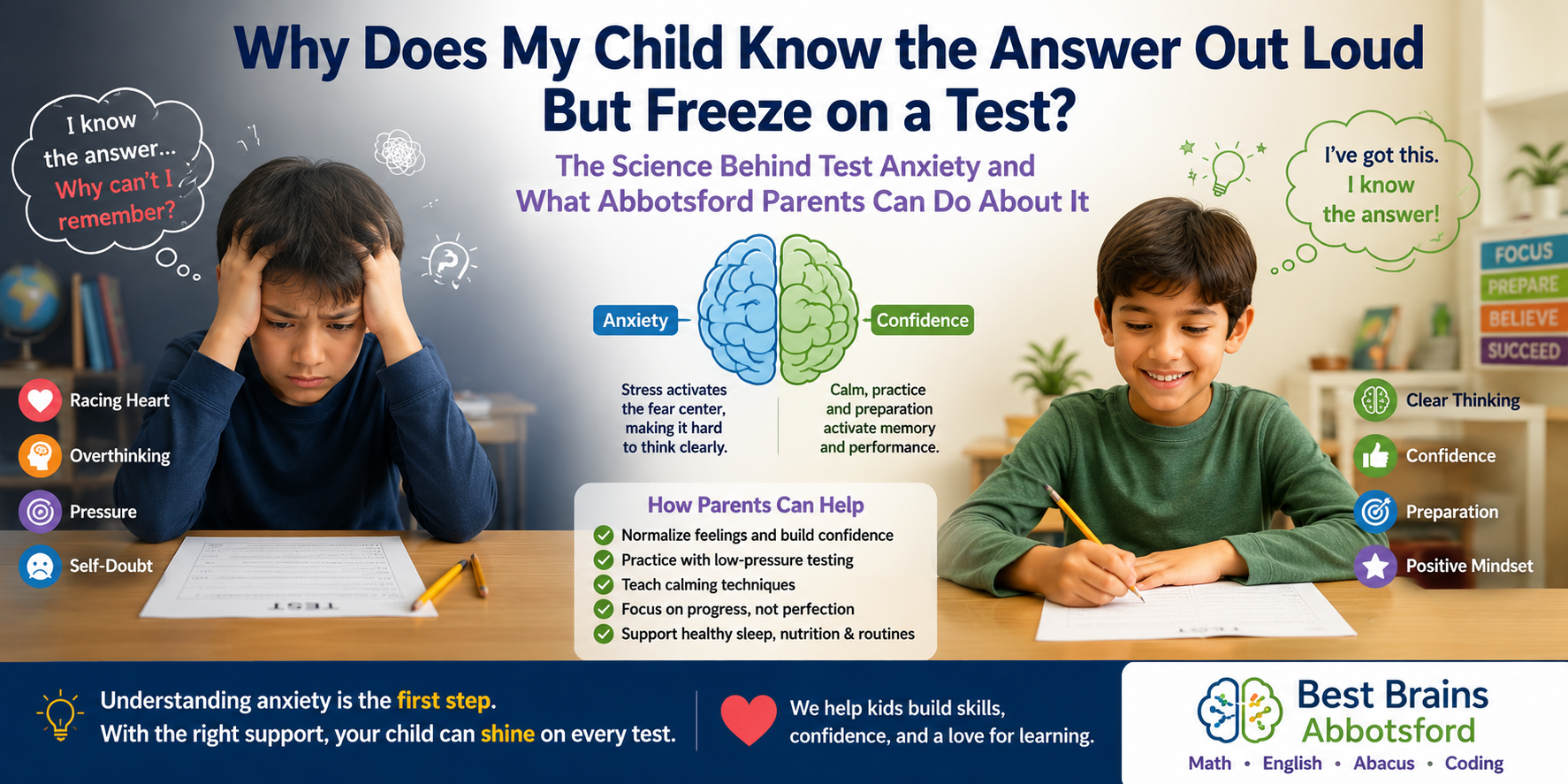
Why Does My Child Know the Answer Out Loud But Freeze on a Test? The Science Behind Test Anxiety and What Abbotsford Parents Can Do About It
You have watched it happen and it makes no sense.
Your child answers every question correctly at the dinner table. They explain the concept back to you confidently in the car on the way to school. They tell you they feel ready. Then the test comes back with a grade that does not remotely reflect the child who was sitting across from you the night before.
This is not a mystery. It is not laziness. It is not your child being careless or failing to try. It is one of the most well-documented phenomena in educational psychology — and it has a specific name, a specific cause, and a specific solution.
Here is what is actually happening in your child's brain, and what you can do about it.
The Science: Why the Brain Freezes Under Pressure
When your child sits down for a test and anxiety kicks in, something very real happens physiologically. Research from UCLA Health explains it precisely: when a child becomes anxious, their body activates the fight-flight-freeze response. Their heart may race, their breaths may become shorter, their vision may narrow, and their digestion may shut down to put all of their body's energy into survival — making it much more difficult to access memory in this state. Anxious thoughts tend to play on a loop in the brain, interrupting thinking and the effort to demonstrate and access knowledge.
This is the critical point: the knowledge is still there. It did not disappear. The retrieval pathway to it has been temporarily blocked by a brain that believes — incorrectly — that it is under physical threat.
Research published in peer-reviewed cognitive psychology journals identifies the mechanism more precisely. Cognitive load theory suggests that the executive control of working memory is limited — only a finite amount of resources are available to process information at one time. Test anxiety can overwhelm the working memory system, making the processing of information inefficient and significantly more difficult.
In plain language: your child's working memory — the mental workspace where thinking happens — has been hijacked by anxiety. The space that should be used to retrieve the answer is being consumed by thoughts like "I am going to fail" and "everyone will see" and "I do not know this" — even when they do.
Research identifies this as attention becoming split between preparing for and answering the examination questions and unhelpful negative thoughts about failing the exam and the potential negative consequences. High levels of test worry are associated with measurably lower performance on standardised assessments, and cognitive test anxiety exerts a significant, stable, and negative impact on academic performance measures.
This matters enormously in Abbotsford, where BC's Foundation Skills Assessment in Grades 4 and 7 is a high-stakes standardised test that many children find genuinely threatening. A child who knows the material but cannot access it under test conditions will score below their actual ability — and that score shapes how teachers, parents, and the children themselves perceive their academic capability for years.
Two Completely Different Problems That Look Identical
Before going further, it is essential to distinguish between two situations that produce the same symptom — a child who performs well verbally but poorly on tests — because they require different responses.
Situation A: The child genuinely knows the material but cannot access it under pressure. This is test anxiety. The knowledge is present. The retrieval system is impaired by stress. The solution is a combination of reducing the emotional charge of assessment and building the kind of automatic, deeply embedded knowledge that survives the pressure of a test environment.
Situation B: The child appears to know the material verbally but has surface-level understanding that collapses under the structured demands of a test. This is a knowledge gap dressed as test anxiety. Verbal conversation is forgiving — parents unconsciously provide cues, prompts, and context that help a child produce the right answer without fully independent recall. A test provides none of those scaffolds. The child who could answer with prompting cannot answer without them.
The reason this distinction matters: if you treat Situation B as Situation A — addressing the anxiety without closing the knowledge gap — the problem does not resolve. The child becomes calmer about tests but still performs poorly, because the underlying gap was never addressed.
Both situations are fixable. But they require different starting points.
How to Tell Which Situation Your Child Is In
Here is a practical diagnostic you can run at home:
Step 1: Ask your child the question with no hints or context. Just the question, cold. Step 2: If they get it right, ask them to explain why — not just what. Step 3: Change the format slightly. If they can solve 4 x 6, can they solve 6 x 4? Can they solve it written as a word problem? Step 4: Ask the same question three days later, without reviewing in between.
Children with genuine test anxiety can usually do all of these things — they have real understanding, they just cannot access it under timed, formal conditions. Children with surface-level gaps will typically struggle at Step 2 or Step 3, because the understanding is shallower than it appears in supported conversation.
Most children who freeze on tests have elements of both situations — some genuine anxiety layered on top of some genuine gaps. Addressing both simultaneously, rather than treating it as one or the other, produces the fastest results.
Seven Things Parents Can Do Right Now
1. Stop Reviewing the Night Before
Cramming the night before a test does not close gaps — it adds anxiety. A child who does not feel prepared will feel more unprepared after a rushed review session reveals things they are unsure about. If the learning has not happened over time, one evening will not change that. Instead, use the evening before for a short, calm, confidence-building review of things they already know well — ending on success, not on struggle.
2. Normalise Testing as a Skill Separate From Knowledge
Testing is a skill. It can be taught, practised, and improved independently of the academic content being tested. Children who have practised producing answers under mild time pressure in a low-stakes environment are significantly better equipped for the real thing. The key word is low-stakes — the practice environment must feel safe enough that no anxiety is triggered. A kitchen timer and a few questions over dinner is practice. A practice test announced as "let us see how you would do on the real thing" is just another test.
3. Teach Your Child the Physiology of Anxiety
Children who understand what is happening in their body during anxiety are measurably better at managing it. When your child knows that the racing heart and blank mind are a biological response — not a sign that they do not know the material — it removes the layer of anxiety about the anxiety that makes the freeze worse.
A simple explanation: "Your brain thinks you are in danger and it is trying to protect you. That uses up brain space that you need for thinking. So when this happens, we are going to slow it down before we try to answer."
4. Teach a Two-Breath Reset
Research on anxiety intervention consistently identifies slow, controlled breathing as one of the most effective and immediately accessible tools for interrupting the fight-flight-freeze response. Cognitive behavioural approaches to test anxiety include diaphragmatic breathing, mindfulness, progressive muscle relaxation, and guided imagery as evidence-based techniques for interrupting the anxiety cycle.
For children, a practical version is simple: before opening the test paper, take two slow breaths. Breathe in for four counts, out for six. This is not a metaphor for relaxing — it is a physiological intervention that activates the parasympathetic nervous system and measurably reduces cortisol. It takes ten seconds. It works.
5. Reframe What the Test Is For
Many children have absorbed the belief — from somewhere — that tests are about catching them not knowing something. This framing is catastrophic for test anxiety because it makes every test a threat. Reframe it explicitly: a test is information. It tells you and your teacher what you know and what still needs work. Getting something wrong is not failure — it is data. This is not a cliche. It is a cognitive reframe that research consistently shows reduces test anxiety when children genuinely internalise it.
6. Address Perfectionism Directly
Students who have high expectations of themselves or who are perfectionists are likely to struggle with test anxiety. These students tend to put a lot of pressure on themselves and have a hard time dealing with mistakes, which can easily lead to becoming overwhelmed during the test, resulting in the mind freezing or going blank.
If your child is a perfectionist — high-achieving in some areas, genuinely hard on themselves when they fall short — the test anxiety conversation needs to include a direct discussion about the value and inevitability of imperfection. Perfectionism is not ambition. It is fear of failure dressed as high standards, and it is one of the most reliable accelerants of test freeze.
7. Build the Kind of Knowledge That Survives Pressure
The deepest and most durable solution to test freeze is building knowledge that is so well-embedded it becomes automatic — retrievable even when the working memory is under stress. This is not the same as memorising. Memorised information is the first thing lost under pressure because it requires conscious recall. Genuinely understood, practised-to-fluency knowledge is different — it comes back even when the brain is partially occupied by anxiety.
This is why the quality and structure of how your child learns between tests matters more than anything that happens the night before one.
Why Structured, Teacher-Led Learning Specifically Reduces Test Freeze
Not all learning environments are equally effective at building the kind of durable, retrievable knowledge that survives test pressure. And the differences between approaches are not minor.
Self-directed learning — whether through worksheets, online platforms, or independent homework — builds surface-level familiarity. The child encounters a problem, finds a method that works, and moves on. Under calm conditions with plenty of time, that familiarity is enough. Under timed test conditions with anxiety present, it frequently is not — because familiarity and fluency are different things.
Teacher-led instruction that requires children to explain, apply, and transfer knowledge — not just recognise it — builds the deeper encoding that produces fluency. When a BC-certified teacher at Best Brains Abbotsford works through a concept with a small group, they do not just show the method and move on. They ask the child to explain the reasoning. They vary the format. They revisit the concept from different angles. They check for genuine understanding, not just correct answers.
This is the difference between a child who can answer the question when the question looks familiar and a child who can answer the question when it looks different — which is exactly what tests do.
How Best Brains Abbotsford Is Built to Solve Both Sides of This Problem
Test freeze has two causes: anxiety and gaps. Best Brains addresses both — not as separate programs but as integrated elements of every session.
Weekly Assessments That Normalise Testing
Every week at Best Brains, students complete a short assessment. Not as a high-stakes event — as a normal, expected part of the learning process. Over time, the act of being assessed stops feeling threatening and starts feeling routine. This is deliberate. A child who has been gently assessed every week for six months arrives at the FSA or a school test with a fundamentally different relationship to the testing environment than a child for whom formal assessment is rare and therefore frightening.
Research is clear on this: self-efficacy — a child's belief in their own ability to succeed — is one of the most reliable predictors of test performance, and it is built through repeated mastery experiences, not through reassurance alone. Weekly assessments that children can succeed at build exactly this self-efficacy, systematically, over time.
BC Certified Teachers Who Teach for Understanding, Not Completion
Every session at Best Brains Abbotsford is led by a BC-certified teacher. The distinction between a certified educator and someone handing out worksheets is not administrative — it is instructional. A certified teacher knows how to check for genuine understanding versus surface familiarity. They know when a child has memorised a procedure without understanding why it works. They catch the gap before the test does.
For children who freeze on tests because their knowledge is shallower than it appears in conversation, certified teacher instruction is specifically what closes the gap — because it is built around conceptual understanding from the ground up.
A Structured, Level-Based Curriculum That Builds Fluency
Best Brains' curriculum is sequenced so that every concept is genuinely mastered before the next is introduced. There is no moving forward on surface familiarity. This is critical for test performance: a child who has genuinely mastered Grade 4 fractions at a fluency level — not just a familiarity level — can retrieve that knowledge under pressure. A child who encountered fractions, did some worksheets, and moved on cannot.
The level-based structure also means every child works at the right level of challenge — not so easy that nothing is being built, not so hard that the material is overwhelming. This optimal challenge zone is where genuine learning happens and where test-retrievable knowledge is formed.
Free 24/7 Online Support — Because Anxiety Peaks After Hours
One of the most acute triggers of test anxiety is the moment a child gets stuck on something the night before a test with no one available to help. That feeling of helplessness — I do not understand this and there is no one to ask — is one of the most reliable seeds of the freeze that happens the next morning.
Best Brains Abbotsford offers free 24/7 online academic support to every enrolled student. No other tutoring provider in Abbotsford or the Fraser Valley offers this. When your child hits a wall at 8:45 PM on a Tuesday night, they are not alone. Help is available. That availability — just knowing it is there — measurably reduces the anticipatory anxiety that produces the freeze.
Tailored Learning Plans That Start From the Right Place
Every Best Brains student begins with a free academic assessment that identifies exactly where they stand — not what grade they are in. A child who freezes on Grade 5 math tests because of a Grade 3 fraction gap is placed at the Grade 3 fraction level and works forward from there. Closing the foundational gap closes the anxiety that grows from it. A child who understands the material at a deep level is a child who has reason to feel confident — and confidence is the most reliable antidote to test freeze that exists.
The Bottom Line
Your child is not broken. Their brain is working exactly as it was designed to — protecting them from a perceived threat. The problem is that tests are not threats, and their brain does not know that yet.
The solution is two-pronged: teach them to manage the physiological response when it happens, and build knowledge that is deep enough to survive it. Both are achievable. Both are achievable faster than most parents expect. And both are what Best Brains Abbotsford exists to support.
Book a Free Assessment — Find Out What Is Actually Going On
If your child knows the answers out loud but performs differently on tests, a free academic assessment at Best Brains Abbotsford will tell you precisely where the knowledge is solid, where gaps exist, and what a structured path forward looks like.
One session. No obligation. Real answers.
Best Brains Learning Center — Abbotsford, BC 📍 Serving Abbotsford, Langley, Chilliwack, Mission and the Fraser Valley 📞 236-622-2074 🌐 bestbrains.com/ca-en/abbotsford 📧 abbotsford@bestbrains.com
Your child knows more than their test scores suggest. Let us prove it — then build on it.
Frequently Asked Questions
Is test anxiety a diagnosable condition? Test anxiety is a well-documented psychological phenomenon studied extensively in educational research. It is not a formal diagnosis in the same category as an anxiety disorder, but it is real, measurable, and responsive to intervention. If your child's test anxiety is severe — involving physical symptoms, school avoidance, or significant distress — a conversation with your family doctor or a registered psychologist is appropriate alongside academic support.
My child does not seem anxious — they seem indifferent. Can they still freeze on tests? Yes. Some children present test freeze as apparent indifference or disengagement rather than visible anxiety. The physiological response is the same — the working memory overload produces a blank — but the child has learned to mask the anxiety as nonchalance. If a child regularly performs below what their verbal understanding suggests, the mechanism is worth investigating regardless of how they appear to feel about it.
How long does it take to see improvement with Best Brains? Most families report a visible shift in academic confidence within six to eight weeks. Measurable improvement in test performance typically follows within one school term. The timeline depends on the size of the underlying knowledge gap and the consistency of attendance — but because both the gap and the anxiety are being addressed simultaneously, progress tends to accelerate once it begins.
Does Best Brains help with FSA preparation specifically? Yes. Best Brains' math and English curriculum directly targets the skills assessed in BC's Grade 4 and Grade 7 Foundation Skills Assessment. More importantly, the weekly assessment format that is built into every Best Brains level means children arrive at the FSA having already practised being assessed in a structured environment — which is one of the most effective things any program can do to reduce FSA freeze specifically.
My child is in Grade 6. Is it too late to address this before high school? No. Grade 6 is actually an ideal intervention point — early enough that the gaps are still manageable, late enough that the child's self-awareness makes some of the anxiety-management strategies particularly effective. High school introduces higher-stakes assessments and faster-paced content, making Grade 6 one of the best windows available for building the fluency and confidence that carry children through.
Sources: UCLA Health — What a Child's Test Anxiety Looks Like (August 2023) · Oxford Learning — What Is Test Anxiety (2025) · Frontiers in Psychology — How to Reduce Test Anxiety and Academic Procrastination (2019) · PMC — Test Anxiety and Standardised Reading Comprehension (2017) · Tandfonline — Test Anxiety and High-Stakes Examinations (2022) · Wiley Online Library — Reducing Test Anxiety and Improving Student Wellbeing (2022) · NCBI — Revisiting the Role of Worries in the Test Anxiety-Performance Link (2021) · Abbotsford School District Measuring Up Report 2024–25 · BC Ministry of Education Foundation Skills Assessment data