Abbotsford
What Does BC's FSA Test Actually Measure? An Abbotsford Parent's Guide
Every fall, an envelope comes home from school. Inside is a result from something called the FSA. And for many Abbotsford parents, the reaction is the same: what exactly is this test, and should I be worried about the number on this page?
You are not alone in asking. The FSA is one of the least understood assessments in the BC school system, even though almost every child in the province writes it. This guide explains exactly what the FSA measures, what it does not measure, what Abbotsford's recent results actually show, and what you can do at home to support your child either way.
WHAT IS THE FSA?
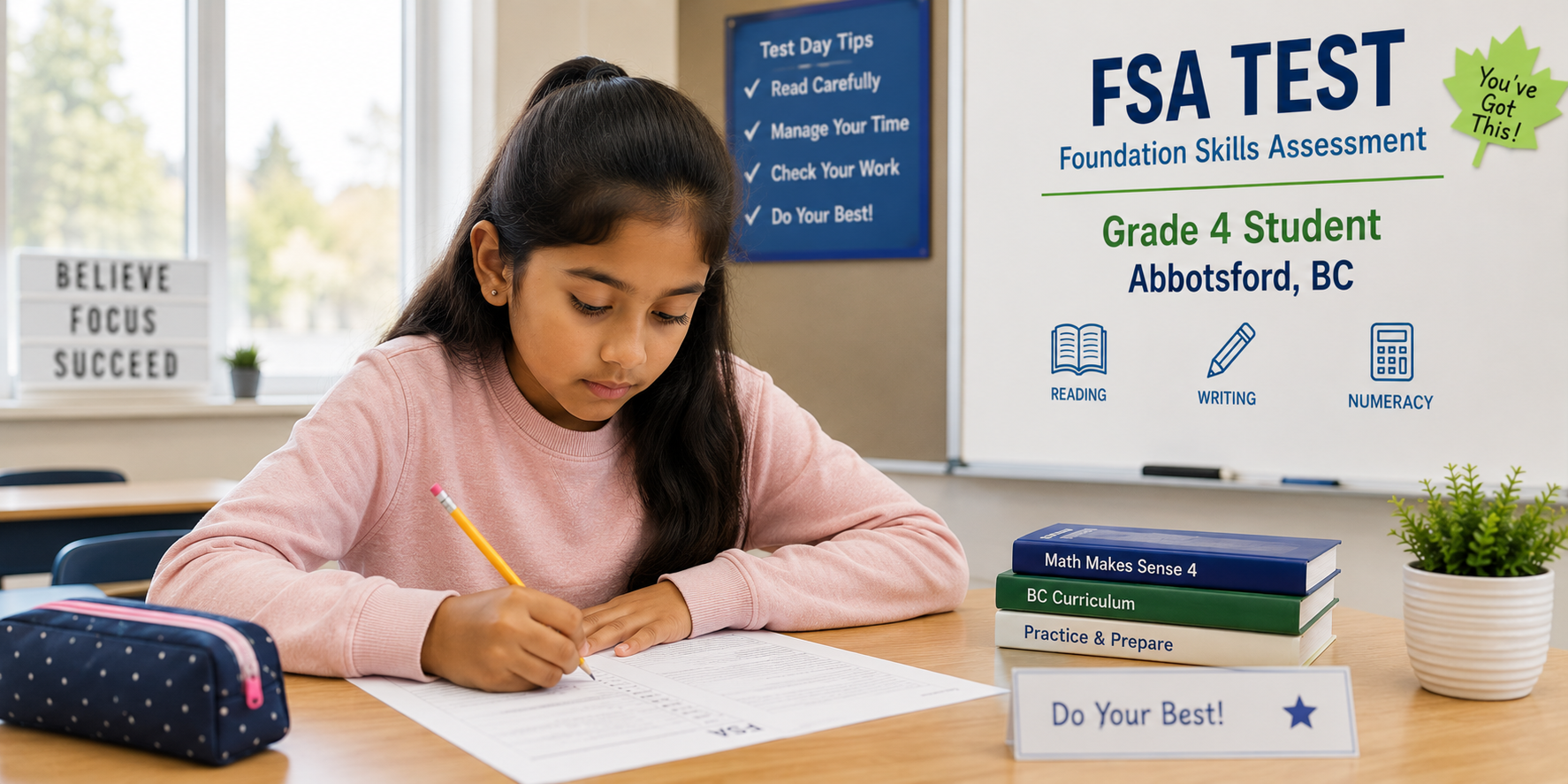
The Foundation Skills Assessment, or FSA, is an annual learning assessment of literacy and numeracy for students in Grades 4 and 7, given each fall to every public school student in British Columbia. It is developed in collaboration with classroom teachers, educational experts, and the Ministry of Education and Child Care, and is based directly on the BC curriculum your child is already learning in class.
The 2024 administration window ran from October 1 to November 8, with results sent home roughly a month after testing. Students complete the assessment in several parts spread across multiple days, combining online interactive questions with written response booklets completed in class.
Importantly, your child does not need to study or prepare for the FSA in the traditional sense. It is designed to reflect ordinary classroom learning, not test-specific cramming.
WHAT DOES THE FSA ACTUALLY MEASURE?
This is the part most parents get wrong, so let's be precise.
The FSA measures two things: Literacy and Numeracy.
Until 2021/22, the FSA measured Reading and Writing as separate categories. The assessment was redesigned that year, combining reading and writing into a single Literacy component, alongside Numeracy.
Literacy measures your child's reading comprehension and writing skills — not just the ability to read words, but to understand, interpret, and respond to what they read in writing.
Numeracy measures your child's ability to work with numbers and solve problems — and importantly, numeracy written response questions often require students to solve problems with multiple parts and multiple steps, not simply produce a single correct answer.
Here is something most parents do not realize: these skills are tested across subjects, not just in math class or language arts. Students read in science and social studies as well as language arts, and they work with numbers in subjects besides math — so the FSA reflects how your child applies literacy and numeracy broadly across their entire education, not just in two specific class periods.
HOW IS THE FSA SCORED?
The FSA does not give your child a letter grade or a percentage. Instead, it uses three proficiency levels: Emerging, On Track, and Extending.
These levels are strength-based and descriptive, designed to explain what a score actually means rather than simply ranking students against each other. The cut points between levels are established through the professional judgment of educators and detailed analysis of student responses by a standard-setting panel — not an arbitrary number cutoff.
Critically, FSA results are not reported on your child's transcript and do not count toward report card grades. The Ministry has been explicit that the FSA is not intended to be used to rank students, teachers, or schools. It is described as a snapshot of student learning at a moment in time — one data point among many, not a verdict on your child's ability or future.
This matters because some families experience real anxiety around FSA results, treating them like a high-stakes exam. They are not. They are a planning tool.
WHAT IS THE FSA ACTUALLY FOR?
If it is not a graded exam, what is the point?
The FSA exists to give three groups information they would not otherwise have:
For your child and your family, the FSA tells you where your child currently stands in literacy and numeracy development, and identifies specific areas where they may need support — well before a larger gap has time to form.
For your child's school and the Abbotsford School District, FSA data helps identify trends across classrooms and grade levels, allowing teachers and administrators to direct attention and resources to the areas where students need it most.
For the BC Ministry of Education, province-wide FSA data shows how the education system is performing as a whole, allows comparison of how different student groups are learning, and helps the Ministry understand how BC is doing over time — including comparisons to other provinces and countries.
The FSA is administered as a Ministerial Order under the School Act, which means schools are legislatively required to administer it, supervise it, and transmit the resulting data to the Ministry.
WHAT ABBOTSFORD'S RECENT FSA RESULTS ACTUALLY SHOW
This is where the FSA becomes directly relevant to Abbotsford families specifically.
The Abbotsford School District's 2024-25 Measuring Up report revealed that literacy and numeracy proficiency rates have largely fallen among Grade 4 and 7 students district-wide. This decline comes during a period of rapid district growth — Abbotsford public schools served 21,160 students in 2024-25, a 4 percent year-over-year increase, with English language learners making up a significant share of that growth at 17.6 percent of the district's total student population.
The declines were not evenly distributed. The most striking drop was among Grade 7 Indigenous students, whose literacy proficiency rate fell to 49 percent in 2024-25 — a 14 percentage point drop from the previous year, and the lowest rate recorded in more than five years. Grade 7 diverse learners (a Ministry category covering students with intellectual, physical, sensory, emotional, or behavioural disabilities, or exceptional gifts and talents) saw literacy proficiency drop from 42 percent to 36 percent over the same period.
These numbers tell a clear story: Abbotsford is growing fast, serving an increasingly diverse student population, and certain groups of students are falling behind faster than the district average. This is not a reason for panic about any individual child — remember, the FSA is a snapshot, not a verdict — but it is a clear signal that supplemental support matters more in Abbotsford right now than it has in recent years.
WHAT THE FSA DOES NOT TELL YOU
It is just as important to understand the limits of the FSA as it is to understand what it measures.
The FSA does not measure every subject your child is learning. Science, social studies, art, physical education, and most classroom learning outside literacy and numeracy are not assessed.
The FSA does not predict your child's future success on its own. It is one data point, intended to be used together with teacher assessments and other classroom information — not as a standalone judgment.
The FSA does not replace report card grades, and a lower proficiency level on the FSA does not mean your child is failing in school. The two systems measure different things in different ways.
The FSA is not something your child needs to be specifically coached or drilled for. Because it reflects ordinary curriculum learning, the most effective preparation is the same thing that helps with everything else: strong, consistent literacy and numeracy skill-building throughout the year, not test-specific cramming in October.
WHAT TO DO IF YOUR CHILD'S FSA RESULT SHOWS "EMERGING"
If your child's FSA report comes home showing an Emerging proficiency level in literacy or numeracy, here is the right way to think about it.
First, remember this is a snapshot from one assessment, not a permanent label. An Emerging result identifies an area for growth — it is information, not a diagnosis.
Second, look at which component shows the concern. A literacy concern suggests focusing on reading comprehension, vocabulary, and written expression. A numeracy concern suggests focusing on number sense, multi-step problem solving, and applying math concepts to real situations — not just memorizing procedures.
Third, use the result as a starting point for a conversation with your child's teacher about what classroom strategies are already in place, and what additional support might help.
Fourth, consider whether structured enrichment outside the classroom would help close the gap before it widens. This is exactly where a program like Best Brains Abbotsford becomes valuable — not as a reaction to a single test score, but as ongoing support for the literacy and numeracy skills the FSA is designed to measure in the first place.
HOW BEST BRAINS ABBOTSFORD BUILDS THE SKILLS THE FSA MEASURES
The FSA assesses two specific things: literacy and numeracy, applied across multiple steps and multiple contexts. This is precisely what Best Brains Abbotsford's curriculum is built around.
Our English program develops reading comprehension, vocabulary, and written expression through a structured, non-repetitive curriculum — not through workbooks aimed at any single test, but through consistent skill-building that strengthens the literacy foundation the FSA is designed to assess.
Our Math program builds number sense and multi-step problem solving — the exact skill format the FSA numeracy section uses, where written response questions often require solving problems with multiple parts and steps rather than producing a single answer.
Our Abacus program adds a layer most families do not realize matters here: because abacus training strengthens working memory, concentration, and number sense simultaneously, it directly supports the kind of numeracy thinking the FSA — and BC's broader numeracy curriculum — is built to measure.
For Abbotsford's significant population of English language learners and newcomer families specifically, our programs are designed to build literacy and numeracy skills in a structured, low-pressure environment — directly addressing the population the district's own Measuring Up data identifies as needing the most additional support.
This is not test prep. It is the same kind of consistent, curriculum-aligned skill building that produces strong FSA results as a natural byproduct — because the skills underneath are real, not memorized for a test day.
THE BOTTOM LINE
The FSA is not something to fear, and it is not something to ignore. It is a useful, well-designed snapshot of two foundational skill areas — literacy and numeracy — built directly from BC's curriculum and reviewed by real classroom teachers.
For Abbotsford specifically, recent district data shows real and uneven declines in these exact skill areas, particularly among Indigenous students and diverse learners, during a period of rapid district growth. Whether your child's FSA result came home strong or showed room to grow, the right response is the same: consistent, structured support in literacy and numeracy that builds real skill, not just test performance.
That is exactly what Best Brains Abbotsford was built to do.
FAQ SECTION:
Q: What grades take the FSA test in BC?
A: The Foundation Skills Assessment is administered every year to all students in Grades 4 and 7 across British Columbia public schools, typically in the fall.
Q: What does the FSA actually measure?
A: The FSA measures two components: Literacy (reading comprehension and writing skills) and Numeracy (number sense and multi-step problem solving). It does not assess other subjects like science, social studies, or art.
Q: Does the FSA count toward my child's grades?
A: No. FSA results are not reported on student transcripts and do not count toward report card marks. The Ministry of Education states clearly that the FSA is not intended to rank students, teachers, or schools.
Q: What do the FSA proficiency levels mean?
A: The FSA uses three proficiency levels: Emerging, On Track, and Extending. These are strength-based descriptive categories, not percentage grades, and are set through professional judgment and detailed analysis by a standard-setting panel of educators.
Q: How are Abbotsford students performing on the FSA?
A: According to the Abbotsford School District's 2024-25 Measuring Up report, literacy and numeracy proficiency rates declined across Grade 4 and 7 students district-wide, with the steepest drops among Grade 7 Indigenous students (down to 49 percent literacy proficiency) and diverse learners (down to 36 percent literacy proficiency).
Q: Should my child prepare or study for the FSA?
A: The FSA is designed to reflect ordinary classroom learning based on BC curriculum, so students are not expected to study or prepare specifically for it. The most effective support is consistent literacy and numeracy skill-building throughout the year.
Q: What should I do if my child's FSA results show "Emerging"?
A: Treat the result as one data point identifying an area for growth, not a permanent judgment. Speak with your child's teacher about classroom strategies already in place, and consider structured enrichment support — such as Best Brains Abbotsford's literacy and numeracy programs — to build the underlying skills the FSA assesses.
Q: How does Best Brains Abbotsford help with the skills the FSA measures?
A: Best Brains Abbotsford's English and Math programs build reading comprehension, written expression, number sense, and multi-step problem solving — the exact literacy and numeracy skills the FSA is designed to assess — through a structured, certified-teacher-led curriculum rather than test-specific cramming.
CALL TO ACTION:
Wondering where your child stands in literacy and numeracy — FSA results or not?
Book a free assessment at Best Brains Abbotsford. We help children ages 3 to 14 build real literacy, numeracy, abacus, and coding skills — the same foundational skills the FSA is designed to measure.
📍 3720 Townline Rd, Unit 230, Abbotsford, BC 📞 236-622-2074 🌐 bestbrains.com/ca-en/abbotsford
SOURCES REFERENCED:
- Government of British Columbia — Foundation Skills Assessment (FSA) official page (gov.bc.ca/foundation-skills-assessment)
- Government of British Columbia — Foundation Skills Assessment: Specifications English Language Version (www2.gov.bc.ca)
- BC Student Success — Abbotsford School District: Foundation Skills Assessment Results (studentsuccess.gov.bc.ca/school-district/034/report/fsa)
- Nanaimo Ladysmith Public Schools — Foundation Skills Assessment (FSA) information page (sd68.bc.ca)
- School District 83 — What is the Foundation Skills Assessment (FSA)? (sd83.bc.ca)
- School District 91 Nechako Lakes — Foundation Skills Assessment (FSA) (sd91.bc.ca)
- School District 61 — Foundation Skills Assessment (FSA) Information for Grade 4 and 7 Families (sd61.bc.ca)
- Abbotsford News — More Abbotsford Students Graduate Even as Literacy Rates Decline, December 2025 (abbynews.com)
- Abbotsford School District — 2024-2025 Measuring Up Report (abbyschools.ca)
- Open Government Portal — BC Schools Foundation Skills Assessment (FSA) Dataset (open.canada.ca)