Abbotsford
Structured Enrichment Without the Pressure — Why How Your Child Learns Matters as Much as What They Learn
There is a moment many Abbotsford parents recognise. The one where a child who was initially excited about their new enrichment program starts dragging their feet. The enthusiasm of the first few weeks gives way to a quiet Sunday evening negotiation. The worksheets get done — eventually — but the child who sits down to do them is not the child who used to love numbers.
If this sounds familiar, it is worth asking a question that does not get asked often enough in conversations about children's education: is the way my child is learning working — or is it working against them?
Not all structured academic programs are structured in the same way. And the differences between them are not superficial. They are rooted in decades of cognitive science research about how children actually build durable, transferable knowledge — and how they can be made to dread the very subject they are trying to improve at.
What "Structured" Really Means — and What It Does Not
The word structured is used loosely in the tutoring and enrichment industry. Almost every program claims to be structured. But structure can mean very different things depending on what it is built around.
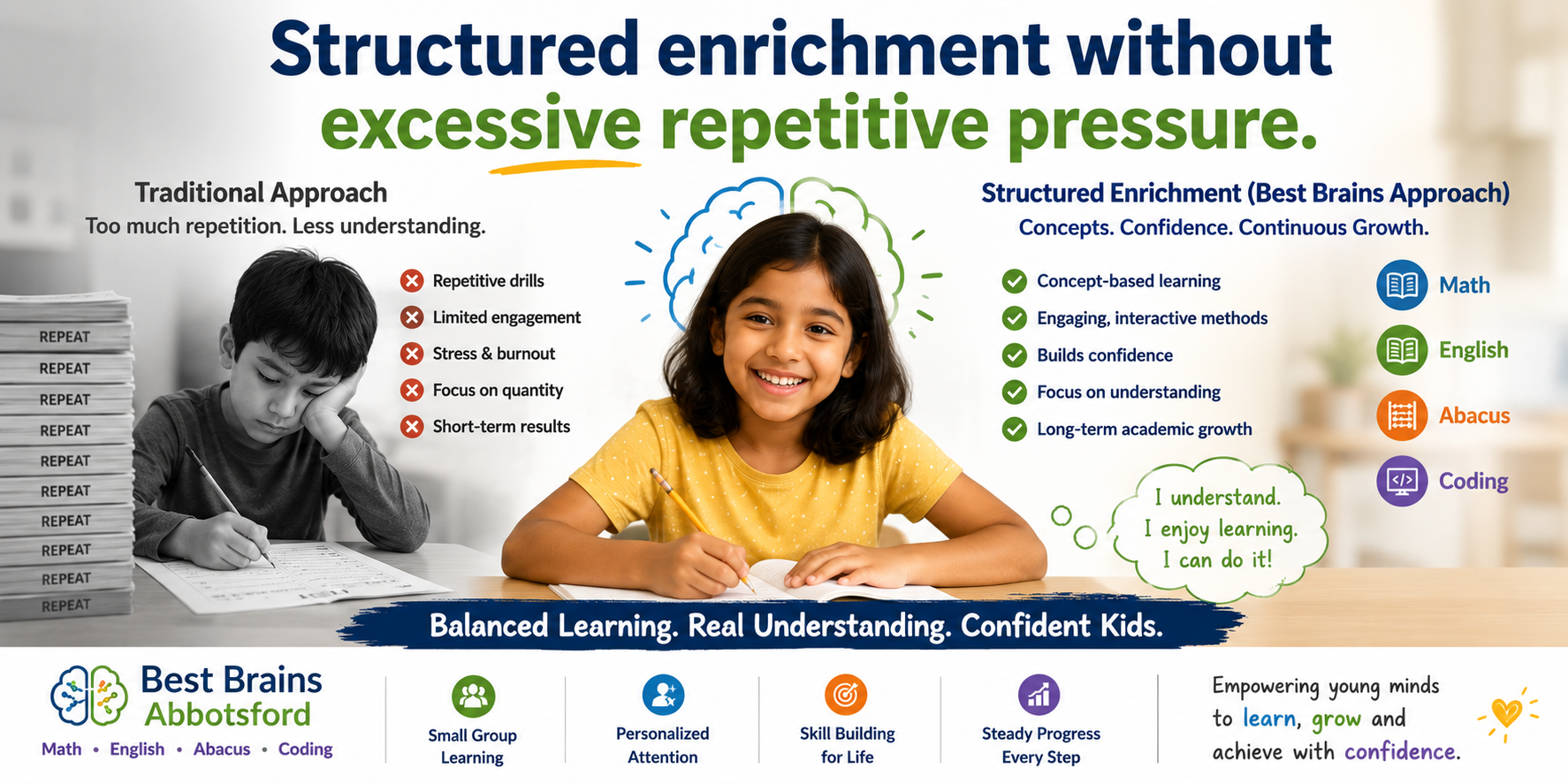
There is a version of structure that is built around repetition — the belief that if a child does enough of the same type of problem, often enough, for long enough, the skill will eventually stick. This approach has an intuitive logic. Practice matters. Repetition has a role. Nobody learns to read without reading many, many times.
But there is a critical difference between repetition that reinforces genuine understanding and repetition that substitutes for it. And that difference determines whether a child comes out of a program more confident or less.
The research is not ambiguous on this point. Studies in educational cognitive science consistently find that drill and practice ideologies — which have taken the forefront in many instructional plans due to their perceived efficiency — actually downplay effectiveness when compared to conceptual instruction. Many studies document a preoccupation with transmission of information and rote application of skills, and a significant lack of class time devoted to promoting students' ability to think critically.
In plain language: a child who can complete 200 multiplication worksheets correctly has not necessarily understood multiplication. They have practised a procedure. The moment the question changes format — or the test arrives — the gap between procedure and understanding becomes visible.
The Worksheet Trap — When More Practice Produces Less Learning
The most widely recognised worksheet-heavy enrichment program in the world has served millions of children over six decades. Its global reach is undeniable. Its name recognition is unmatched. For a specific subset of learners — highly self-motivated, independently driven, comfortable with repetition — it has produced real results.
But the pattern of what happens to other children in this model is well-documented enough to be worth examining carefully.
The model works as follows: a child receives a stack of worksheets calibrated to their current level, attends a centre session once or twice a week, and completes daily worksheets at home — approximately 30 minutes per subject, every day, including weekends. When a child does not understand a concept, the approach is to redo the worksheet until they reach the required accuracy rate. That is the model by design. Instructors in this framework are rarely teaching new concepts — students are expected to figure things out independently.
The honest assessment from educators and education researchers is this: the program is not a tutoring program by design. It does not create a learning plan, rebuild concepts from scratch, or adjust instruction based on how a child is thinking. It adjusts the level of worksheets based on how many a child gets right.
Parent reviews of this approach — drawn from platforms like Trustpilot and Reddit in 2025 and 2026 — are telling. One reviewer questions the effectiveness of an approach that drills material their child has already mastered. Others describe children feeling overwhelmed by the workload and pressure to perform. Multiple students who completed years in the program use words like rigorous, relentless, and — in a significant number of documented cases across multiple countries — traumatising.
One education researcher quoted in a New Zealand news investigation put it directly: when repetition is forced, children end up learning two things at once. They learn the academic content — and they learn to resent it.
The relationship a child has with a subject matters enormously. A child who develops a negative association with math at age 8 because of daily forced worksheet completion does not simply forget that association when they transition to a different program. It persists. It shapes how they approach math in Grade 5, Grade 8, and beyond.
This is not a criticism of every family's experience. For some children, the discipline and routine of this model are exactly what they need. But for the majority — particularly those who are already anxious about a subject, who learn best through explanation and dialogue, or who are simply average children rather than independently driven self-starters — the model's limitations are real and consequential.
What Cognitive Science Says About How Children Actually Build Durable Knowledge
The science of how children learn is not a new field — and its findings consistently point in a different direction from worksheet repetition as a primary learning mechanism.
Research on children's conceptual understanding of mathematics identifies number sense and structural understanding — not procedural fluency alone — as the foundation of durable mathematical competence. Studies of 8 to 10-year-old children find that conceptual understanding of arithmetic is most strongly associated with a child's knowledge of the structure of the number system — not their ability to rapidly complete calculations.
What this means practically: a child who understands why 7 x 8 = 56 — who can visualise it, explain it, and relate it to surrounding number concepts — will retain and apply that knowledge under test pressure, in new contexts, and at more advanced levels. A child who has completed 400 worksheets containing 7 x 8 without that structural understanding will perform fluently in familiar conditions and struggle in novel ones.
This distinction becomes critical at the exact point where Abbotsford students are most vulnerable — the FSA in Grade 4 and Grade 7, and the Grade 10 Numeracy Assessment, where the format and context of problems is deliberately varied to assess genuine understanding rather than procedural familiarity.
The Abbotsford School District's own 2024-25 Measuring Up report found that only 62% of Grade 4 students and 66% of Grade 7 students are meeting provincial literacy and numeracy benchmarks. If worksheet-heavy programs were closing these gaps effectively, those numbers should be improving. They are not.
What Structured Enrichment Without Excessive Repetitive Pressure Actually Looks Like
The alternative to repetition-as-structure is not no structure. It is better structure — curriculum that is sequenced, progressive, and built around genuine mastery rather than volume completion.
Here is what that looks like in practice:
Concepts are taught before they are practised. A certified teacher introduces the concept, explains the reasoning behind it, demonstrates how it works, and checks for understanding — before a single practice problem is assigned. The child understands why before they practise how.
Practice problems are varied, not repeated. A child who has genuinely understood a concept does not need to see the same question 40 times. They need to see it in three or four different formats to confirm that understanding is genuine and transferable. Varied practice builds flexible knowledge. Repeated identical practice builds familiarity with one format.
Progress is determined by mastery, not by volume. The question "has this child completed enough worksheets?" is a different question from "has this child genuinely understood this concept?" Genuine enrichment programs use the second question.
A qualified teacher makes the call. The most important check on a child's understanding is a skilled educator who can hear how a child explains their thinking, notice when something sounds right but is reasoned incorrectly, and adjust instruction accordingly. No algorithm, no worksheet stack, and no accuracy rate threshold does this reliably.
Learning happens primarily in the session. A child who requires 30 minutes of daily at-home worksheet completion to produce results is a child whose in-session learning is insufficient to sustain retention between sessions. When teaching is effective, the session itself does the heavy lifting — and at-home practice is light, purposeful, and never a source of household conflict.
Best Brains Abbotsford — Structured Enrichment Built the Right Way
Best Brains Learning Center in Abbotsford is not a worksheet delivery system. It is a structured academic enrichment program built on the principles that cognitive science identifies as most effective for children ages 3 through 14 — and it is delivered by people with the qualifications to execute those principles well.
BC Certified Teachers — Because the Person in the Room Matters
Every session at Best Brains Abbotsford is led by a BC-certified teacher. This is the foundational difference between Best Brains and any worksheet-based model.
A certified teacher does not hand your child a stack of problems and wait for accuracy rates. They teach. They explain. They ask your child to reason out loud. They notice when a child has the right answer for the wrong reason — which is invisible in a worksheet model and visible in an instructed one. They adjust pace, approach, and explanation based on the specific child in front of them.
For children who have come to Best Brains after a worksheet-heavy program — sometimes with real anxiety about the subject they spent months practising — the experience of being taught by a skilled human educator in a small, safe group is frequently transformative within weeks.
A Structured, Non-Repetitive, Level-Based Curriculum
Best Brains' curriculum is carefully sequenced — every concept builds on the last, and progression happens when genuine mastery is present, not when a volume threshold has been reached.
The curriculum covers math, English, abacus mental math, and general knowledge. It is level-based, meaning every child works at their actual ability level rather than their grade level. It is non-repetitive, meaning problems are varied to build flexible understanding rather than repeated to build narrow familiarity.
Crucially, the curriculum is designed so that learning happens in the classroom. Homework is minimal. There are no daily worksheet requirements. There is no Sunday evening negotiation. The child attends, they are taught by a certified educator, they practise meaningfully in the session, and they go home having made genuine progress — not having completed a quota.
Tailored Learning Plans That Start From the Right Foundation
Every Best Brains student begins with a free academic assessment that identifies exactly where their skills currently stand — in math and in English. A personalised learning plan is built from those findings.
A child who is in Grade 5 but has a Grade 3 fraction gap begins at the Grade 3 level in fractions — not in a way that is humiliating, but in a way that is honest and effective. Closing the foundational gap is the fastest path to Grade 5 performance. Attempting to work at Grade 5 level over a missing Grade 3 foundation is the fastest path to continued struggle and increasing anxiety.
This is the structural advantage of a tailored plan over a standardised worksheet sequence: it addresses the actual source of the problem rather than layering more content on top of an unstable foundation.
Weekly Assessments That Build Confidence, Not Dread
Assessment at Best Brains is built into every level as a routine, low-stakes part of the learning process. Children are assessed weekly — not to create pressure, but to normalise it. A child who has been gently assessed every week for six months arrives at the BC FSA with a fundamentally different relationship to formal testing than a child for whom assessment is rare and therefore frightening.
Progress is tracked, measured, and communicated to parents in clear, specific terms. Not "they did well today" — but a precise picture of which level they have reached, what they have mastered, and what comes next. Parents are never left guessing whether the program is working.
24/7 Free Online Support — Learning Does Not End at 4:00 PM
Best Brains Abbotsford offers every enrolled student free access to online academic support 24 hours a day, seven days a week. This is a feature no other major tutoring or enrichment provider in Abbotsford or the Fraser Valley offers.
When your child encounters a concept between sessions and has a question — at 8:00 PM on a Thursday, on a Sunday morning, during school holidays — support is available. This continuity of support is one of the most practically significant differences between Best Brains and every alternative, and it reflects a fundamental commitment: your child's learning does not stop when they leave the classroom.
The Question Every Abbotsford Parent Should Ask
Before enrolling your child in any enrichment program, ask two questions:
First: Does this program teach my child, or does it assign my child?
Second: When my child does not understand something, what happens? Are they taught again, differently? Or are they given more of the same?
The answers to those two questions will tell you more about whether a program is right for your child than any marketing material, global franchise number, or decades-long brand name.
At Best Brains Abbotsford, the answers are: we teach, and when a child does not understand, we teach differently. That is what certified teachers do. That is what a structured, non-repetitive curriculum makes possible. And that is what produces the kind of academic confidence that carries children through the FSA, through high school, and beyond.
Book a Free Assessment — Find Out What Your Child Actually Needs
One session. A certified teacher. A clear picture of where your child is, what is driving their current performance, and what a structured, non-pressurised path forward looks like.
Best Brains Learning Center — Abbotsford, BC 📍 Serving Abbotsford, Langley, Chilliwack, Mission and the Fraser Valley 📞 236-622-2074 🌐 bestbrains.com/ca-en/abbotsford 📧 abbotsford@bestbrains.com
Structure without pressure. Learning without dread. Progress that lasts.
Frequently Asked Questions
Is repetition bad for children's learning? Not inherently — repetition has a legitimate role in building fluency once genuine understanding is present. The problem arises when repetition replaces understanding rather than reinforcing it. A child who repeats a procedure they do not understand builds speed, not knowledge. A child who repeats a concept they genuinely understand builds fluency and durability.
My child did well in a worksheet-based program. Why would they need something different? Children who thrive in worksheet-based models are typically self-motivated, independent, and comfortable with repetitive practice. If your child is in that group and performing well, the model may be appropriate. If performance has plateaued, engagement has dropped, or anxiety has increased, a structured teaching-led model will typically produce better outcomes from that point forward.
How is Best Brains different from a regular school classroom? Best Brains operates in small groups of six to ten students with a certified teacher, using a level-based curriculum that moves at the child's pace rather than the class's pace. Every child is at their own level. Progress is tracked weekly. The focus is on closing specific gaps and building ahead — not covering a standardised syllabus at a standardised speed.
Does Best Brains have daily homework like some other programs? No. Best Brains is designed so that learning happens primarily in the session. Take-home work is minimal and purposeful — never a daily requirement, never a source of household conflict. The program respects your family's time outside of sessions.
Can Best Brains help a child who has developed a negative association with math or reading after a previous program? Yes — and this is one of the situations where Best Brains' certified-teacher, small-group, non-pressurised model is most effective. Children who arrive with anxiety or negative associations around a subject typically respond well when placed in a structured but human-centred environment where a skilled teacher meets them at their level, explains concepts clearly, and gives them the experience of genuine understanding — often for the first time.
Sources: Journal of Scholarship of Teaching and Learning — Teacher Candidates' Conceptual Understanding (2006) · NCBI — Understanding Arithmetic Concepts: The Role of Domain-Specific and Domain-General Skills (2018) · 1News New Zealand — Kumon: The Education Programme Some Students Call Traumatising (April 2024) · Cuemath — Kumon Reviews 2026: Who It's For and Who Should Skip It · Brighterly — Is Kumon Bad For Your Child: Reviews, Drawbacks, Alternatives (2026) · Abbotsford School District Measuring Up Report 2024–25 · BC Ministry of Education Foundation Skills Assessment data