Abbotsford
How Best Brains' Teaching Methods Mirror Atomic Habits — And Why It Raises Winners
In Atomic Habits, James
Clear argues that success is not the product of massive one-time efforts — it is the result of tiny, consistent improvements compounded over time. At Best Brains, we have been quietly practicing exactly this philosophy. Here's how every core principle of our curriculum maps directly to what science says makes a winner in life.
1% Better Every Day: The Compound Classroom
James Clear opens Atomic Habits with a striking idea: improve just 1% every day, and by year's end, you will be 37 times better. The math sounds impossible. The reality? Best Brains has built its entire curriculum around this principle.
Our non-repetitive, depth-first curriculum ensures students aren't recycling the same shallow understanding. Every concept is fully digested before the next is introduced — giving the brain time to build real neural pathways, not surface-level familiarity.
Principle 1: Non-Repetitive Curriculum with In-Depth Understanding
Atomic Habits says: You do not rise to the level of your goals. You fall to the level of your systems.
Best Brains does: Deep mastery before moving on. Each concept taught once, but thoroughly. Clear teaches that systems beat goals. Best Brains is that system. By covering every concept once but deeply, students build a solid foundation rather than a house of cards. Each new idea connects organically to the last — exactly how the brain forms long-term memory.
The 4 Laws of Behavior Change, Applied to Learning
Clear's Four Laws of Behavior Change — Make it Obvious, Make it Attractive, Make it Easy, Make it Satisfying — are not just self-help theory. They are the invisible architecture behind Best Brains' teaching methods.
Principle 2: Multiple Applications of Each Concept
Atomic Habits says: Repetition through varied contexts encodes habits deeply (Make It Obvious).
Best Brains does: Every concept applied across different question types.
A student who has seen a mathematical principle in 5 different forms doesn't just know it; they own it. This mirrors Clear's principle of contextual repetition making a behavior automatic. Best Brains builds flexibility and pattern recognition — the hallmarks of a truly capable mind.
Principle 3: Slow but Consistent Improvement with Tests & Revision
Atomic Habits says: The Plateau of Latent Potential — real progress is invisible before the breakthrough.
Best Brains does: Regular tests and structured revision make progress visible and measurable.
One of Clear's most powerful insights is the "Valley of Disappointment" — students often grow frustrated before the breakthrough arrives. Best Brains combats this by making progress measurable through regular tests and structured revision. Students see themselves improving in concrete, documented steps — transforming patience into motivation.
Principle 4: Daily Homework Habit — Small but Consistent
Atomic Habits says: The
2-Minute Rule — make the entry point of a habit so small it feels impossible to say no to.
Best Brains does: Short, daily homework that builds identity-level learning habits.
Instead of overwhelming students with hour-long sessions, small daily practice ingrains learning as identity — "I am a student who works every day" — which is precisely how Clear defines lasting habit formation. The student who does 20 minutes every day beats the one who crams for 3 hours once a week, every single time.
Rewarding the Process, Not Just the Prize
Perhaps the most underrated part of Atomic Habits is the role of immediate rewards. Clear argues that the brain responds to dopamine from immediate satisfaction — not distant goals. This is where Best Brains truly shines.
Principle 5: Rewards for Every Small Achievement
Atomic Habits says: What is immediately rewarded is repeated. What is immediately punished is avoided (Make It Satisfying).
Best Brains does: Celebrates every milestone — not just the final result.
Best Brains celebrates every small win — not just the medal at the finish line, but the step taken today. This creates a neurological feedback loop where learning itself becomes pleasurable, and children begin to associate effort with the feeling of reward — the foundation of intrinsic motivation.
Principle 6: Constructive Feedback
Atomic Habits says: Identity-Based Habits — lasting change begins with who you believe you are.
Best Brains does: Growth-oriented feedback that builds student identity. Constructive feedback at Best Brains is not about pointing out failure — it is about helping students see who they are becoming. Every piece of feedback reinforces an identity: "You are a careful thinker, a persistent problem-solver, a growing mathematician." That identity becomes self-fulfilling. The student starts showing up for who
they believe they are.
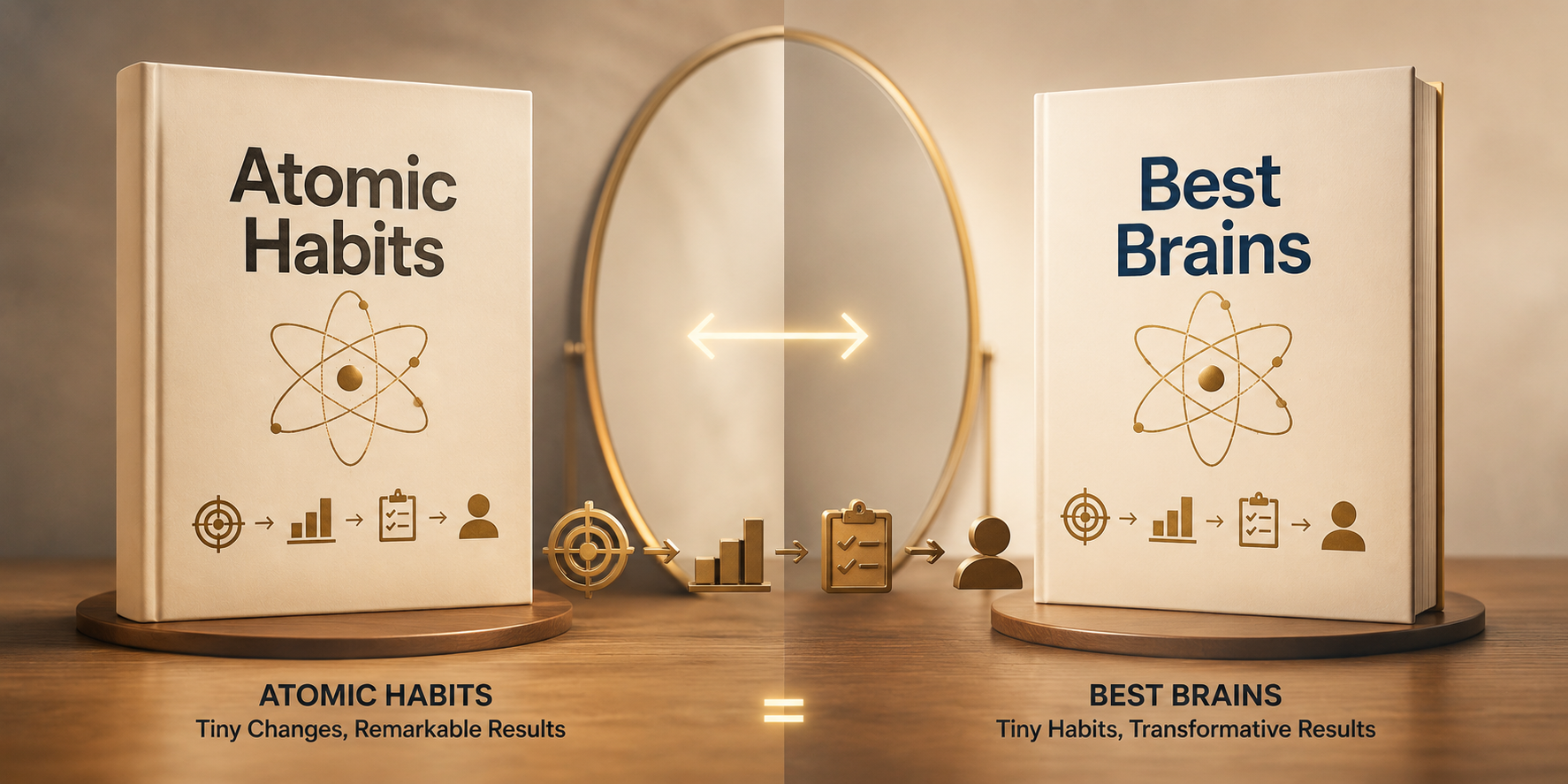
Atomic Habits ↔ Best Brains: The Mirror
Every principle from the book has a direct match in the Best Brains classroom:
Book: Tiny habits compound into extraordinary results |
Best Brains: Daily micro-homework
builds lasting knowledge
Book: Systems matter more than goals |
Best Brains: Structured curriculum with tests and revision
Book: Identity shapes behavior — 'I am a learner' |
Best Brains: Constructive feedback
builds student identity
Book: Immediate rewards make habits stick |
Best Brains: Rewards at every milestone, not just the finish
line
Book: Varied contexts make behaviors
automatic |
Best Brains: Each concept applied
across different question types
Book: The Plateau of Latent Potential precedes breakthroughs |
Best Brains: Slow, consistent
growth tracked through regular tests
The Verdict: Best Brains Is Atomic Habits in a Classroom
James Clear spent years studying the science of how humans build lasting, life-changing behavior. He distilled it into one thesis: small, consistent actions — repeated daily, rewarded immediately, and tied to identity — are the architecture of excellence.
Best Brains didn't read the book and adapt. Best Brains lived the book before it was written. Every principle — the depth-first curriculum, the varied practice, the small daily homework, the constructive feedback, the celebration of small wins — is a direct expression of what neuroscience and behavioral psychology confirm: this is how winners are made.
Not in one dramatic moment. But in a thousand quiet, consistent, rewarded steps. That's Best Brains. That's Atomic Habits.
That's the way.