Abbotsford
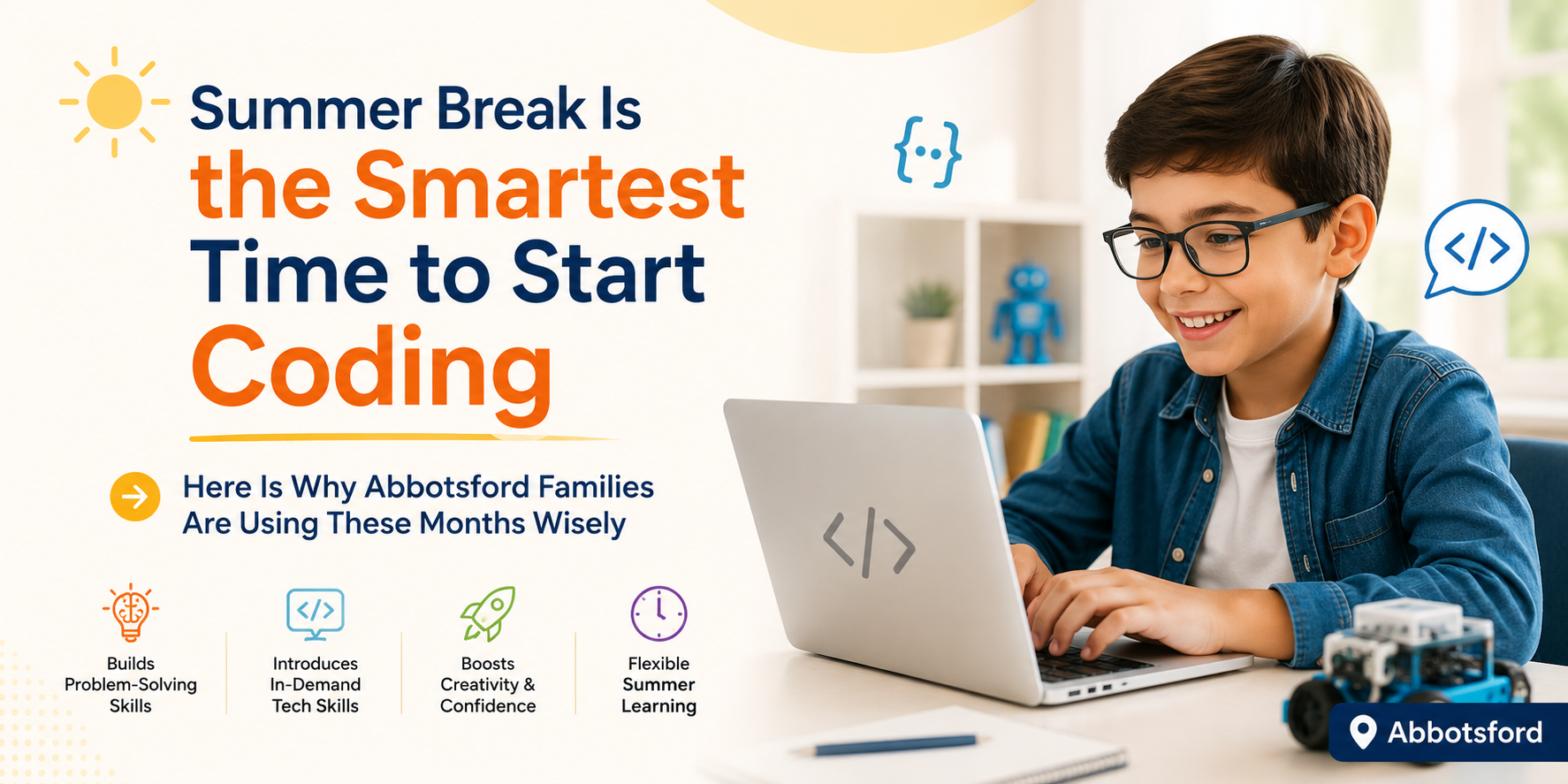
Summer Break Is the Smartest Time to Start Coding — Here Is Why Abbotsford Families Are Using These Months Wisely
Let's be honest. When most Abbotsford parents think about summer learning, they imagine a child hunched over a workbook at the kitchen table while their friends are at the water park. That image is enough to make any parent say no — and fairly so.
But here is the thing. That is not what coding in the summer looks like. Not even close.
Coding is the one subject a child can genuinely start during summer break and not feel like they are extending the school year. The reason is specific and worth understanding — because once you see it, the summer window looks very different.
THE SCHOOL YEAR IS ACTUALLY THE WORST TIME TO START SOMETHING NEW
During the school year, your child's learning bandwidth is already committed. Homework, tests, projects, extracurriculars, social navigation — every weekday is accounted for. There is almost no room for something genuinely new, especially something exploratory.
Starting coding during the school year means starting it tired, starting it compressed, and starting it alongside ten other competing demands. Most children who begin coding under those conditions either move through it too slowly to feel the momentum, or drop it before they build enough skill to feel genuinely capable.
During the school year, kids often have limited time and energy to try something new. Summer breaks that routine. With fewer commitments, children can take the time to dive into something they're curious about — like coding — without pressure or deadlines.
Summer removes all of that. No homework. No tests. No competing deadlines. Two months of flexible time that a child can actually use to go deep into something they find interesting — and coding is one of the few things that can hold a child's genuine interest for that long, because it produces something real at every stage.
THE SUMMER SLIDE IS REAL — BUT CODING IS NOT THE SOLUTION PARENTS USUALLY IMAGINE
Most Abbotsford parents who think about summer learning are thinking about the summer slide — the well-documented loss of academic skills that occurs when children disengage from learning for two to three months.
The research on this is not ambiguous. Studies have shown that students can lose the equivalent of two months of learning over the summer, with greater declines noted in subjects like mathematics compared to reading. Research indicates that 70% to 78% of elementary students lose math knowledge over the summer, while 62% to 73% lose skills in reading.
The standard solution parents reach for is remedial math worksheets or reading assignments — things that feel like school, are treated by children like school, and produce exactly the kind of summer resistance every parent dreads.
Coding is a different kind of answer. It is not a substitute for math and English enrichment — Best Brains Abbotsford offers those as separate programs and they remain important. But coding in the summer does something those programs alone cannot: it keeps a child's brain actively engaged in logical thinking, sequencing, problem solving, and creative output during the months when passive screen time would otherwise be the default.
Coding doesn't have to feel like schoolwork. In fact, when kids are given the freedom to create animations, design games, or tell stories through code, they often forget they're learning at all.
The child who spends part of their summer building a game in Scratch, writing their first Python functions, or designing a simple web page is not doing school. They are creating. And that distinction matters enormously to a child's willingness to engage.
WHAT SUMMER CODING ACTUALLY LOOKS LIKE
This is where parents are often surprised by how accessible the entry point is.
Scratch is the gold standard for young beginners. Its drag-and-drop block system removes the frustration of syntax errors and lets kids focus on logic, creativity, and building real projects — games, animations, and interactive stories — from day one. A child who has never written a line of code can sit down with Scratch in their first session and leave having built something that moves, responds, and does what they designed it to do. That immediate feedback loop — design, build, see it work — is what makes coding uniquely suited to summer learning.
Python is the most recommended first text-based language — and for good reason. Its clean, readable syntax closely resembles plain English, making the jump from block coding far less intimidating. More importantly, Python powers AI, data science, automation, and web development, making it one of the most future-relevant skills a young learner can pick up today.
And Web Development — HTML, CSS, and introductory JavaScript — takes everything a step further by producing something every child can point to and say: I built that. A functional website, viewable on any device, created by a child who started the summer not knowing what a tag was. That sense of authorship is powerful and motivating in a way that worksheets simply are not.
At Best Brains Abbotsford, all three levels are taught by BC-certified teachers in small groups — which means your child is not watching a tutorial alone and hoping they understood it. They are being taught, being corrected, being encouraged, and being challenged by a credentialed educator who knows when understanding is genuine and when it only looks that way.
THE SUMMER CODING ADVANTAGE: WHAT SEPTEMBER LOOKS LIKE DIFFERENTLY
Here is the outcome that most Abbotsford parents do not think about until they see it.
A child who begins coding in July and spends six to eight weeks building genuine foundational skills arrives at September in an entirely different position to one who did not.
They are not starting from scratch in a classroom where everyone is at the same zero. They have already debugged their first program. They have already figured out what a loop does. They have already built something and shown it to someone. That prior experience changes the confidence with which they approach any technology-related learning in the school year ahead — and it changes their relationship with difficulty, because they have already experienced the cycle of confusion, persistence, and breakthrough that coding repeatedly produces.
Coding isn't just about learning programming languages — it's about developing problem-solving skills, critical thinking, and creativity. These are skills that benefit children far beyond just tech-related fields.
Several studies have shown that children who code from the beginning of their elementary school education achieve better academic performance throughout their education. When compared to children who don't engage in coding-related learning, a higher percentage of children who start coding early gain interest in STEM, both in college and professionally.
The summer start is not just about coding. It is about arriving at September as a different kind of learner.
FROM CONSUMER TO CREATOR — THE SHIFT SUMMER MAKES POSSIBLE
There is a larger shift that summer coding enables that is worth naming directly.
Most children spend their summers consuming technology — watching videos, playing games, scrolling. This is not a moral failure; it is the default of an accessible digital environment. But there is a meaningful difference between a child who is a consumer of technology and a child who is a creator of it.
Instead of spending hours watching videos or playing games, kids can create those games themselves. Coding turns screen time from passive to active. They're no longer just consumers of technology — they become creators.
This shift matters beyond coding specifically. A child who experiences themselves as someone who builds things — who looks at a website and thinks about how it was made rather than just what it shows — develops a fundamentally different relationship with the digital world. They understand it as something human-made, and therefore something they can contribute to. That confidence and curiosity is one of the most durable gifts a summer can produce.
If children know how to code, they can develop apps, video games, websites and more, as they watch their coding come to life. The summer is the first place most children experience that — and the experience tends to stick.
WHY SUMMER IS SPECIFICALLY BETTER THAN THE REST OF THE YEAR FOR THIS
To be direct about what makes summer structurally different:
No grades. Coding during the summer carries none of the evaluation anxiety that the school year brings. A child can try something, fail at it, try again, and learn from the failure without it appearing on a report card. Without the pressure of homework, exams, and school projects, children can fully immerse themselves in learning a new skill like coding. This dedicated learning time allows kids to take a deep dive into programming without the typical distractions of the school year.
No syllabus competition. During the school year, every new subject competes with every other. Coding competes with math homework, science projects, and social studies assignments for the limited mental energy a school-age child has at 4pm. In summer, there is no competition. Coding gets a child's best attention, not their leftover attention.
More time for depth.Taking coding classes during the summer without the pressure of school allows kids to explore new skills in a relaxed environment. A concept introduced in a session can be explored further at home that afternoon, picked up again the next day, and built into something more complex by the end of the week. The school year rarely allows this kind of iterative depth.
Self-paced discovery. Summer coding can be completely self-driven. Kids can follow tutorials, build their own games, or explore coding challenges at their own pace. Unlike structured school subjects, coding during the summer allows children to be in control. They decide what to build, how to build it, and when to stop or try again. This kind of learning builds confidence, independence, and curiosity — all essential qualities for future success
WHAT BEST BRAINS ABBOTSFORD OFFERS THIS SUMMER
Best Brains Abbotsford runs its full coding program through the summer months. This is not a one-week camp or a holiday activity. It is the same structured, certified-teacher-led program available year-round — which means children who begin coding in July build real, cumulative skills that carry directly into the September school year and beyond.
The three coding levels offered are:
Scratch — for children beginning their coding journey. Scratch uses a visual, block-based environment developed by MIT that introduces algorithmic thinking, sequencing, loops, conditionals, and creative project-building without the intimidation of written syntax. Children leave their first sessions having built something real — an animation, a simple game, an interactive story. This is the entry point where genuine enthusiasm for coding is built.
Python — for children ready to move from visual blocks to text-based programming. Python is the world's most in-demand programming language by recruiters in 2026, and the primary language of AI, machine learning, and data science. At Best Brains, Python is taught through project-based learning — calculators, quiz games, logic programs — that make each concept feel purposeful and immediately applicable. A child who completes even one level of Python over the summer arrives at September with a skill that most of their peers do not have and will not develop in school for years.
Web Development — for children ready to build for the real world. HTML, CSS, and introductory JavaScript give children the ability to design and publish actual websites. Every child who completes the web development level leaves with something tangible — a page they built, that works, that they can show anyone. This level of portfolio-building during summer is a genuine differentiator as children move toward high school, university applications, and employment.
All three levels are taught by BC-certified teachers in small groups, with a free placement assessment to ensure every child begins at exactly the right level — not too easy to be boring, not too advanced to be discouraging.
For families interested in combining coding with math or English enrichment over the summer — addressing the summer slide across all three areas simultaneously — Best Brains Abbotsford offers multi-subject enrolment at one combined monthly fee. One centre. One weekly visit. Coding, math, English, and abacus all available under the same roof with the same certified teachers.
We have written a full post on why the middle school years specifically are the optimal window for building long-term coding foundations — read it here: bestbrains.com/ca-en/abbotsford/article/why-middle-school-is-the-perfect-time-to-learn-to-code-abbotsford
But the short version is this: the summer before the school year matters. The skills a child builds between July and August are the foundation that September stands on. Coding started in summer, with no pressure and no grades, by a certified teacher in a small group, is the head start that compounds forward.
THE BOTTOM LINE
Summer break does not have to be a choice between rest and learning. For most children, the best summers are ones where they discover something that genuinely captivates them — and leave in September feeling like they grew.
Coding is one of the few subjects that a child can start in July, enjoy throughout August, and arrive at September proud of what they built. No test anxiety. No grades. No workbooks. Just a child who now knows how to make a computer do what they want it to do — and who has discovered, possibly for the first time, that they are capable of creating something from nothing.
That is a summer well spent.
FAQ SECTION:
Q: Is summer a good time for kids to start coding in Abbotsford?
A: Yes — summer is one of the best times for children to start coding. Without the competing demands of school homework, tests, and projects, children have the time and mental space to dive into something new without pressure. Best Brains Abbotsford runs its full Scratch, Python, and Web Development coding program through the summer months with certified teachers.
Q: What coding programs does Best Brains Abbotsford offer in the summer?
A: Best Brains Abbotsford offers three coding levels throughout the summer: Scratch (visual block-based coding for beginners), Python (text-based programming for intermediate students), and Web Development (HTML, CSS, and JavaScript for building real websites). All are taught year-round by BC-certified teachers in small groups.
Q: Does my child need coding experience to start at Best Brains Abbotsford?
A: No. Every child begins with a free placement assessment that identifies exactly where they should start. Children with no prior experience begin with Scratch, which is designed as a zero-experience entry point. Children with some prior coding knowledge are placed at the appropriate intermediate level.
Q: How is summer coding different from coding during the school year?
A: Summer removes the competing pressure of homework, tests, and extracurriculars that limit how deeply a child can engage with something new during the school year. Without grades and without a syllabus to compete with, children approach coding more playfully, more persistently, and with more genuine curiosity. Research consistently shows that low-pressure environments produce stronger early skill development in exploratory subjects like coding.
Q: Will summer coding at Best Brains help my child in September?
A: Yes. Children who build coding foundations over the summer arrive in September with skills most of their peers do not have, with demonstrated experience in debugging and problem-solving, and with the confidence that comes from having built something real. These outcomes carry over into how they approach technology-related learning throughout the school year.
Q: How does coding help prevent the summer slide?
A: While coding does not replace math and English enrichment for directly preventing the summer slide, it keeps a child's brain actively engaged in logical thinking, sequencing, and problem-solving during the months when passive screen time would otherwise be the default. Children who engage in structured coding over the summer maintain cognitive engagement that supports their return to academic learning in September.
Q: Can my child combine coding with math or English enrichment at Best Brains this summer?
A: Yes. Best Brains Abbotsford offers multi-subject enrolment at a single combined monthly fee. Children can study coding alongside math enrichment, English enrichment, and abacus mental math — all taught by certified teachers under one roof in a single weekly visit.
Q: At what age can children start coding at Best Brains Abbotsford?
A: Best Brains Abbotsford's coding program is available for children from approximately age 7 upward, with Scratch being the ideal entry point for younger children and Python and Web Development suited to children aged 10 and above. A free placement assessment ensures every child is placed at the right level for their age, prior experience, and learning pace.
CALL TO ACTION:
Summer 2026 is the head start your child will carry into September and beyond.
Book a free assessment at Best Brains Abbotsford today and find out exactly which coding level is the right starting point for your child.
📍 3720 Townline Rd, Unit 230, Abbotsford, BC 📞 236-622-2074 🌐 bestbrains.com/ca-en/abbotsford 📧 abbotsford@bestbrains.com
SOURCES REFERENCED:
- Pinecone Academy — Why Summer Is the Best Time to Start Coding for Kids, May 2025 (pinecone.academy)
- Pinecone Academy — Why Summer Is the Perfect Time to Learn Coding: Unlock the Advantages of a Summer Coding Camp, March 2025 (pinecone.academy)
- EBSCO Research Starters — Summer Learning Loss (ebsco.com)
- Math and Movement — Summer Learning Loss Statistics: What Principals Need to Know, December 2025 (mathandmovement.com)
- United for Literacy — Preventing Summer Learning Loss: How Literacy Programs Keep Kids Learning, May 2025 (unitedforliteracy.ca)
- CodaKid — Coding for Kids: The Ultimate Guide for Parents 2026 (codakid.com)
- Noble Desktop — Best Coding Summer Courses: Discover Summer 2025 Programs (nobledesktop.com)
- CodeMonkey — The Best Age for a Child to Start Coding, June 2025 (codemonkey.com)
- FunTech — Why Kids Should Learn Programming in 2025 (funtech.co.uk)
- Wikipedia — Summer Learning Loss (en.wikipedia.org)
- Best Brains Abbotsford — AI Is Coming: Why Middle School Is the Perfect Time to Learn to Code (bestbrains.com/ca-en/abbotsford/article/why-middle-school-is-the-perfect-time-to-learn-to-code-abbotsford)