Abbotsford
Is My Child Ready for Grade 1? What Abbotsford Parents Need to Know (And How to Help at Home)
Every June, a wave of quiet worry passes through Abbotsford households. Your child is finishing Kindergarten, summer is coming, and somewhere in the back of your mind a question keeps surfacing: Is my child actually ready for Grade 1?
It is one of the most common concerns parents bring to us at Best Brains Abbotsford — and it is a completely valid one. The jump from Kindergarten to Grade 1 is real. Expectations shift. The pace picks up. And the foundational skills your child builds right now will shape how confident they feel in the classroom for years to come.
This post will walk you through exactly what BC teachers look for, what the Abbotsford School District emphasizes, and what you can do at home today — starting with the little ones in your house who are still years away from Grade 1.
WHAT DOES "READY FOR GRADE 1" ACTUALLY MEAN IN BC?
In British Columbia, Kindergarten is not just play time. The BC Ministry of Education curriculum for Kindergarten focuses on early literacy through phonics, storytelling, shared reading, and vocabulary building, with a strong emphasis on oral language, listening skills, and print awareness. By the time a child completes Kindergarten, teachers are looking for growth across three core competency areas: communication, thinking, and personal and social responsibility.
The Abbotsford School District takes this transition seriously. The district has a long history of planning carefully for the move into school, acknowledging the need for a gradual entry process designed to set up students for success for the rest of their school years. That same intentional approach should carry over into how you support your child at home.
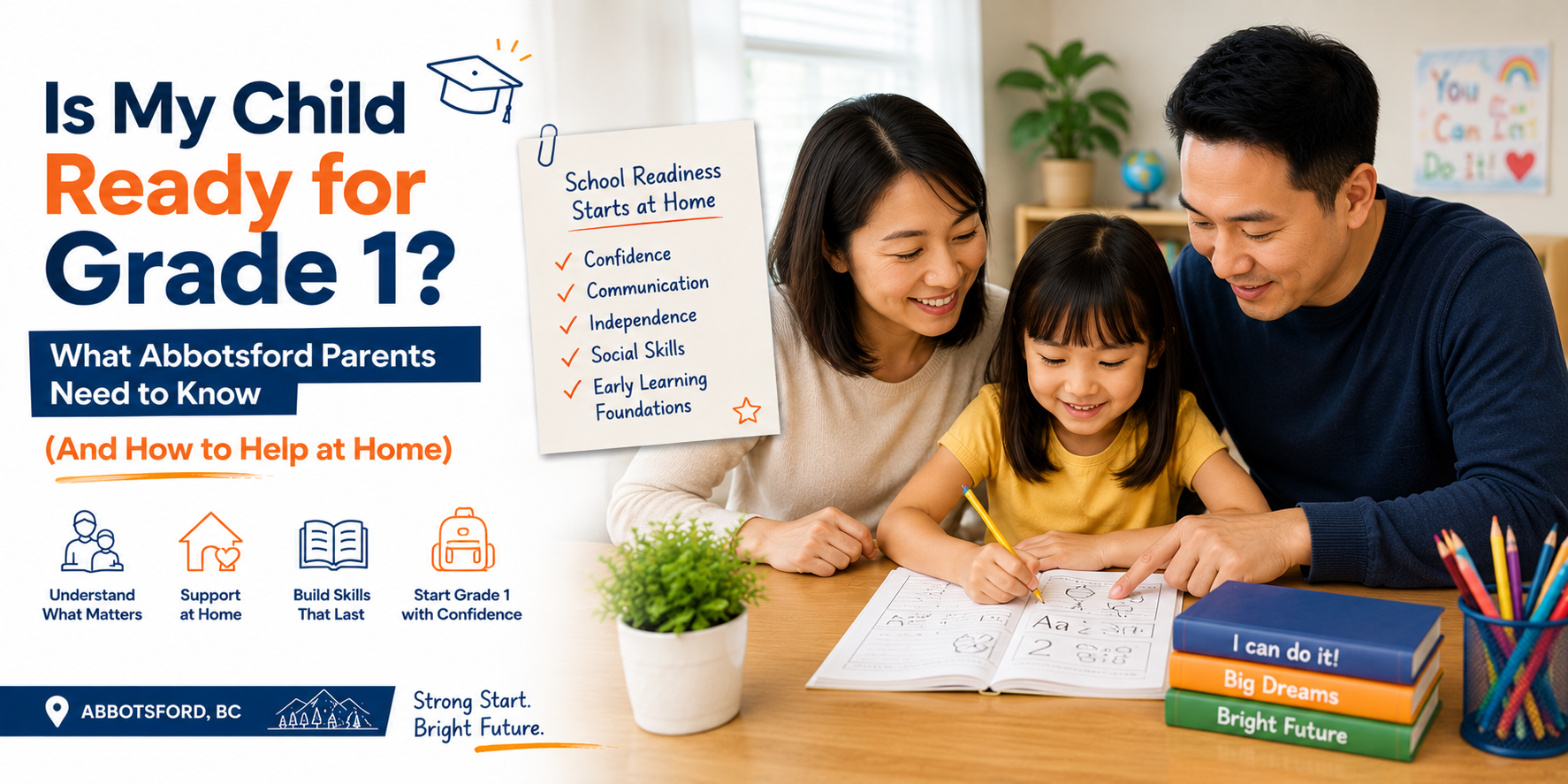
"Ready for Grade 1" does not mean your child needs to read chapter books or solve addition problems before September. It means they have built a solid base across four key areas: literacy, numeracy, social and emotional skills, and independence.
THE FOUR AREAS TEACHERS LOOK AT
- Early Literacy Skills
Your child does not need to be a fluent reader entering Grade 1, but they should be comfortable with the building blocks. Teachers look for children who can:
- Recognize and write most letters of the alphabet (upper and lowercase)
- Understand that letters make sounds and sounds make words
- Recognize their own name in print
- Follow along with a simple story and answer basic questions about it
- Hold a book correctly and understand that print reads left to right
If your child can sit with a picture book and tell you what is happening on the page, they are already doing literacy work. That listening and storytelling instinct is exactly what Grade 1 teachers build on.
- Early Numeracy Skills
Math readiness at this stage is less about memorized facts and more about number sense — an intuitive feel for how numbers work. Children entering Grade 1 are generally expected to:
- Count reliably to 20 or beyond
- Recognize written numerals 0 to 10
- Understand basic concepts like more, less, and equal
- Sort and classify objects by colour, shape, or size
- Begin to recognize simple patterns
These skills develop naturally through play, cooking, building, and everyday conversation. If you count steps on the way upstairs or sort laundry together, you are already doing numeracy work at home.
- Social and Emotional Readiness
This is the area parents underestimate most — and the one teachers say matters as much as academics. A child who struggles to manage their emotions or communicate with peers will find Grade 1 exhausting, regardless of how strong their reading is.
Children who thrive in Grade 1 can typically:
- Separate from a parent without significant distress
- Take turns and share with other children
- Follow simple two or three-step instructions
- Express their needs and feelings using words
- Sit and focus on a task for at least 10 to 15 minutes
Social readiness is built through interaction. Playdates, group programs, and structured activities with other children all contribute to this foundation.
- Independence and Self-Care
Grade 1 classrooms move quickly. Teachers work with large groups of children and cannot manage every individual need. Children who feel secure and capable on their own do better. This includes:
- Managing their own belongings (backpack, lunch kit, jacket)
- Going to the washroom independently
- Asking for help when they need it
- Attempting a task before giving up
These may sound minor, but for a five or six-year-old, they represent real confidence and self-sufficiency.
A NOTE FOR MULTILINGUAL FAMILIES IN ABBOTSFORD
Abbotsford is one of the most diverse and fastest-growing communities in Canada, and many families in our city are raising children in homes where English is not the primary language. If this describes your family, this section is especially for you.
Children learning English alongside another language are not behind. Research consistently shows that multilingual children develop strong cognitive flexibility and problem-solving skills. However, they may need extra support with English vocabulary, following classroom instructions, and expressing ideas in a second language — all of which can affect how confident they feel entering Grade 1.
The best thing you can do is keep your home language rich and strong. Read together in your first language. Tell stories. Discuss the world. A child who has strong language foundations in any language learns English faster and more deeply than a child who has been pushed to abandon their mother tongue prematurely.
At the same time, expose your child to English through songs, books, educational programs, and play with English-speaking peers before Grade 1 starts. The more comfortable they are with basic English vocabulary and classroom language, the smoother the transition will be.
WHAT YOU CAN DO AT HOME RIGHT NOW
You do not need to turn your home into a classroom. The most effective early learning happens through warm, playful, intentional moments woven into daily life.
Here are simple strategies organized by skill area:
For Literacy:
Read together every day, even for just 10 minutes. Let your child choose the book. Ask open questions while you read: What do you think will happen next? How is the character feeling? Why did they do that? Run your finger under the words as you read so your child begins connecting sound to print. Practice writing their name, the names of family members, and simple words they care about. Play rhyming games in the car or at dinner. Rhyme awareness is one of the strongest early predictors of reading success.
For Numeracy:
Count everything. Grapes on the plate, steps to the car, socks in the laundry. Play simple board games that involve counting spaces or collecting pieces. Cook together and let your child measure ingredients. Use language like more, less, the same, bigger, and smaller naturally throughout the day. Build with blocks and talk about shapes: that is a rectangle, this is a square, which one is bigger?
For Social and Emotional Skills:
Name emotions out loud in your own life and your child's. When you say I feel frustrated right now, or I can see you are really disappointed, you give your child the vocabulary to process and communicate their own feelings. Practice turn-taking through games. Role-play school scenarios at home: What would you do if someone took your crayon? What would you say if you needed help? Let your child experience small frustrations without rescuing them immediately. Learning to persist through difficulty is one of the most important school-readiness skills there is.
For Independence:
Give your child age-appropriate responsibilities. Let them pack their own bag, choose their clothes, or help set the table. Resist doing things for your child that they are capable of doing themselves. The goal is not perfection — it is the practice of trying.
WHEN TO CONSIDER EXTRA SUPPORT
Most children develop these skills at different rates, and a child who is behind in one area is not behind in all areas. However, there are some signs that suggest your child may benefit from structured support before or alongside Grade 1:
- Significant difficulty recognizing letters or numbers after repeated exposure
- Very limited interest in books, stories, or drawing
- Frequent and intense emotional outbursts that are difficult to recover from
- Trouble following simple instructions even in calm, familiar settings
- Limited vocabulary compared to peers of the same age
If any of these feel familiar, the right response is not worry — it is action. Early support makes an enormous difference. Children who receive targeted enrichment before and during early primary school build confidence faster and carry that confidence forward.
HOW BEST BRAINS ABBOTSFORD HELPS
At Best Brains Abbotsford, we work with children starting at age 3 — which means we are not a catch-up program. We are a head-start program.
Our enrichment curriculum is designed to build exactly the skills described in this post: strong number sense, early literacy, logical thinking, and the confidence that comes from genuinely understanding what you are learning. Children in our programs do not drill worksheets — they engage with structured, age-appropriate challenges that build real academic ability.
For families with children approaching Grade 1, we offer a free assessment to show you exactly where your child stands, what they are ready for, and what areas would benefit from a little extra attention. There is no pressure and no guesswork — just a clear picture of where your child is and where they can go.
For multilingual families, we are experienced in supporting children who are building skills in English alongside another home language, and we welcome families from all backgrounds.
THE BOTTOM LINE
Ready for Grade 1 is not a single checkbox — it is a constellation of skills that develop over time with the right experiences, encouragement, and support. The best thing an Abbotsford parent can do right now is be intentional: read together, count together, talk together, and play together. And if you want to know exactly where your child stands heading into Grade 1, come see us.
A strong start is the greatest gift you can give your child. And it starts long before September.
CALL TO ACTION:
Book a free assessment at Best Brains Abbotsford today and find out exactly where your child stands — and what they are ready to learn next. Serving children ages 3 to 14 in Abbotsford, BC.
Call: 236-622-2074 Email: abbotsford@bestbrains.com
SOURCES REFERENCED:
- BC Ministry of Education — British Columbia Kindergarten Curriculum and Early Learning Framework
- Abbotsford School District — Kindergarten Gradual Entry Program (abbyschools.ca)
- Abbotsford School District — Early Learning Department (earlyyears.abbyschools.ca)
- Columbia Academy — British Columbia Kindergarten Curriculum: Foundations of Early Learning (columbiaacademy.ca)
- Procare Software — Benefits of Offering Preschool Enrichment Programs (procaresoftware.com)
- KLA Schools — 25 Key Benefits of Enrichment Programs for Children (klaschools.com)
- Government of British Columbia — Full Day Kindergarten Program Guide (gov.bc.ca)
- Education in British Columbia — Wikipedia overview of BC compulsory education structure