Abbotsford
Is Free Khan Academy Enough or Does Your Child Need Structured Tutoring? An Honest Answer for Abbotsford Parents
Khan Academy is genuinely impressive. It is free, it covers an enormous range of subjects from Kindergarten through university level, it is beautifully designed, and the research behind it is real. If you are a parent in Abbotsford who has discovered it and is wondering whether it is enough — you are asking exactly the right question.
The honest answer is: it depends. And the details of what it depends on matter enormously for your child specifically.
This guide gives you a clear-eyed, research-backed comparison of what Khan Academy actually delivers, where it falls short, and how to know whether your child is the kind of learner who will thrive with it — or the kind who needs something more.
What Khan Academy Actually Is — and Is Not
Khan Academy is a free, self-directed online learning platform offering video lessons, practice exercises, and progress tracking across virtually every academic subject. It is not a tutoring service. It is not a structured enrichment program. And it does not employ teachers who know your child.
It is a tool. A very good tool — but a tool nonetheless. And like any tool, its value depends entirely on how it is used, by whom, and under what conditions.
What the Research Says About Khan Academy — the Full Picture
Khan Academy is unusually transparent about its own efficacy data, which is worth acknowledging and examining carefully.
Khan Academy's own November 2024 efficacy study of approximately 350,000 students in Grades 3 through 8 found that using Khan Academy for 30 or more minutes per week — or 18 or more hours over the school year — is associated with approximately 20% greater-than-expected learning gains, as measured by the nationally normed MAP Growth Assessment.
That is a meaningful result. Here is the number that sits beside it, buried further down in the same report:
Approximately 9% — roughly 33,000 of the 350,000 students studied — actually reached the recommended usage threshold of 30 minutes per week.
Read that again. Khan Academy works — for the 9% of children who use it at the recommended level.
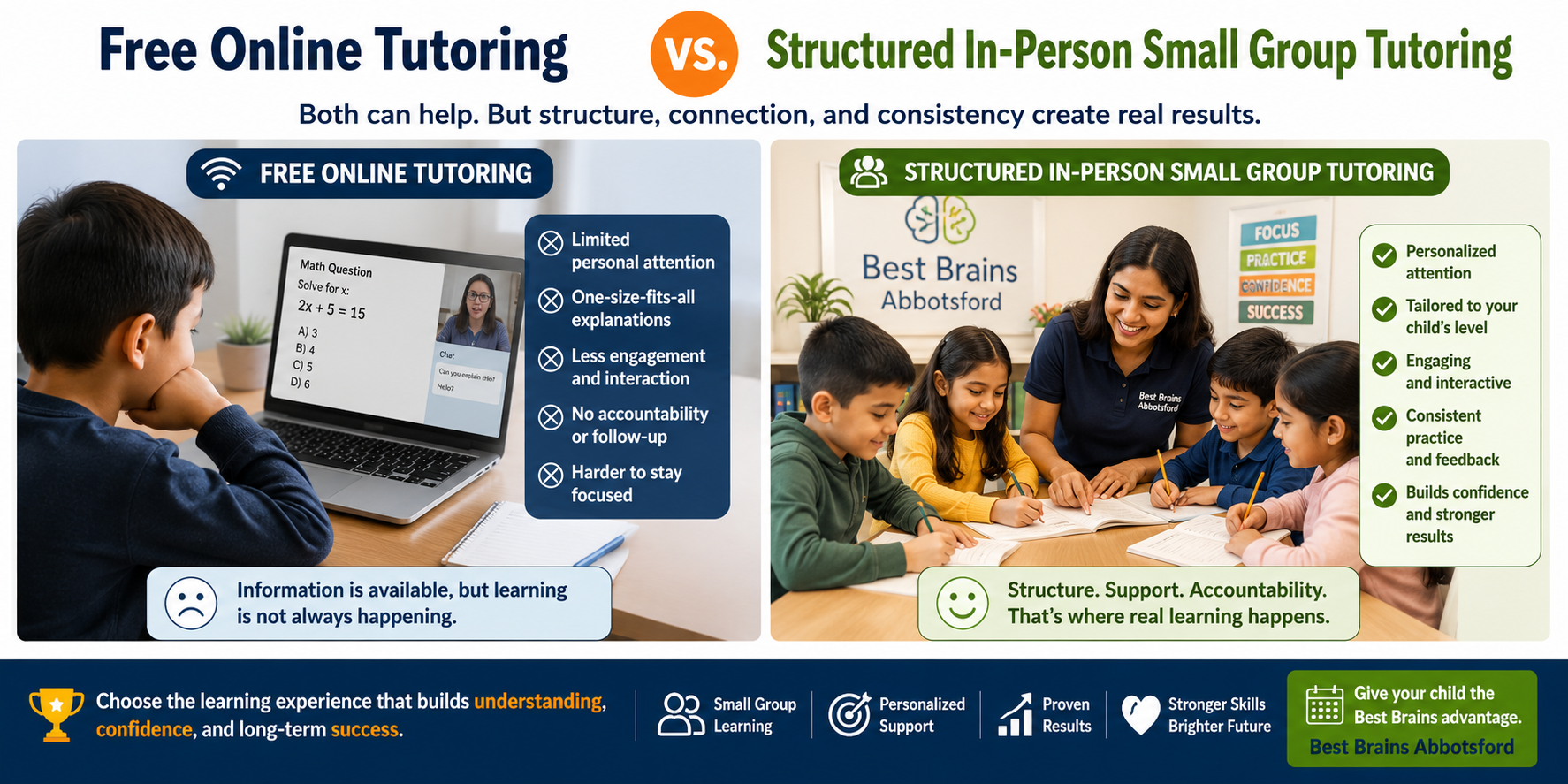
The other 91% of children in the study used it below the threshold that produces meaningful results. Not because they are lazy or their parents do not care. But because sustaining 30 minutes of independent, self-directed online learning every week — without a teacher, without accountability, without a structured curriculum driving them forward — is genuinely hard for most children, particularly those in the K–8 age range.
This is not a criticism of Khan Academy. It is the central fact that every parent needs to understand before deciding whether it is enough for their child.
The Self-Direction Problem — Why Most Children Cannot Unlock Khan Academy's Benefits
The research on self-directed learning is consistent and clear: the approach works well for learners who are already motivated, organised, and confident in their ability to manage their own learning. It works significantly less well for everyone else.
Research published in peer-reviewed education journals consistently finds that without sufficient guidance and scaffolding from teachers, students struggle to control and interact with an online learning environment effectively.
Education researchers identify several key barriers to self-directed learning, including students who are poorly motivated, lack confidence, or do not yet possess the self-regulation skills the approach requires.
Now consider the average child in Grades 1 through 8. The human brain's prefrontal cortex — the region responsible for planning, self-regulation, sustained attention, and goal-directed behaviour — does not fully develop until the mid-twenties. Expecting a Grade 4 student to independently manage their own learning schedule, identify their own knowledge gaps, and sustain motivation through a free online platform without external structure is asking a great deal of a brain that is, by design, not yet built for it.
Academic research comparing self-directed and teacher-directed instruction finds that while self-directed learning fosters autonomy, teacher-directed instruction provides essential structure and guidance, consolidating knowledge and aligning learning with curriculum standards.
Khan Academy provides the content. It does not provide the teacher. And for most K–8 learners, that distinction is the difference between results and a tab that gets opened twice and abandoned.
Who Khan Academy Works Well For
To be genuinely fair — because Khan Academy deserves that — here are the children for whom it is a strong supplementary resource:
✅ Highly self-motivated learners who will voluntarily open the platform, set their own goals, and return to it consistently without being prompted. These children exist. They are not the majority.
✅ Children filling a specific, well-defined knowledge gap — a single concept they missed, a topic they want to revisit before a test, or a subject they are curious about independently. Khan Academy's video explanations are excellent for this narrow use case.
✅ Children whose parents can sit alongside them regularly to guide the sessions, set the agenda, and provide the accountability and instruction the platform itself cannot. In this scenario, the parent becomes the teacher and Khan Academy becomes the curriculum. It works — but it requires significant parental time and capability.
✅ Advanced learners who are genuinely self-directed and want to explore content ahead of their grade level out of personal interest.
Who Khan Academy Is Not Enough For
This is the more important list for most Abbotsford families.
❌ Children who are already behind in math or reading. A child who does not understand the concept being taught in the Khan Academy video has no one to ask. The video plays again. The exercise repeats. The child guesses. The gap does not close — it becomes more frustrating.
❌ Children with math or reading anxiety. Self-directed learning is particularly poorly suited to anxious learners. When a child who is already afraid of math encounters a problem they cannot solve on a screen with no human support available, the anxiety cycle accelerates rather than breaking.
❌ Children who need accountability to engage consistently. If your child will not do it unless someone sits with them and makes it happen — Khan Academy is not going to change that. Motivation does not come from a platform. It comes from relationships, from the experience of genuine progress, and from a teacher who knows them and holds them gently accountable.
❌ Children who need social learning. Significant research shows that children learn more durably when they learn alongside peers, in a structured group setting with a skilled facilitator. A screen cannot replicate that.
❌ Children who need a tailored learning plan. Khan Academy's adaptive algorithm adjusts difficulty based on performance — but it does not assess a child's overall skill profile, identify the specific foundational gaps driving their current struggles, or build a structured plan to address them in the right sequence. It responds to answers. It does not understand your child.
The Deeper Question: What Does Your Child Actually Need?
Here is a useful framework for Abbotsford parents deciding between free online resources and structured enrichment programs.
Ask yourself three questions:
1. Is my child consistently using Khan Academy for 30+ minutes per week without prompting? If yes — it may be working. Monitor their school performance and FSA results to verify. If no — the platform's own research tells you the results will be limited.
2. Does my child have a real, identified skill gap in math or reading? If yes — a gap requires structured, sequential intervention. Khan Academy can supplement that work. It cannot replace it. A child who does not understand place value cannot learn multiplication on Khan Academy, because the foundation the algorithm assumes is missing.
3. Is my child engaged, confident, and progressing? If yes — maintain what is working. If no — the tool is not the issue. The approach is. Self-directed, screen-based learning is simply the wrong modality for this child at this stage.
Where Best Brains Abbotsford Fills Every Gap Khan Academy Cannot
Best Brains Learning Center in Abbotsford is not a competitor to Khan Academy. It is the structured, teacher-led, human-centred enrichment program that makes the use of any independent resource — including Khan Academy — more effective, because it first closes the foundational gaps that screen-based learning cannot address on its own.
Here is specifically how Best Brains addresses what Khan Academy cannot provide:
BC Certified Teachers — The Human Element That Changes Everything
Research comparing teacher-led and self-directed learning consistently finds that teacher-led approaches are more effective in fostering structured social interactions, peer engagement, and the consolidation of academic knowledge aligned with curriculum standards.
Every session at Best Brains Abbotsford is led by a BC-certified teacher. Not an algorithm. Not a video. A credentialed human educator who knows your child's name, understands their specific learning profile, notices when they are confused before they say so, and adjusts instruction in real time. This is the irreplaceable core of what structured enrichment provides — and what no free platform can replicate.
A Structured, Non-Repetitive, Level-Based Curriculum
Khan Academy is built around mastery — a sound pedagogical principle. But its implementation relies on the child correctly identifying their own gaps, which most K–8 students cannot do reliably.
Best Brains uses a carefully sequenced, level-based curriculum where every concept is taught, practised, and genuinely mastered before the next is introduced. There is no skipping. No accidentally bypassing the foundational concept that everything else depends on. No algorithm deciding readiness based on quiz performance alone. A certified teacher makes that call — based on genuine understanding, not a percentage score.
A Tailored Learning Plan Built Around Your Child's Actual Level
Every Best Brains student begins with a free academic assessment that identifies exactly where they stand in math and English — regardless of grade level. A personalised learning plan is then built around those specific findings.
Khan Academy places children on a continuum and lets the algorithm guide them. Best Brains places children in the hands of an educator who understands where they are, why they are there, and precisely what needs to happen next.
24/7 Free Online Support — The Feature No Other Provider Offers
Here is where Best Brains does something that genuinely has no equivalent in the market — including Khan Academy itself.
Every Best Brains student has access to free online academic support available 24 hours a day, 7 days a week. Not a chatbot. Not a video library. Real academic support, always available, at no additional cost.
Khan Academy is available 24/7 — but only to show your child the same content they already did not understand. Best Brains' 24/7 support is available to actually help when that content does not land.
No other major tutoring or enrichment provider in Abbotsford offers this. Not Kumon. Not Sylvan Learning. Not a private tutor. The combination of structured, certified-teacher-led in-person sessions and always-available online support is genuinely unique — and it is the reason Best Brains students do not fall behind between sessions the way students of other programs often do.
Small Group Learning — The Social Dimension Online Cannot Replicate
Best Brains sessions run in small groups of six to ten students, led by a certified teacher. Children learn alongside peers, experience healthy academic motivation from their group, and build the kind of collaborative learning habits that a solo screen-based experience fundamentally cannot develop. For children in Grades 1 through 8, peer learning in a structured setting is not a bonus — it is a core component of durable academic development.
The Honest Bottom Line
Khan Academy is one of the most valuable free educational resources ever created. Use it. Encourage your child to explore it. It is excellent for curious, self-directed learners filling specific knowledge gaps, and it is a legitimate supplement to any structured enrichment program.
But for most children in Abbotsford — particularly those who are behind, anxious, or simply in need of the accountability and human connection that drives real academic progress — Khan Academy alone is not enough. The platform's own research confirms that only 9% of students use it at the level required to produce meaningful results. The other 91% need something more.
That something more is a certified teacher. A structured curriculum. A tailored plan. And a programme that is there for your child not just when they log in voluntarily — but every day, at every level, including when it is 8:30 PM and a math problem is not making sense.
That is Best Brains.
Find Out Where Your Child Actually Stands — Free Assessment
Book a free academic assessment at Best Brains Abbotsford. In one session we identify exactly where your child is in math and English, what gaps exist, and what a clear path forward looks like. No pressure. No obligation. Just information you can use.
Best Brains Learning Center — Abbotsford, BC 📍 Serving Abbotsford, Langley, Chilliwack, Mission and the Fraser Valley 📞 236-622-2074 🌐 bestbrains.com/ca-en/abbotsford 📧 abbotsford@bestbrains.com
Free is not always enough. Your child deserves what works.
Frequently Asked Questions
Can my child use both Khan Academy and Best Brains at the same time? Absolutely — and many Best Brains families do exactly this. Best Brains provides the structured foundation, tailored plan, and certified-teacher instruction. Khan Academy can be a valuable supplement for curious learners who want to explore topics between sessions. The two are complementary, not competing.
Is Khan Academy suitable for children who are behind in math? It can help at the margins, but a child with a real foundational gap needs structured intervention — not more of the content that did not land in the classroom. Khan Academy assumes the foundational concept is present. If it is not, the platform's adaptive algorithm will continue to present content built on a foundation that is missing.
How does Best Brains' 24/7 online support work? Best Brains' online academic support is available to all enrolled students around the clock, at no additional charge. It provides real academic assistance outside of session hours — filling the gap between the classroom and the next scheduled session that most tutoring providers leave open.
My child watches Khan Academy videos but their grades are not improving. Why? Watching is not learning. Research consistently shows that passive video consumption — without practice, without feedback, without a teacher who can identify misunderstanding — produces very limited academic gains. The same child, in a structured setting with a certified teacher and a sequential curriculum, typically shows measurable improvement within six to eight weeks.
Does Best Brains follow the BC curriculum? Yes. Best Brains' math and English curriculum is aligned with BC provincial standards, including the skills assessed in the Foundation Skills Assessment (FSA) at Grades 4 and 7. Students who progress through Best Brains levels are building the exact competencies the BC curriculum measures.
Sources: Khan Academy Efficacy Results November 2024 (blog.khanacademy.org) · Multiple Studies Show Khan Academy Drives Learning Gains (blog.khanacademy.org) · Tandfonline — Reexamining the Online Environment for Self-Directed Learning (2023) · EBSCO Research Starters — Self-Directed Learning · Dinkum Publishers — Teacher-Led Online Learning vs. Self-Directed Learning (2025) · Tandfonline — Examining Self-Directed and Teacher-Directed Learning's Impact on Achievement Goals (2025) · Abbotsford School District Measuring Up Report 2024–25 · BC Ministry of Education Foundation Skills Assessment data