Abbotsford
Is AI Helping Your Child Learn — or Doing the Thinking for Them?
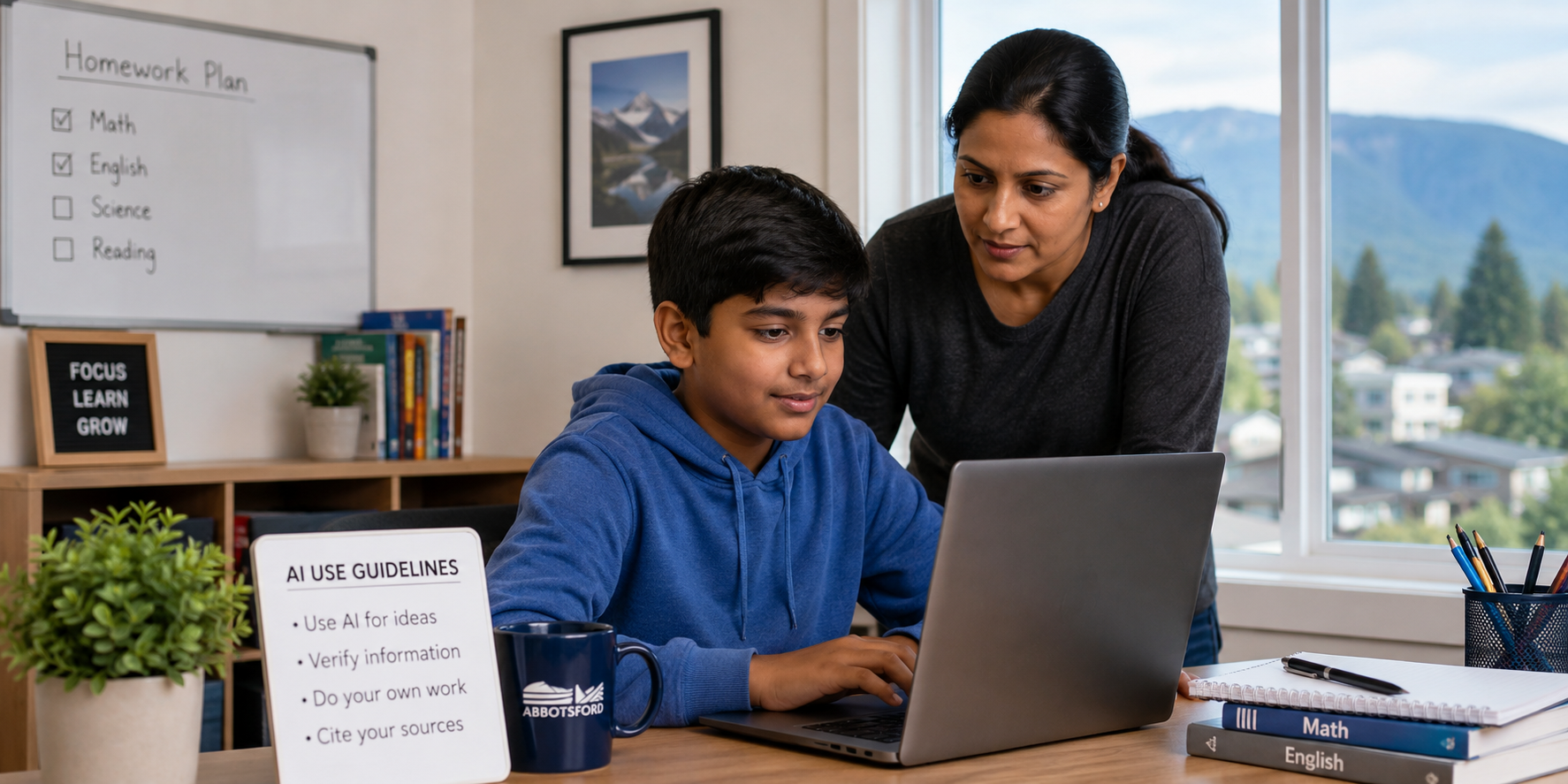
It's 8:30 p.m. on a school night in Abbotsford. Your child is stuck on a math question, everyone's tired, and an AI chatbot can spit out a full answer in about four seconds.
Quick answer: AI can genuinely help kids learn — but only when it's used to guide their thinking, not replace it. The difference comes down to when and how it's used, not whether it's used at all.
That's the real question more and more Fraser Valley parents are asking:
Is AI helping my child understand the material — or just helping them finish faster?
The honest answer isn't "ban it" or "let them use it for everything." AI tools like ChatGPT, Gemini, and homework-help apps can be useful when they explain, hint, and give feedback. They stop being useful — and start working against your child — when they remove the actual thinking: reading closely, working through a problem, revising a paragraph. A polished-looking assignment can hide the fact that almost no learning happened.
The goal isn't to raise kids who never touch AI. BC's curriculum, workplaces, and post-secondary programs are all moving toward AI literacy as a real skill. The goal is to raise kids who can use these tools without losing their own judgment, curiosity, or ability to think for themselves.
At a Glance
| Topic | AI use for homework and learning |
| Audience | Parents of children ages 3–14 |
| Region | Abbotsford & Fraser Valley, BC |
| Curriculum context | BC Ministry of Education, Abbotsford School District 34 |
| Bottom line | AI should support thinking, not replace it |
In This Guide
- When AI genuinely supports learning
- When AI becomes a shortcut
- Helpful AI use vs. AI doing the work (comparison table)
- The four-step AI homework rule
- Is using AI for homework "cheating"?
- Age, privacy, and safety considerations
- Five signs AI may be replacing your child's thinking
- Practical family rules
- How Best Brains Abbotsford builds the foundation kids need
- Frequently Asked Questions
When AI Can Genuinely Support Learning
Used carefully, AI can step in at the exact moment a child gets stuck — the moment that used to mean giving up or waiting for you to be free. A child might use it to:
- explain a difficult concept in simpler language
- get a hint without being handed the answer
- generate extra practice questions
- quiz themselves before a test
- find out where a calculation went wrong, not just that it's wrong
- get feedback on a paragraph they already wrote
- compare two different ways to solve the same problem
In every one of these cases, the child is still doing the thinking. AI is acting as a tutor pointing the way, not a machine doing the work.
When AI Becomes a Shortcut
AI stops helping the moment it does the hardest part of the task for your child — solving the problem before they've tried, writing the whole assignment, summarizing a book they haven't read, or handing over information nobody checked.
This isn't just a parenting hunch. A large field study of high-school math students found that kids using a general-purpose AI assistant performed better while they had access to it — and then performed worse than students who'd never used it once the tool was taken away. The gap mostly disappeared when the AI was restricted to giving hints and explanations instead of full answers.
The takeaway for Fraser Valley families: better homework in the moment doesn't always mean better learning by test day.
Helpful AI Use vs. AI Doing the Work
| AI supports learning when a child… | AI replaces learning when a child… |
|---|---|
| attempts the question first | asks for the complete answer immediately |
| asks for a hint or explanation | asks AI to finish the assignment |
| uses AI to generate extra practice | uses AI to avoid reading or practising |
| asks for feedback on their own draft | submits AI-written work as their own |
| checks the AI's answer against another source | assumes the first answer must be right |
| can explain the final answer without the screen | can't explain how the answer was reached |
If your child can't explain the answer without looking at the screen, AI probably didn't help them learn it — it just helped them finish.
The Four-Step AI Homework Rule
You don't need a complicated household tech policy. Four steps cover almost every situation:
1. Try
Your child attempts the question on their own first — even a messy, incomplete attempt shows what they actually understand and gives their brain a starting point.
2. Ask
They ask AI for guidance, not the finished answer. Useful prompts to teach your child:
- "Give me one hint, but don't solve it."
- "Explain this a simpler way."
- "Where did my reasoning go wrong?"
- "What's one thing I could improve in this paragraph?"
3. Explain
After using AI, your child explains the idea back in their own words — out loud, to you, a sibling, or even the dog. If they can close the laptop and still explain why the answer makes sense, it stuck.
4. Verify
AI can sound completely confident while being wrong, outdated, or missing context. Kids should check important facts, calculations, and quotes against their textbook, class notes, or teacher's instructions.
Try first. Ask for guidance. Explain it back. Verify the result.
Is Using AI for Homework Cheating?
Not automatically — it depends on the assignment and the teacher's instructions, which should always come first.
AI use crosses the line when a student:
- uses it after a teacher has said not to
- submits AI-generated work as their own
- uses it during a test or independent assessment
- can't demonstrate the knowledge behind what they handed in
Before using AI for schoolwork, a good habit is for kids to ask themselves:
- Is AI allowed for this task?
- What kind of help is allowed — hints, or full answers?
- Do I need to say I used it?
- Can I explain everything I'm submitting?
When it's unclear, the simplest move is to ask the teacher directly.
Age, Privacy, and Safety Matter
Not every AI tool is built with kids in mind.
ChatGPT, for example, isn't intended for children under 13, and users aged 13–18 need parental consent. OpenAI's own guidance says that when ChatGPT is used with a child under 13 in a learning context, an adult should be the one actually interacting with it.
Before your child uses any AI tool, check its current age requirements and privacy settings, and make sure they know never to enter identifying information — full name, home address, school name, phone number, passwords, or unedited school documents. UNESCO's guidance on AI in education stresses age-appropriate use and human oversight for exactly this reason — kids can end up treating a friendly-sounding chatbot as more private and trustworthy than it actually is.
Five Signs AI May Be Replacing Your Child's Thinking
You don't need special software to catch this — just watch for a shift in how homework happens:
- Homework is finishing unusually fast.
- The writing doesn't sound like your child anymore.
- Rough work and corrections have disappeared completely.
- They can read the answer out loud but can't explain it.
- They won't start even easy work without opening an AI tool first.
One sign on its own doesn't prove misuse. A simple way in: ask "What did you try first?" and "What did the tool actually help you understand?"
Practical AI Rules for Fraser Valley Families
A few consistent boundaries work better than rules that shift week to week:
- Teacher and school instructions always come first.
- AI comes out only after an independent attempt.
- Ask for hints and feedback — not finished answers.
- Never submit words or solutions your child can't explain.
- Verify anything important and protect personal information.
- Keep some homework, reading, and writing completely AI-free.
- Be upfront about when and how AI was used.
AI may help your child think. It shouldn't think for them.
How Best Brains Abbotsford Builds Independent Thinkers
Our goal at Best Brains Abbotsford isn't just correct answers on a worksheet — it's students who understand the concept, can explain their reasoning, and can catch their own mistakes without a tool doing it for them.
AI actually makes strong foundational skills more important, not less. A child needs solid reading skills to judge whether an AI summary is any good. They need real number sense to spot a wrong answer instead of trusting it blindly. They need practice thinking through a problem to know the difference between a shortcut and understanding.
Every class at Best Brains Abbotsford is taught by the same BC-certified teacher every session, following a structured, non-repetitive curriculum across Math, English, Abacus, and Coding — so progress is tracked by a person who actually knows your child, not just an algorithm. Students also get free 24/7 online academic support between classes, for the nights when they're stuck and you're not sure whether to help, hint, or hand it off to a chatbot.
We start every new student with a free placement assessment, so we know exactly where their foundational skills stand before building on them.
A Note from Best Brains Abbotsford
AI isn't going anywhere, and pretending kids can avoid it isn't realistic — or useful. Our job isn't to fight the technology, it's to make sure the fundamentals underneath it are strong enough that AI becomes a tool our students use well, instead of one that quietly does their thinking for them.
— Best Brains Abbotsford
Frequently Asked Questions
Should I just ban my child from using AI for homework? A full ban rarely teaches responsible use, and kids will likely use it elsewhere anyway. Clear rules around age, permission, privacy, and what kind of help is acceptable tend to work better. Teacher instructions should always come first.
Can AI actually help a child learn, or does it just make homework easier? It can genuinely help — when it's giving hints, explanations, and feedback while the child stays actively involved. It stops helping the moment it hands over finished answers.
How can I tell if my child actually understands AI-assisted work? Ask them to close the tool and explain the answer or idea in their own words, then give them a similar question to try on their own.
Is ChatGPT okay for elementary school kids? ChatGPT isn't intended for children under 13. For younger kids in an educational setting, OpenAI recommends an adult handle the actual interaction. Always check a tool's current age requirements before your child uses it.
Should my child tell their teacher they used AI? Follow the teacher's instructions. If it's unclear, ask directly whether AI is allowed for that assignment and whether its use needs to be disclosed.
What's the best way to build the skills AI can't replace? Consistent, structured practice in reading, math reasoning, and problem-solving — the kind that happens over months, not the night before a test. That's the foundation AI use should sit on top of, not replace.
Looking for Academic Support in Abbotsford?
Best Brains Abbotsford offers BC-curriculum-aligned enrichment in Math, English, Abacus, and Coding for students ages 3–14, taught by the same certified teacher every class in small, personalized groups.
📍 Best Brains Learning Center Abbotsford 3720 Townline Rd, Unit 230, Abbotsford, BC
Book a free placement assessment to see exactly where your child's foundational skills stand today.
References and Further Reading
- OpenAI: Is ChatGPT safe for all ages?
- UNESCO: Guidance for Generative AI in Education and Research
- Bastani et al., PNAS: Generative AI Without Guardrails Can Harm Learning
Content note: AI tools, age requirements, and school policies change frequently. Families should confirm current terms with the AI provider and follow guidance from their child's school and teacher.