Abbotsford
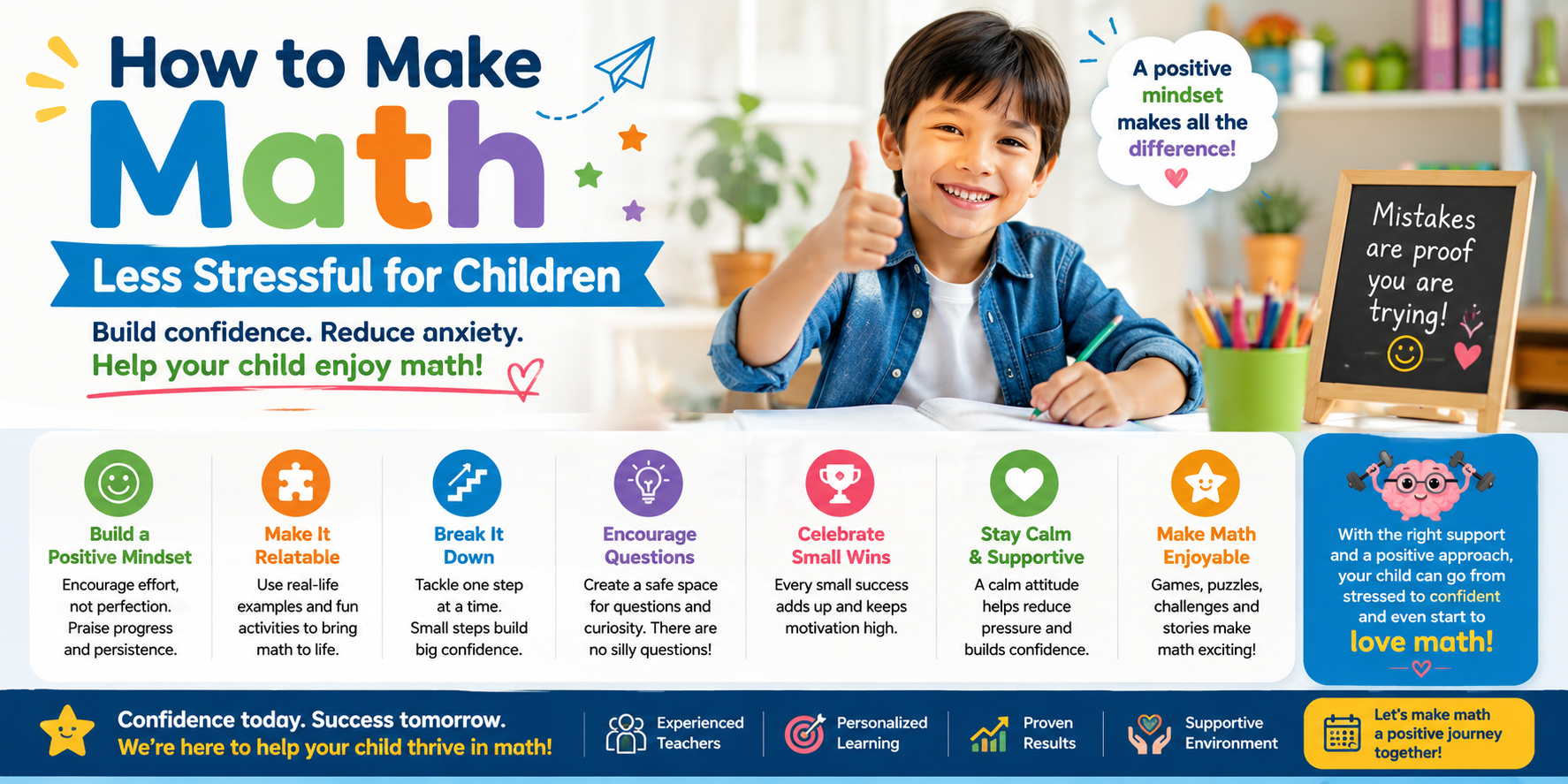
How to Make Math Less Stressful for Children — And Why the Right Support Makes All the Difference
It is 7:30 PM on a Tuesday. Math homework is open on the kitchen table. Your child's shoulders are hunched, their pencil has been chewed to a stub, and what started as a gentle nudge to finish their work has quietly escalated into tears — yours or theirs, possibly both.
If this scene is familiar, you are not alone. Math anxiety is one of the most common and least talked-about challenges facing elementary and middle school students in Canada today. And in Abbotsford, where Grade 4 literacy sits at 62% and numeracy results consistently fall below provincial benchmarks, the stress your child feels around math is not a personality quirk. It is a predictable response to a very real skills gap.
The good news: math anxiety is not permanent. It is not genetic. And it is entirely reversible — with the right approach.
What Is Math Anxiety and Why Does It Happen?
Math anxiety is a genuine psychological response — not laziness, not stubbornness, and not a sign that your child is "not a math person." Researchers define it as a feeling of tension, apprehension, or fear that interferes with math performance. Studies show it affects as many as one in three students at some point in their school years, and it can begin as early as Grade 1.
The anxiety cycle works like this: a child encounters a math concept they do not fully understand. Because they do not understand it, they perform poorly. Because they perform poorly, they feel embarrassed. Because they feel embarrassed, they avoid math. Because they avoid math, the gap grows. Because the gap grows, the next concept is even harder. And so on.
Breaking that cycle requires two things working together: reducing the emotional charge around math, and genuinely closing the skill gap that triggered the anxiety in the first place. One without the other does not work.
Why Drilling and Repetition Make Math Anxiety Worse — Not Better
The instinctive response many parents and programs reach for is more practice. If a child cannot do long division, give them fifty long division problems. If they struggle with fractions, send home a worksheet with forty fraction questions.
This approach feels logical. It is not.
Research in educational psychology consistently shows that repetitive drill-based practice without conceptual understanding increases anxiety rather than reducing it. When a child does not understand why a method works — only that they are supposed to repeat it — each wrong answer feels like personal failure rather than a natural step in the learning process. The worksheet becomes evidence of inadequacy, not a path to mastery.
This is why programs built almost entirely on worksheets and repetition — however well-marketed — often leave anxious children more anxious. Completing 200 subtraction worksheets does not teach a child to understand subtraction. It teaches them to dread it.
What actually works is structured, conceptual instruction — teaching children the why behind the how, building understanding level by level, and only introducing new complexity once the foundation is genuinely secure. This is not a soft approach. It is a more rigorous one, because it requires real mastery at every stage rather than surface-level familiarity.
8 Practical Ways to Make Math Less Stressful at Home
These strategies work whether your child is in Grade 2 or Grade 8, and whether math is a mild frustration or a full-blown source of dread.
1. Separate the Emotion From the Work
Before your child opens their math book, acknowledge that math can feel hard — and that hard is okay. Children who feel judged for struggling shut down. Children who feel safe making mistakes stay open. A simple "let's just see what we can figure out together" does more for math performance than any trick or shortcut.
Never say "I was bad at math too" — even as comfort. Research shows this phrase significantly increases math anxiety in children, particularly in daughters hearing it from mothers. It signals that math incompetence is inherited and expected, not something to be overcome.
2. Make Math Physical and Real Before Making It Abstract
Abstract numbers on a page are hard. Real objects are easy. Before your child works through fraction problems in a workbook, cut an apple into quarters. Before they practice multiplication, count out groups of physical objects. Before they tackle area and perimeter, measure the actual kitchen table.
The brain learns abstract concepts most durably when it has a physical or visual anchor to attach them to. This is not "dumbing down" math — it is how mathematical understanding is actually built, at every age.
3. Focus on the Process, Not the Answer
When your child gets a problem wrong, the instinct is to focus on the wrong answer. Redirect instead: "Walk me through how you thought about this." Often you will discover the reasoning was nearly correct — one small misstep produced the wrong answer. Praising the thinking process, even when the answer is wrong, keeps children engaged rather than defeated.
Children who are praised for effort and process develop what psychologist Carol Dweck calls a "growth mindset" toward math — the belief that ability is built through work, not born through talent. This single shift in framing has been shown in studies to produce measurable improvements in math performance over time.
4. Keep Sessions Short and End on a Win
A child in math distress cannot absorb new concepts for 45 minutes straight. Fifteen focused minutes with one concept fully understood is worth more than an hour of anxious flailing through several. Set a timer. Work on one idea. Find a problem they can get right before you stop. Ending on success — even a small one — changes the emotional association with the next session.
5. Never Rush the Basics
The most common source of chronic math anxiety is a gap in foundational skills that was never properly closed. A Grade 6 student who is anxious about algebra is almost always a student who never fully mastered multiplication in Grade 3. A Grade 4 student who panics around fractions often has a shaky understanding of division.
Resist the pressure to push forward to grade-level content before the foundational concept is solid. Slowing down to close a real gap is always faster in the long run than racing ahead over an unstable foundation.
6. Use the Language of "Yet"
"I can't do this" becomes "I can't do this yet." This is not empty optimism — it is an evidence-based linguistic shift that research shows meaningfully changes how students approach difficulty. The word "yet" signals that the current state is temporary and that progress is possible. For a child in the grip of math anxiety, that signal matters enormously.
7. Be Careful With Timed Tests
Timed math tests are one of the most reliable triggers of math anxiety in children, particularly in Grades 3 through 7. Speed is not the same as understanding, and for children who process carefully and correctly but slowly, a ticking clock communicates that their way of thinking is wrong — even when their answers are right.
If timed practice is necessary for exam preparation, introduce it gradually and separate it entirely from new concept learning. Never time a child on content they are not yet fully confident with.
8. Get Structured Support Before the Gap Gets Bigger
Home strategies help significantly. But they have a ceiling — especially if the underlying skill gap is real and the anxiety is well-established. The most effective intervention for math anxiety combines emotional support at home with structured, expert-led instruction outside the home.
This is where the choice of program matters enormously.
What to Look for in a Math Support Program — And Why It Matters in Abbotsford
Not all tutoring programs and enrichment centres approach math the same way. And for an anxious child, the wrong approach can do real harm — deepening the association between math and failure rather than rebuilding confidence.
Here is what actually matters, and how the options available to Abbotsford families stack up:
Teaching by Certified Educators vs. Teaching by Worksheet
Programs that rely primarily on worksheets and self-directed practice — regardless of how established they are internationally — are structurally poorly suited for children with math anxiety. When a child who already feels defeated by math is handed a stack of problems and told to figure them out, the message received is: "You should already know this." For an anxious learner, that message is crushing.
Best Brains Abbotsford employs only BC-certified teachers. Every session is led by a credentialed educator who is trained not just in math, but in how children learn, how learning gaps form, and how to rebuild confidence while closing skill deficits. For a child who has been struggling and shutting down, the quality of the adult in the room is not a secondary consideration — it is the primary one.
Structured and Progressive vs. Repetitive
Best Brains uses a carefully sequenced, level-based curriculum where each concept genuinely builds on the last. Children are never pushed to the next level until the current one is solid. This approach — structured, conceptual, and non-repetitive — directly addresses the root cause of math anxiety rather than its symptoms.
Compare this to programs built on daily worksheet repetition, where the same type of problem is practised hundreds of times. For a child without anxiety, this builds speed. For a child with anxiety, it builds dread.
Tailored Learning Plans vs. Grade-Level Assumptions
Best Brains begins every new student's journey with a free academic assessment that identifies exactly where they are in math — not what grade they are in. A Grade 5 student working at a Grade 3 math level begins at the right level, in a setting where no one makes them feel embarrassed about it. Progress is visible, measurable, and celebrated.
Programs that place children by grade level rather than actual skill level inadvertently reinforce anxiety — the child already knows they cannot do the work their peers appear to find easy.
24/7 Online Support — The Feature No Other Major Provider Offers
Math anxiety does not keep business hours. The moment a child gets stuck on a problem at 8:30 PM and has no one to ask is exactly the moment anxiety takes hold and avoidance begins.
Best Brains students have access to free online academic support 24 hours a day, 7 days a week — included in their enrollment at no additional cost. No other major tutoring provider in Abbotsford or the Fraser Valley offers this. Not Kumon. Not Sylvan. Not a private tutor who stops answering texts after 6:00 PM.
For a child rebuilding their relationship with math, knowing that help is always available — even on a Sunday evening before a Monday test — is not a small thing. It is the safety net that keeps the anxiety cycle from restarting every time a new challenge appears.
The Bigger Picture: Math Confidence Is Built, Not Born
The children who grow up to be confident, capable math thinkers are not the ones who were naturally talented. They are the ones who were taught correctly, supported consistently, and never allowed to believe that struggling meant failing.
Canada's PISA math scores have been declining for twenty years. Abbotsford's FSA numeracy results sit below provincial benchmarks. The public school system — through no fault of its teachers — cannot provide the one-on-one, level-based, confidence-rebuilding instruction that a child with math anxiety specifically needs.
That gap is exactly what Best Brains Abbotsford exists to fill.
Take the First Step — Free Assessment, No Obligation
If your child tenses up at the mention of math, avoids homework, or repeatedly says "I'm just not good at math" — that is not a personality trait. That is a signal. And the earlier it is addressed, the easier it is to reverse.
Book a free academic assessment at Best Brains Abbotsford. In one session we identify exactly where your child's math skills currently stand, what is driving their frustration, and what a clear, structured path forward looks like.
Best Brains Learning Center — Abbotsford, BC 📍 Serving Abbotsford, Langley, Chilliwack, Mission and the Fraser Valley 📞 236-622-2074 🌐 bestbrains.com/ca-en/abbotsford 📧 abbotsford@bestbrains.com
Math confidence is not a gift. It is something we build together.
Frequently Asked Questions
At what age does math anxiety typically start? Research shows math anxiety can begin as early as Grade 1, with a significant spike around Grades 3 and 4 when multiplication and division are introduced. This is precisely why early intervention — before the gap and the anxiety are both well-established — produces the best outcomes.
Can a child overcome math anxiety without professional help? Mild math stress can often be managed with the home strategies outlined above. However, when anxiety is accompanied by a genuine skill gap — which it almost always is — structured support from certified educators is the most reliable path to lasting improvement.
How long does it take for Best Brains to make a difference? Most families report a visible shift in confidence within the first six to eight weeks. Measurable improvement in academic performance typically follows within one school term. Progress depends on the size of the original gap and the consistency of attendance.
My child's teacher says they are doing fine. Should I still be concerned? A child can be "doing fine" by classroom standards while still experiencing significant math anxiety and working below their potential. Best Brains' free assessment gives you an independent, objective picture of where your child actually stands.
Sources: Abbotsford School District Measuring Up Report 2024–25 · OECD PISA 2022 Canada Country Note · Carol Dweck, Mindset: The New Psychology of Success (2006) · Sian Beilock, Choke: What the Secrets of the Brain Reveal About Getting It Right When You Have To (2010) · The Tyee — "Math and Reading Scores Are Declining in BC. Why?" (October 2025) · Chilliwack School District Board Presentation January 2024