Abbotsford
Grade 4 Math in BC: What Your Child Learns and How to Help (Abbotsford Parent Guide)
Grade 4 Math in BC: What Your Child Learns and How to Help
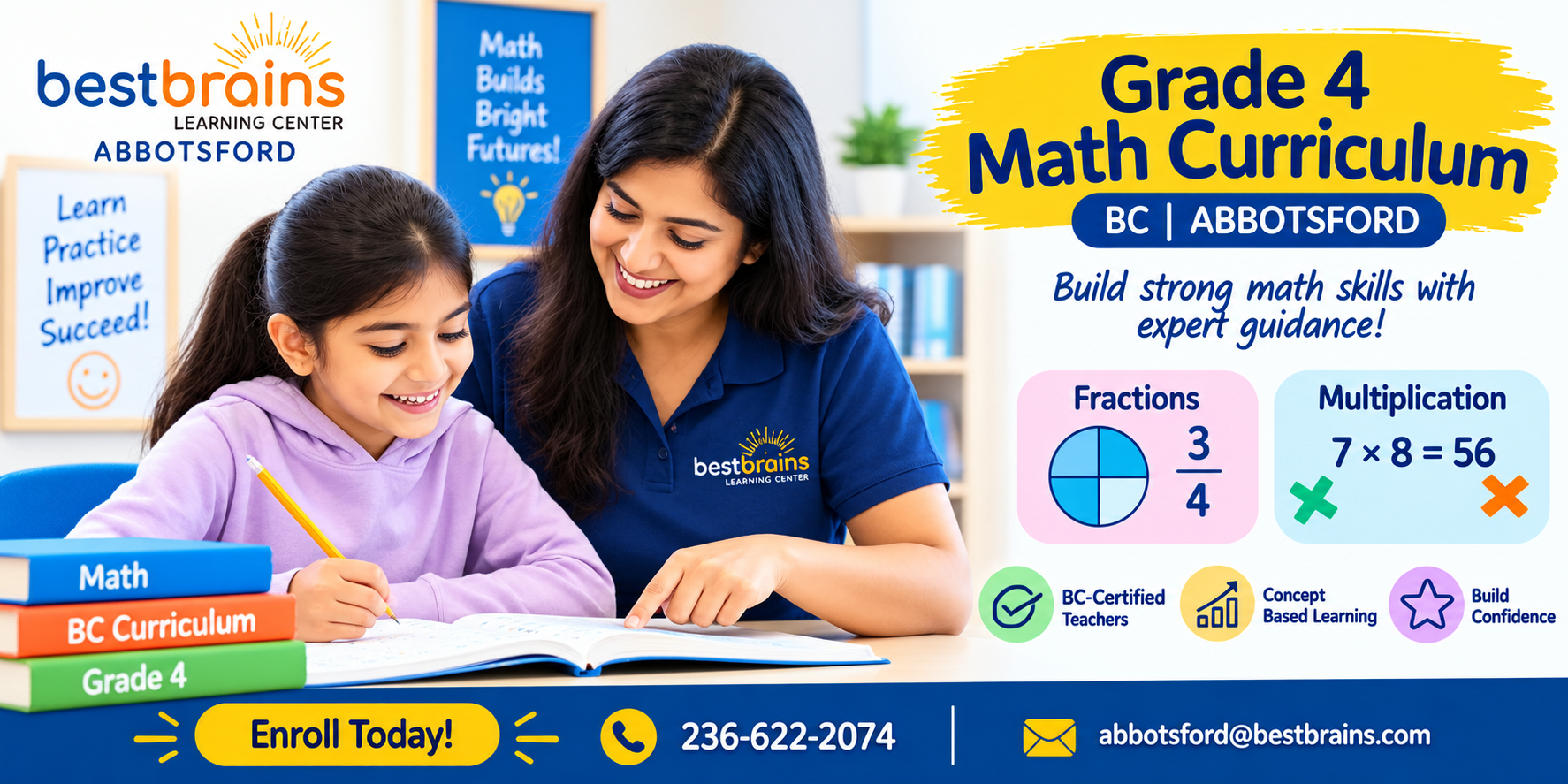
The short answer: In British Columbia, Grade 4 math focuses on five big ideas: fractions and decimals, multiplication and division, patterns and equations, shapes and perimeter, and probability. By the end of the year, students are expected to work with numbers up to 10,000, multiply two- and three-digit numbers by one-digit numbers, and understand decimals to hundredths. This is set by the BC Ministry of Education and followed by the Abbotsford School District.
If your child is in Grade 4 in Abbotsford, this guide explains what they're learning, why it matters, and how you can support them at home.
Grade 4 Math at a Glance
- Grade level: Grade 4 (ages 9 to 10)
- Set by: BC Ministry of Education (redesigned BC curriculum)
- Big ideas: fractions and decimals; multiplication and division; patterns; polygons; data and probability
- Number range: whole numbers to 10,000
- Decimals: to hundredths
- Multiplication and division: two- and three-digit numbers by one-digit numbers
- Province-wide assessment: the Foundation Skills Assessment (FSA), written in Grade 4 and Grade 7
What Do Grade 4 Students Learn in Math in BC?
1. Numbers to 10,000
Students compare, order, and estimate numbers up to 10,000. They also learn how place value works in the thousands, hundreds, tens, and ones.
2. Addition and subtraction to 10,000
Children learn flexible strategies, such as breaking numbers apart, using "friendly" numbers, and regrouping. They also learn to estimate sums and differences before calculating. They still build quick recall of addition and subtraction facts to 20.
3. Multiplication and division
Students multiply and divide two- and three-digit numbers by one-digit numbers. They learn how multiplication connects to repeated addition and division connects to repeated subtraction. Surprisingly, the curriculum doesn't expect memorizing every times table in Grade 4. Students are expected to recall the 2s, 5s, and 10s by the end of the year, and they use patterns and strategies like doubling and halving to work out the rest.
4. Fractions and decimals
This is where Grade 4 becomes a turning point. Students learn that fractions and decimals both describe parts of a whole. They compare and order fractions with common denominators, estimate using benchmarks like zero, one half, and one whole, and add and subtract decimals to hundredths.
5. Patterns and one-step equations
Students describe increasing and decreasing patterns using tables and charts. They also solve one-step equations with an unknown number, such as ___ + 4 = 15.
6. Telling time
Children read analog and digital clocks, including 12-hour and 24-hour time, and tell time to the nearest minute.
7. Shapes, perimeter, and symmetry
Students sort regular and irregular polygons, measure perimeter, and explore line symmetry using tools like geoboards and pattern blocks.
8. Data, probability, and money
Students read bar graphs and pictographs, run simple probability experiments with spinners and dice, and do money calculations, including making change with amounts up to $100.
How Is Grade 4 Math Taught in BC?
The BC curriculum is built around understanding, not just answers. Students are expected to:
- Explain and justify their thinking ("Prove it!")
- Solve problems in more than one way
- Use concrete materials, drawings, and then numbers and symbols
- Connect math to real life, local community, and place
That's why your child's homework may look different from what you remember. Strategies like number talks and decomposing numbers are intentional. They build the flexible number sense that later supports algebra.
Why Grade 4 Matters
Grade 4 sets up the math your child will use through Grades 5 to 7. Multiplication fluency feeds into fractions, decimals, and division. A child who is shaky on place value or fractions now can find Grade 5 and 6 much harder.
It's also the year Grade 4 students take the provincial Foundation Skills Assessment, which looks at numeracy and literacy. Strong everyday math habits are the best preparation.
How to Support Grade 4 Math at Home
- Use real life. Double a recipe, split a pizza into fractions, compare prices, or work out change at the checkout.
- Practice little and often. Ten focused minutes a few times a week works better than one long weekend session.
- Ask "how do you know?" Explaining their thinking is part of the curriculum, and it builds confidence.
- Play games. Dice, cards, and board games build mental math without feeling like homework.
- Keep it positive. Many adults say "I'm not a math person." Children pick up on that attitude.
A Note for Abbotsford Families
Abbotsford is home to many families who learned math in another country or another school system. If your child's methods look unfamiliar, that's normal, and you don't need to teach it "your way" to help. Ask your child to show you how they solved the problem, and check in with their classroom teacher about what's being covered. The Abbotsford School District and the BC Ministry of Education both publish curriculum information for parents.
How Best Brains Abbotsford Supports Grade 4 Math
Best Brains Learning Center Abbotsford is a children's academic enrichment centre serving families across the Fraser Valley. For Grade 4 students, we focus on building the foundations the BC curriculum depends on: number sense, multiplication fluency, and fractions and decimals.
What makes our approach different:
- BC-certified teachers only, so your child is taught by qualified educators
- The same certified teacher every class, so your child is known and supported
- A structured, non-repetitive curriculum that moves forward instead of repeating the same worksheets
- A free placement assessment, so we start where your child actually is
- Free 24/7 online academic support when questions come up between classes
We also offer Math, English, Abacus, and Coding, so families can build a well-rounded plan for their child. Plans start at $169 per month.
Grade 4 Math FAQ
What math do Grade 4 students learn in BC?
Grade 4 students learn numbers to 10,000, multiplication and division of two- and three-digit numbers by one-digit numbers, fractions, decimals to hundredths, patterns, one-step equations, telling time, perimeter, probability, and financial literacy.
Do Grade 4 students need to memorize times tables in BC?
Not all of them. The BC curriculum expects students to recall the 2s, 5s, and 10s by the end of Grade 4. They use patterns and strategies to work out other multiplication facts.
Does Grade 4 math in BC include area?
No. Grade 4 covers perimeter of regular and irregular shapes. Area is introduced in later grades.
What is the Foundation Skills Assessment?
The FSA is a provincial assessment of numeracy and literacy skills written by Grade 4 and Grade 7 students in BC.
How can I help my child with Grade 4 math at home?
Use everyday situations like cooking, shopping, and games. Practice in short, regular sessions. Ask your child to explain their thinking.
When should I consider extra math support in Abbotsford?
If your child avoids math, struggles with multiplication or fractions, or is falling behind classmates, extra support can help before gaps grow. A free placement assessment shows where your child is.
Book a Free Placement Assessment
Not sure where your child stands in Grade 4 math? Book a free placement assessment at Best Brains Learning Center Abbotsford, 3720 Townline Rd, Unit 230, Abbotsford, BC.
Source: BC Ministry of Education, Mathematics Grade 4 curriculum (curriculum.gov.bc.ca/curriculum/mathematics/4/core)