Abbotsford
BC Grade 5 Math Curriculum: Complete Parent Guide
BC Grade 5 Math Curriculum: Complete Parent Guide
The short answer: In BC, Grade 5 math focuses on numbers up to 1,000,000, decimals to thousandths, equivalent fractions, multiplication and division with up to three digits (including remainders), area and perimeter, one-step equations with variables, and double bar graphs. Students are also expected to explain their thinking, not just find answers. Grade 5 is a bridge year: the fraction, decimal, and multiplication skills built here support the ratios, percents, and algebra that follow in Grades 6 to 8.
If your child is in Grade 5 at an Abbotsford school, this guide explains what they’re expected to learn, how it’s assessed, and how you can help at home. Abbotsford schools follow the provincial BC curriculum set by the Ministry of Education and Child Care.
Grade 5 math at a glance
| Strand | What your child learns |
|---|---|
| Number | Numbers to 1,000,000; decimals to thousandths; equivalent fractions; whole-number, fraction, and decimal benchmarks |
| Computational fluency | Add and subtract whole numbers to 1,000,000 and decimals to thousandths; multiply and divide up to three digits, including remainders; addition and subtraction facts to 20 (extending fluency); multiplication and division facts to 100 (emerging fluency) |
| Patterning | One-step equations with variables; rules for increasing and decreasing patterns using words, numbers, symbols, and variables |
| Geometry and measurement | Area of squares and rectangles; relationship between area and perimeter; duration of time; classifying prisms and pyramids; single transformations |
| Data and probability | Double bar graphs; probability experiments with single events |
| Financial literacy | Making change with amounts to $1,000; simple financial plans |
The Big Ideas behind Grade 5 math
BC’s curriculum organizes learning around Big Ideas, the “why” behind the skills. For Grade 5, they include:
- Numbers can be represented by equivalent fractions. Fractions that look different can describe the same amount.
- Computational fluency extends to larger numbers. The strategies your child learned for small numbers now apply to multi-digit numbers.
- Number patterns can be expressed in tables. Patterns follow rules that can be described and extended.
- Closed shapes have area and perimeter that can be measured and compared.
- Data in graphs can show many-to-one correspondence. One symbol or bar can represent several items.
What Grade 5 looks like in practice
Fractions and decimals
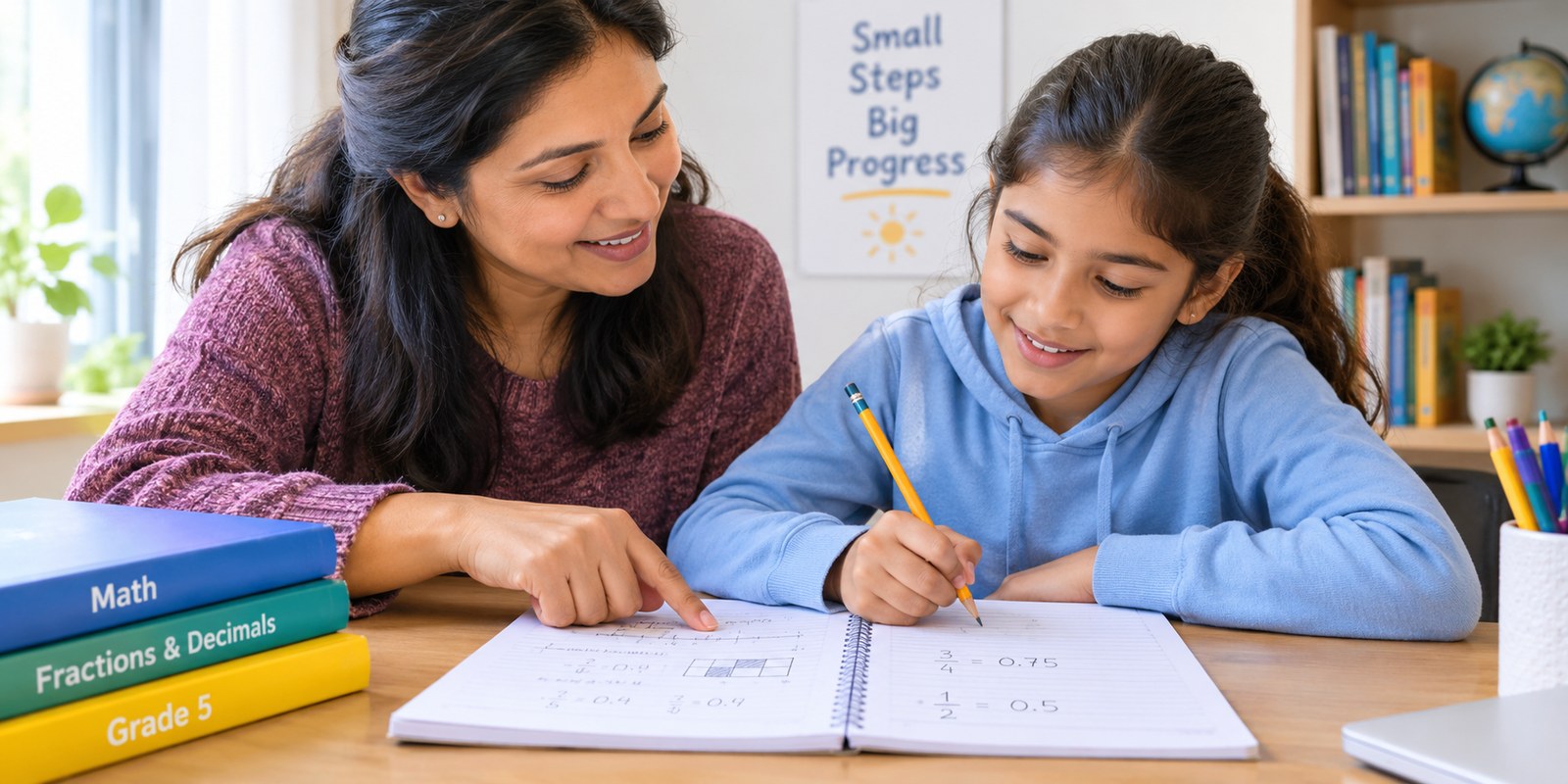
Equivalent fractions are a major focus. Your child should see that 2/3 and 4/6 describe the same amount, and use benchmarks (like 0, 1/2, and 1) to compare and order fractions and decimals. Decimals now extend to thousandths, so 0.375 is a number with a place value for every digit, and students add and subtract decimals to thousandths.
Multiplication and division
Students multiply and divide up to three digits and work with remainders. For example, 157 ÷ 4 is 39 remainder 1. Fact fluency is described as emerging in Grade 5, so students are still building recall of multiplication and division facts to 100. Addition and subtraction facts to 20 should now be solid.
Patterns and early algebra
Students write rules for patterns using words, numbers, symbols, and variables, and solve one-step equations such as n + 8 = 20. This is the first formal step toward algebra.
Area and perimeter
Students find the area of squares and rectangles and explore how area and perimeter relate. A key insight: shapes with the same perimeter can have different areas. A 3 × 7 rectangle and a 5 × 5 square both have a perimeter of 20, but their areas are 21 and 25.
Geometry, data, and money
Students classify prisms and pyramids, explore single transformations (slides, flips, and turns), read and create double bar graphs, and run simple probability experiments. In financial literacy, they make change for amounts up to $1,000 and begin building simple financial plans.
How Grade 5 math is taught: it’s not just answers
BC’s curriculum pairs content with Curricular Competencies, the “doing” side of math. Students are expected to reason and analyze, understand and solve problems, communicate and represent their thinking, and connect and reflect. That’s why your child may be asked to draw a model, explain a strategy, or show more than one way to solve a problem.
A note for families who learned math in another country: the methods your child brings home (number lines, area models, “friendly numbers”) may look different from how you learned. Both approaches work. Ask your child to show you how their method works and why. That conversation helps their understanding.
How Grade 5 math is reported
Report cards for Grades K to 9 in BC use a four-point proficiency scale: Emerging, Developing, Proficient, and Extending. Proficient is the goal for students, and Emerging and Developing aren’t failing grades. They show where learning is still growing. Teachers also add written comments on strengths, areas to improve, and how families can help.
Getting ready for Grade 6
Grade 6 builds directly on Grade 5. Students move into factors and multiples (greatest common factor and least common multiple), improper fractions and mixed numbers, an introduction to ratios, whole-number percents, order of operations, and multiplication and division of decimals. The skills to lock in during Grade 5:
- Multiplication and division facts. These carry into fractions, ratios, and percents.
- Equivalent fractions. Everything in Grade 6 fractions depends on them.
- Decimal place value. Operations with decimals only work if the place value is secure.
- Explaining a solution. Written and spoken reasoning becomes more important every year.
Signs your Grade 5 child may need extra support
- Still counting on fingers or using slow methods for basic facts
- Confusing fraction size (for example, thinking 1/8 is larger than 1/4)
- Struggling to line up decimals when adding or subtracting
- Mixing up area and perimeter
- Getting right answers but being unable to explain them
- Avoiding math homework or saying “I’m just bad at math”
Early support in Grade 5 is far easier than catching up in Grade 7.
5 ways to practice at home in 10 minutes
- Fraction pizza talk. Ask which is bigger, 2/3 or 3/5, and have your child draw it.
- Fact warm-ups. Practice a few multiplication facts at dinner or in the car, rather than one long session.
- Real-life decimals. Compare prices at the grocery store and add them up.
- Backyard area. Measure a room or garden bed and calculate area and perimeter.
- Change challenge. Pay with a $20 bill and have your child work out the change.
How Best Brains Abbotsford supports Grade 5 math
At Best Brains Learning Center Abbotsford (3720 Townline Rd, Unit 230), we help children ages 3 to 14 build math and English foundations, with Abacus and Coding also available.
- BC-certified teachers only, with the same certified teacher every class
- A structured, non-repetitive curriculum that builds skills step by step
- A free placement assessment to see which skills are solid and which need attention
- Free 24/7 online academic support between classes
Many families also choose Abacus to build mental math and number sense alongside school math.
Frequently asked questions
What do kids learn in Grade 5 math in BC?
Numbers to 1,000,000, decimals to thousandths, equivalent fractions, multiplication and division up to three digits with remainders, area and perimeter, one-step equations with variables, double bar graphs, single-event probability, and making change up to $1,000.
Do Grade 5 students in BC learn algebra?
They learn the beginnings of it: one-step equations with variables and pattern rules written with symbols and variables.
Should my Grade 5 child know their times tables?
Multiplication and division facts to 100 are described as emerging fluency in Grade 5, developing in Grade 6, and extending in Grade 7. Regular, short practice works better than cramming.
What do Emerging, Developing, Proficient, and Extending mean?
They are the four levels on BC report cards for Grades K to 9. Proficient is the goal, and Emerging and Developing mean learning is still growing.
Is the Grade 5 curriculum the same in Abbotsford as the rest of BC?
Yes. Abbotsford schools teach the provincial BC curriculum. Teaching methods and pacing can vary by school and teacher.
How can I tell if my Grade 5 child is behind in math?
Compare their skills with the grade-level list above, review their report card and teacher comments, and ask the teacher where they’d like to see growth. A free placement assessment provides a skill-by-skill picture.
What math comes after Grade 5?
Grade 6 introduces factors and multiples, mixed numbers, ratios, whole-number percents, and order of operations.
Wondering where your Grade 5 child stands?
Book a free placement assessment at Best Brains Learning Center Abbotsford. You’ll get a clear picture of your child’s strengths and gaps, and a plan for next steps with no pressure.
SOURCES (citation links)
- BC Ministry of Education and Child Care, Math K–9 Content (grade-by-grade content): https://curriculum.gov.bc.ca/sites/curriculum.gov.bc.ca/files/curriculum/continuous-views/en_math_k-9_content.pdf
- BC Curriculum, Mathematics: https://curriculum.gov.bc.ca/curriculum/mathematics
- BC Curriculum, Introduction to Mathematics (Big Ideas, Curricular Competencies, Content): https://curriculum.gov.bc.ca/curriculum/mathematics/introduction
- BC Curriculum, Explore Curriculum (Grade 5 Big Ideas): https://curriculum.gov.bc.ca/curriculum/search?page=784
- BC Ministry, K–12 Student Reporting Policy presentation (proficiency scale): https://www2.gov.bc.ca/assets/gov/education/administration/kindergarten-to-grade-12/k-12-student-reporting-policy-presentation.pdf
- BC Government news release on K–9 proficiency scale reporting: https://news.gov.bc.ca/releases/2023ECC0051-000985
- School District 41, Redesigned Math Curriculum (Know-Do-Understand and competencies): https://blogs.sd41.bc.ca/alpha-math/?p=124