Abbotsford
BC Grade 3 Math Curriculum: Skills Your Child Should Master
By the end of Grade 3, BC students should be able to add and subtract multi-digit numbers with regrouping, know their multiplication and division facts up to 10, understand place value into the thousands, and compare simple fractions. Grade 3 is the year math shifts from concrete counting toward fact fluency and multi-step problem solving, which is why it's often considered a pivotal year — the habits and fluency built here carry directly into Grade 4 and beyond.
The BC Grade 3 Math Curriculum, Broken Down
The BC Ministry of Education's Grade 3 numeracy curriculum builds directly on Grade 2 foundations. Here's what falls into each core strand:
1. Number Sense (Numbers to 1,000)
- Reading, writing, and comparing numbers up to 1,000
- Understanding place value: hundreds, tens, and ones
- Rounding numbers to the nearest 10 or 100
- Skip counting by 3s, 4s, and other intervals beyond Grade 2
2. Addition and Subtraction
- Adding and subtracting multi-digit numbers (up to 3 digits) with regrouping
- Solving multi-step word problems involving addition and subtraction
- Estimating sums and differences before calculating
3. Multiplication and Division
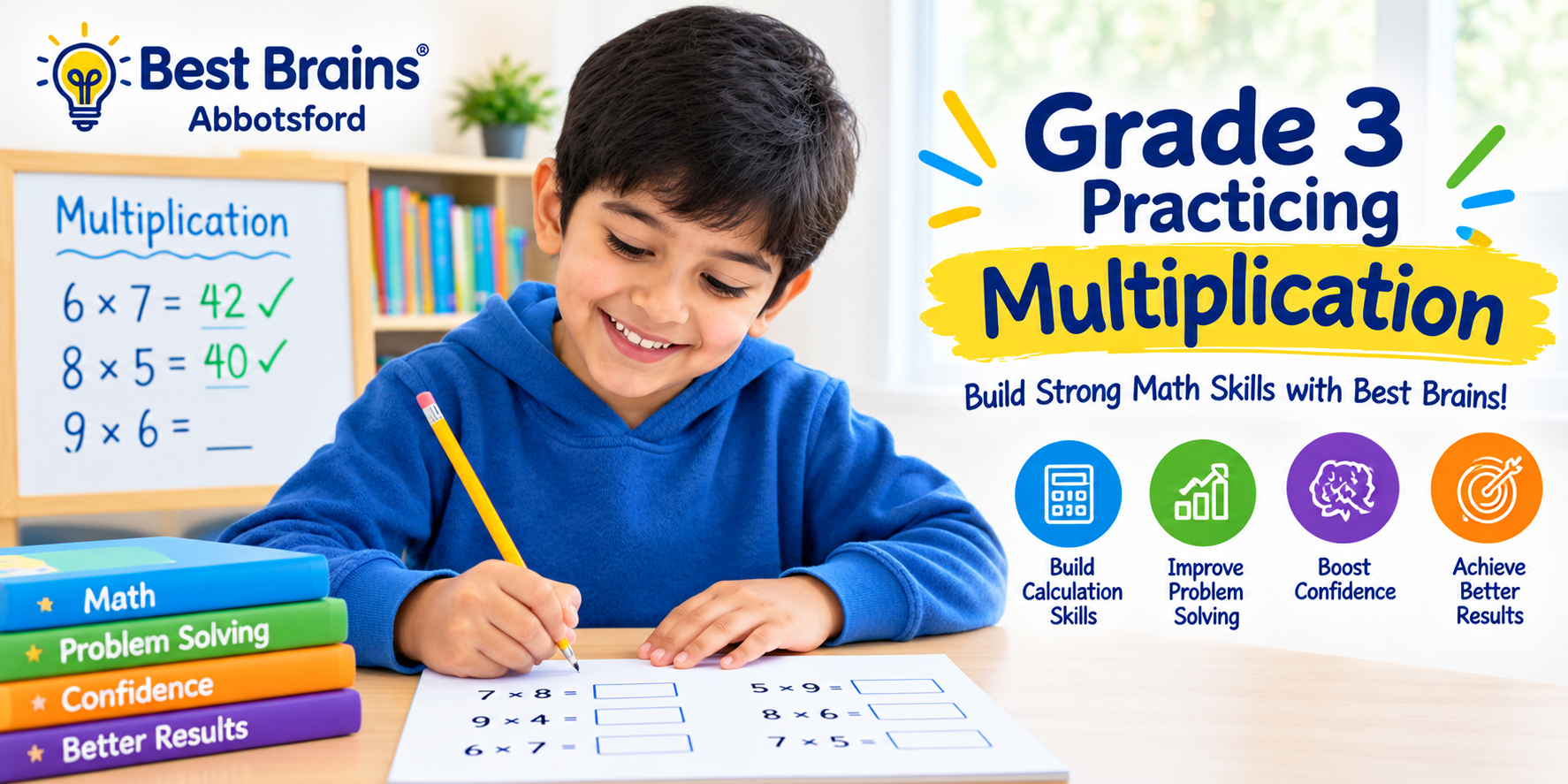
- Memorizing multiplication facts up to 10 x 10
- Understanding division as the inverse of multiplication
- Solving simple division problems, including those with remainders
- Applying multiplication and division to solve word problems
4. Fractions
- Understanding and naming fractions beyond halves, thirds, and fourths (fifths, sixths, eighths)
- Comparing fractions with the same denominator
- Recognizing equivalent fractions in simple cases (1/2 = 2/4)
- Understanding fractions as part of a whole and part of a group
5. Measurement
- Telling time to the nearest minute
- Measuring length, mass, and capacity using standard units (cm, m, g, kg, mL, L)
- Calculating simple perimeter of shapes
- Counting and making change with Canadian money
6. Geometry
- Identifying and describing properties of 2D shapes (sides, corners, angles)
- Classifying 3D objects by their properties (faces, edges, vertices)
- Recognizing lines of symmetry
7. Data and Probability
- Collecting and organizing data using tally charts, pictographs, and bar graphs
- Interpreting data to answer questions and draw simple conclusions
- Describing and predicting the likelihood of events using probability language
8. Patterns and Algebraic Thinking
- Identifying, extending, and describing more complex numeric and geometric patterns
- Solving simple equations with a missing number (e.g., 7 + ☐ = 12)
Signs Your Child Might Be Behind
Grade 3 math relies heavily on fluency built in earlier grades, so gaps tend to show up more visibly here. Watch for:
- Still counting on fingers for basic addition or subtraction facts
- Not yet knowing multiplication facts that classmates have memorized
- Confusing place value when working with 3-digit numbers
- Difficulty solving word problems even when the calculation itself is simple
- Guessing rather than reasoning through fraction comparisons
If two or three of these show up together, it's usually a sign that an earlier skill — not just the current unit — needs reinforcement before the gap widens further.
How Best Brains Abbotsford Supports Grade 3 Math
Best Brains Abbotsford's Math program is built to align with what BC classrooms are actually teaching at each grade level, reinforcing skills rather than duplicating them. The program includes:
- A free placement assessment to pinpoint exactly which Grade 3 skills need reinforcing, including gaps carried over from earlier grades
- Instruction from a BC-certified teacher, every class
- The same certified teacher for every session, so progress is tracked consistently rather than restarting with someone new each time
- A structured, non-repetitive curriculum that builds skill by skill instead of recycling the same worksheets
- Free 24/7 online academic support for homework questions between sessions
Math tutoring starts at $169/month, with multi-subject options available across Math, English, Abacus, and Coding.
The Bottom Line
Grade 3 is where math fact fluency becomes the foundation for everything else — multi-digit arithmetic, fractions, and multi-step problem solving all depend on it. A quick check against the list above is often enough for Abbotsford parents to see where their child stands, and a free placement assessment can confirm exactly where to focus.
FAQ: BC Grade 3 Math Curriculum
What math skills should a Grade 3 student in BC know? By the end of Grade 3, students should add and subtract multi-digit numbers with regrouping, know multiplication and division facts up to 10, understand place value to 1,000, and compare simple fractions.
When should multiplication facts be memorized in BC schools? Grade 3 is when multiplication and division facts up to 10 x 10 are expected to become fluent, building on the conceptual introduction to multiplication in Grade 2.
What if my child still struggles with basic addition facts in Grade 3? This is a sign that Grade 1–2 fact fluency needs reinforcement, since Grade 3 skills like regrouping and multi-step word problems all rely on quick, automatic recall of basic facts.
How can I tell if my child needs extra math support in Grade 3? Look for a combination of signs — finger-counting for basic facts, unfamiliarity with multiplication facts classmates already know, place value confusion, or difficulty with word problems. A free placement assessment can confirm exactly where the gaps are.
What subjects does Best Brains Abbotsford offer? Math, English, Abacus, and Coding, taught by BC-certified teachers, starting at $169/month.