Abbotsford
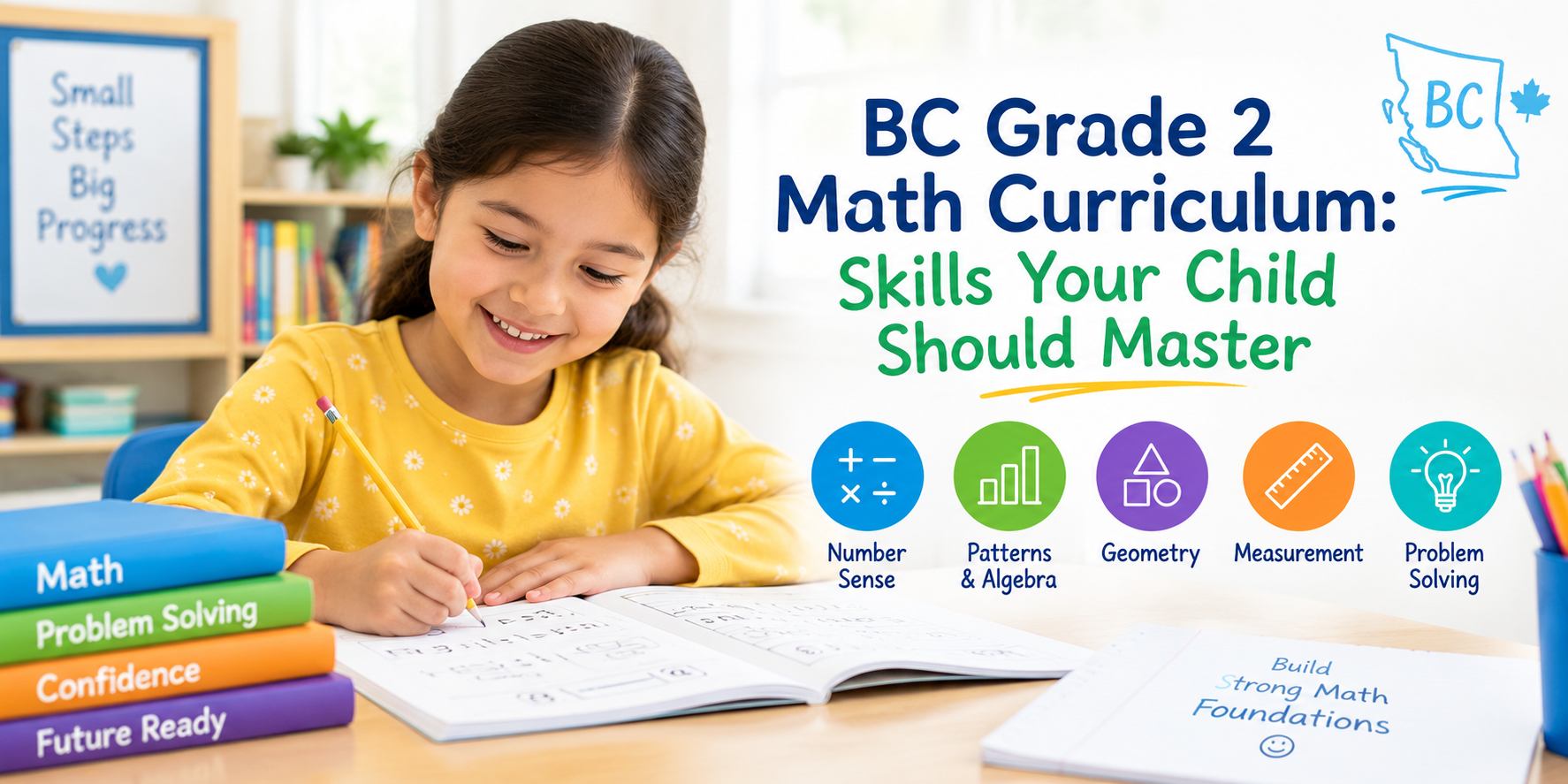
BC Grade 2 Math Curriculum: Skills Your Child Should Master
By the end of Grade 2, BC students should be able to add and subtract fluently within 20, understand place value up to 100, skip count by 2s, 5s, and 10s, recognize simple fractions, tell time to the half hour, and read basic graphs. These skills form the foundation for every math unit that follows in Grade 3, which is why gaps at this stage tend to compound quickly if they go unnoticed.
The BC Grade 2 Math Curriculum, Broken Down
The BC Ministry of Education's curriculum for Grade 2 numeracy is organized around a few core strands. Here's what falls into each one:
1. Number Sense (Numbers to 100)
- Counting forward and backward from any number up to 100
- Comparing and ordering numbers using greater than, less than, and equal to
- Understanding place value: tens and ones
- Skip counting by 2s, 5s, and 10s
2. Addition and Subtraction
- Adding and subtracting fluently within 20 (mental math, not just counting on fingers)
- Solving two-digit addition and subtraction problems, with and without regrouping
- Understanding addition and subtraction as inverse operations
- Solving simple word problems involving addition and subtraction
3. Early Multiplication and Division Concepts
- Understanding multiplication as repeated addition (introductory level)
- Sharing objects equally as an early division concept
4. Fractions
- Recognizing and naming halves, thirds, and fourths
- Understanding that a fraction represents equal parts of a whole
5. Measurement
- Measuring length using non-standard units (paper clips, blocks) and standard units (cm)
- Comparing the length, mass, and capacity of objects
- Telling time to the hour and half hour on an analog clock
- Identifying and counting Canadian coins and simple money amounts
6. Geometry
- Identifying and describing 2D shapes and 3D objects
- Recognizing symmetry in simple shapes
7. Data and Probability
- Collecting, organizing, and interpreting data using pictographs and simple bar graphs
- Describing likelihood using basic probability language (likely, unlikely, certain)
8. Patterns and Algebraic Thinking
- Identifying, extending, and creating repeating and growing patterns
- Understanding equality in simple number sentences (e.g., 4 + 3 = 5 + 2)
Signs Your Child Might Be Behind
Not every child moves through these skills at the same pace, but a few signs are worth paying attention to partway through the year:
- Still relying on fingers to add or subtract within 20 well into the school year
- Confusing tens and ones when reading or writing two-digit numbers
- Struggling to tell time to the half hour
- Difficulty reading a simple bar graph or pictograph
- Guessing at fraction questions rather than reasoning through them
None of these are cause for alarm on their own — but if two or three show up together, it's worth a closer look before the gap carries into Grade 3, where these same skills are extended rather than retaught.
How Best Brains Abbotsford Supports Grade 2 Math
Best Brains Abbotsford's Math program is built to align with what BC classrooms are actually teaching at each grade level, so students reinforce — rather than duplicate — what they're learning in school. The program includes:
- A free placement assessment to pinpoint exactly which Grade 2 skills need reinforcing, rather than assuming a child needs to start from the beginning
- Instruction from a BC-certified teacher, every class
- The same certified teacher for every session, so progress is tracked consistently rather than restarting with a new instructor each time
- A structured, non-repetitive curriculum that builds skill by skill instead of recycling the same worksheets
- Free 24/7 online academic support for homework questions between sessions
Math tutoring starts at $169/month, with multi-subject options available across Math, English, Abacus, and Coding.
The Bottom Line
Grade 2 math looks simple on the surface, but it's where number sense, fluency, and early problem-solving habits get set for years to come. A quick check against the list above is often enough for Abbotsford parents to tell whether their child is on track — and if not, a free placement assessment is the fastest way to find out exactly where to start.
FAQ: BC Grade 2 Math Curriculum
What math skills should a Grade 2 student in BC know? By the end of Grade 2, students should be able to add and subtract fluently within 20, understand place value to 100, skip count by 2s, 5s, and 10s, recognize simple fractions, tell time to the half hour, and interpret basic graphs.
What if my child still counts on their fingers in Grade 2? Occasional finger-counting isn't unusual early in the year, but if it persists for addition and subtraction within 20 later in the year, it's typically a sign that number fluency needs reinforcement.
Does the BC curriculum teach multiplication in Grade 2? Grade 2 introduces multiplication conceptually, as repeated addition and equal sharing, rather than requiring memorized multiplication facts, which come in Grade 3 and beyond.
How can I tell if my child needs extra math support? Look for a combination of warning signs — reliance on finger-counting, confusion with place value, difficulty telling time, or trouble reading a simple graph. A free placement assessment can confirm exactly where the gaps are.
What subjects does Best Brains Abbotsford offer? Math, English, Abacus, and Coding, taught by BC-certified teachers, starting at $169/month.