Abbotsford
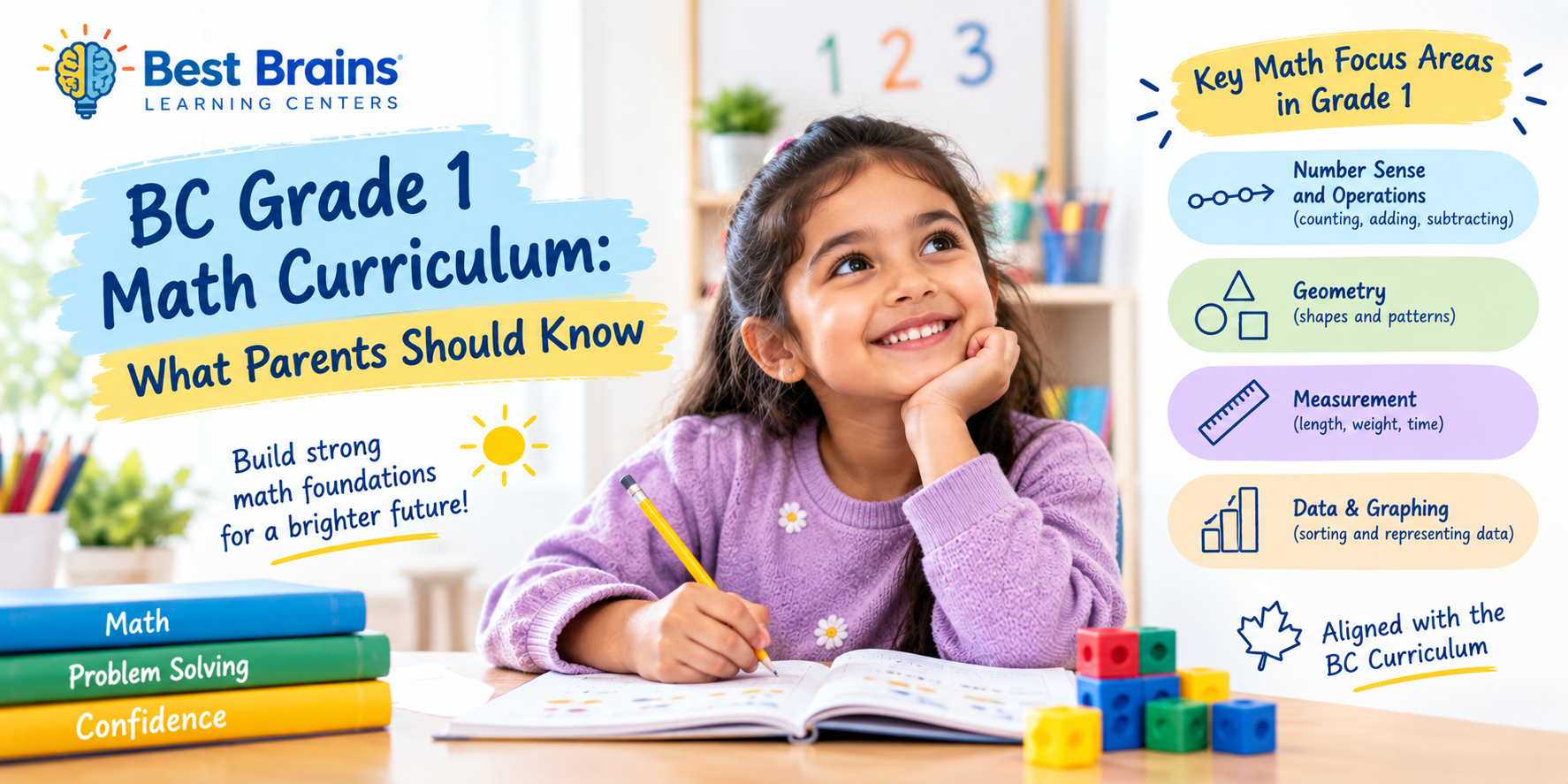
BC Grade 1 Math Curriculum: What Parents Should Know
In short: BC's Grade 1 Math curriculum builds number sense to 20, introduces addition and subtraction, repeating patterns, basic measurement and shape comparison, simple graphing, and financial literacy — all through hands-on, concrete learning rather than worksheets and drills. There's no province-wide test in Grade 1, so the clearest signal of how your child is doing comes from classroom observation, report card comments, and how confidently they handle numbers at home.
If you're an Abbotsford parent trying to figure out what Grade 1 math actually covers — and whether your child is on track — this guide breaks down the BC Ministry of Education's curriculum in plain language, with practical ways to support learning at home.
The Big Picture: How BC Structures Math Learning
BC's curriculum doesn't just hand teachers a list of topics. It's built around three layers that work together:
- Big Ideas — the deep, lasting understandings a child should walk away with (e.g., "number represents and describes quantity")
- Content — the specific topics and skills covered (e.g., counting to 20, addition to 20)
- Curricular Competencies — the doing of math: reasoning, problem-solving, communicating, and reflecting
This "Know-Do-Understand" model means Grade 1 math isn't just about getting the right answer — it's about a child being able to explain how they got there, using objects, drawings, or words. This is a deliberate shift from older, drill-based approaches, and it's one reason Grade 1 math can look different from how many parents remember learning it.
What Grade 1 Students Are Expected to Learn
Number Sense to 20
This is the anchor of the whole year. Students learn to:
- Count on and count back
- Skip-count by 2s and 5s
- Sequence, compare, and order numbers to 20
- Recognize quantities instantly without counting one-by-one (subitizing)
- Understand numbers to 20 as groups of 10s and 1s (an early foundation for place value)
A big milestone here is "making 10" — understanding all the ways numbers can combine to form 10 (like 4 and 6, or 7 and 3). This becomes the mental shortcut kids lean on for years of future math.
Addition and Subtraction to 20
Students explore addition and subtraction using concrete objects, pictures, and symbols — building toward strategies like counting on, using doubles, and making 10. They also start learning what the equals sign (=) and "not equal to" sign (≠) actually mean, which sounds simple but is a common sticking point if skipped over too quickly.
Patterns
Grade 1 students identify and extend repeating patterns with multiple elements and attributes (think: colour, shape, and size combined), and start noticing numerical patterns, like what happens when counting by 2s on a hundred chart.
Measurement and Shapes
Rather than rulers, Grade 1 measurement uses non-standard units — cubes, paper clips, hand spans — to build the concept of measuring before the tool. Students also compare and sort 2D shapes and 3D objects and describe position using words like "up," "down," "in," and "out."
Data and Probability
Students create and interpret simple concrete graphs and begin using probability language like never, sometimes, always, more likely, and less likely to describe everyday events.
Financial Literacy
A part of the curriculum parents often don't expect: Grade 1 students learn to identify Canadian coins (nickels, dimes, quarters, loonies, toonies) and start role-playing simple transactions — an early, practical introduction to money.
The "Doing" Side: Curricular Competencies
Beyond content, BC expects Grade 1 students to build skills in four areas:
- Reasoning and analyzing — estimating, developing mental math strategies, using tools like manipulatives
- Understanding and solving — using play, drawing, and multiple strategies to solve problems
- Communicating and representing — explaining their thinking out loud, pictorially, or symbolically, and using math vocabulary
- Connecting and reflecting — linking math to daily life and reflecting on their own strategies
This is why a Grade 1 report card comment might read something like "explains her thinking using pictures" rather than just "gets addition facts correct." Both matter, but BC is explicitly assessing the reasoning, not just the result.
How Grade 1 Math Is Assessed in BC
There is no provincial standardized test in Grade 1 (the first one, the Foundation Skills Assessment, happens in Grade 4). Instead, teachers assess ongoing classroom work and report using BC's proficiency scale — typically described to parents as Emerging, Developing, Proficient, and Extending — rather than percentage grades. For Abbotsford families, Abbotsford School District (SD34) teachers communicate this through regular report cards and parent-teacher conferences, so those conversations are often the most concrete window into how a child is progressing.
Signs Your Grade 1 Child May Need Extra Support
- Still relies on counting one-by-one for numbers under 10 well into the year
- Struggles to recognize numbers to 20 without counting from 1 each time
- Can't explain how they solved a simple addition or subtraction problem, even with objects to help
- Has difficulty completing or extending a simple pattern
- Shows anxiety or resistance around math tasks that peers seem comfortable with
None of these on their own are cause for alarm — Grade 1 has a wide range of "normal." But a pattern of several together, especially combined with teacher feedback, is worth acting on early rather than waiting to see if it resolves itself.
How Parents Can Support Grade 1 Math at Home
- Make numbers physical. Count stairs, snack pieces, or toy cars. Concrete objects build the same number sense BC's curriculum is built around.
- Talk through "how," not just "what." Instead of "what's the answer?" ask "how did you figure that out?"
- Practice making 10 with everyday objects — this single skill pays off for years.
- Use real coins. Let your child sort and count real Canadian coins during errands or at home.
- Look for patterns everywhere — in clothing, music, or even the walk to school.
Frequently Asked Questions
Does BC Grade 1 math use timed tests or worksheets? Not primarily. BC's curriculum emphasizes concrete, hands-on learning and verbal explanation over speed-based drills, though individual teachers may use some practice sheets alongside hands-on activities.
What math should my child know before starting Grade 1? Comfort counting to 10–20, recognizing numbers, and basic shape/pattern awareness from Kindergarten are helpful starting points, though BC's curriculum is designed to build these skills further regardless of starting point.
Is my child behind if they can't do addition yet at the start of Grade 1? No. Addition and subtraction to 20 is a full-year learning target, built up gradually through concrete strategies — it isn't expected as a day-one skill.
How is BC's approach different from a more traditional math curriculum? BC places heavy emphasis on students explaining their reasoning (Curricular Competencies) alongside learning content, rather than focusing mainly on correct answers.
What's the best way to know if my child is on track? Report card comments using BC's proficiency scale (Emerging, Developing, Proficient, Extending), combined with direct conversations with your child's teacher, are the most reliable indicators.
Where Best Brains Abbotsford Fits In
For Abbotsford parents who want extra reassurance — or a bit more structure than the classroom alone provides — Best Brains Learning Center Abbotsford offers a free placement assessment to pinpoint exactly where your child stands against BC's Grade 1 benchmarks, followed by a structured, non-repetitive math program taught by BC-certified teachers, with the same teacher every class for consistency. Programs also include free 24/7 online academic support for questions that come up outside class time.
Located at 3720 Townline Rd, Unit 230, Abbotsford, BC, Best Brains works alongside what your child is already learning in the classroom — reinforcing the same number sense, mental math strategies, and reasoning skills BC's curriculum is built around, rather than replacing them with an unrelated approach.
Sources: BC Ministry of Education Curriculum (curriculum.gov.bc.ca), Abbotsford School District 34.