Abbotsford
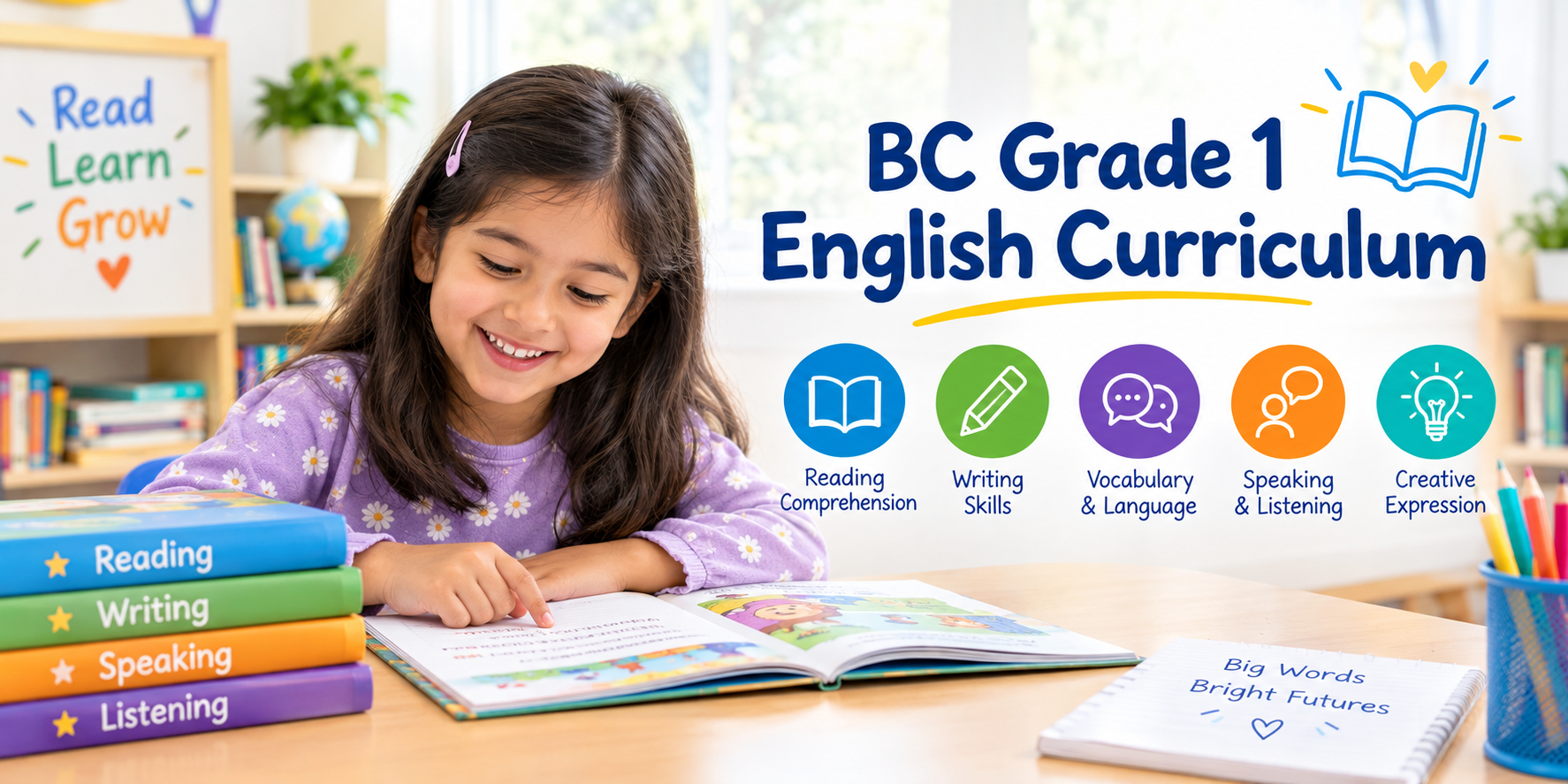
BC Grade 1 English Curriculum: Skills Your Child Should Master
By the end of Grade 1, BC students should be able to read simple decodable books independently, recognize a growing bank of sight words, write simple sentences with a capital letter and period, and retell a story in their own words. These skills are the building blocks for reading fluency and written expression in every grade that follows, which is why Grade 1 is often considered the year reading either "clicks" or needs extra support.
The BC Grade 1 English Curriculum, Broken Down
BC's Grade 1 English Language Arts curriculum centers on a few core strands. Here's what falls into each one:
1. Phonemic Awareness and Phonics
- Blending and segmenting sounds in simple words (e.g., recognizing that "cat" is made of /c/ /a/ /t/)
- Matching letters to their sounds, including common letter combinations (sh, ch, th)
- Decoding simple CVC (consonant-vowel-consonant) words like "sun," "hat," and "pig"
- Recognizing rhyming words and word families (-at, -an, -it)
2. Sight Words and Vocabulary
- Recognizing common high-frequency words by sight (the, said, was, they, come)
- Building vocabulary through read-alouds and classroom discussion
- Using new words in speaking and simple writing
3. Reading Fluency
- Reading simple, decodable texts with increasing accuracy and less sounding-out
- Reading with appropriate pacing, not word-by-word robotic reading
- Self-correcting when a word doesn't make sense in context
4. Reading Comprehension
- Making predictions about what happens next in a story
- Retelling a story's beginning, middle, and end in the right order
- Answering simple who, what, where, and why questions about a text
- Connecting a story to their own experiences
5. Writing
- Writing simple sentences with a capital letter at the start and a period at the end
- Spelling simple words phonetically (sounding words out even if the spelling isn't perfect yet)
- Writing a few connected sentences on a single topic
- Using proper pencil grip and letter formation
6. Oral Language
- Speaking clearly and in complete sentences during class discussion
- Listening to and following multi-step instructions
- Participating in conversations by taking turns and staying on topic
7. Print Concepts
- Understanding that print carries meaning and reads left to right, top to bottom
- Recognizing the difference between a letter, a word, and a sentence
- Understanding the purpose of spaces between words
Signs Your Child Might Be Behind
Reading development varies a lot in Grade 1, but a few signs are worth watching for partway through the year:
- Still struggling to blend simple sounds together (e.g., can name "c," "a," "t" but can't blend them into "cat")
- Guessing at words based on the first letter rather than sounding them out
- Very limited sight word recognition compared to classmates
- Reluctance to write even a single simple sentence independently
- Difficulty retelling a story that was just read aloud to them
As with math, one of these on its own usually isn't a concern — but a cluster of them, especially heading into the second half of the year, is worth addressing early rather than waiting to see if it resolves on its own.
How Best Brains Abbotsford Supports Grade 1 English
Best Brains Abbotsford's English program is designed to reinforce exactly what BC classrooms are teaching at each grade level — phonics, fluency, comprehension, and early writing — rather than a generic one-size-fits-all reading program. It includes:
- A free placement assessment to identify precisely which Grade 1 reading and writing skills need reinforcing
- Instruction from a BC-certified teacher, every class
- The same certified teacher for every session, so a child's progress is tracked consistently rather than restarting with someone new each time
- A structured, non-repetitive curriculum that builds skill by skill instead of recycling the same material
- Free 24/7 online academic support for reading and writing questions between sessions
English tutoring starts at $169/month, with multi-subject options available across Math, English, Abacus, and Coding.
The Bottom Line
Grade 1 is the year foundational reading either takes hold or starts to lag — and because reading underpins nearly every other subject, catching a gap here early has an outsized effect on the years that follow. A quick check against the list above is often enough for Abbotsford parents to gauge where their child stands, and a free placement assessment can confirm exactly where to focus.
FAQ: BC Grade 1 English Curriculum
What reading skills should a Grade 1 student in BC know? By the end of Grade 1, students should be able to blend and decode simple CVC words, recognize common sight words, read simple decodable texts with growing fluency, and retell a story's beginning, middle, and end.
What if my child can't blend sounds together yet? Some children need more time and repetition with phonemic awareness before blending clicks. If it hasn't improved by mid-year, it's usually worth targeted, consistent practice rather than waiting it out.
Does the BC curriculum expect Grade 1 students to write full paragraphs? No. Grade 1 writing expectations focus on simple, complete sentences with correct capitalization and punctuation — full paragraph writing develops in later grades.
How can I tell if my child needs extra reading support? Look for a combination of signs — difficulty blending sounds, limited sight word recognition, guessing at words, or trouble retelling a story. A free placement assessment can confirm exactly where the gaps are.
What subjects does Best Brains Abbotsford offer? Math, English, Abacus, and Coding, taught by BC-certified teachers, starting at $169/month.