Abbotsford
Is Your Child Ready for the Grade They Are Entering? A Back-to-School Readiness Guide for Abbotsford Families — Grades 1 to 8
Jul 30, 2026
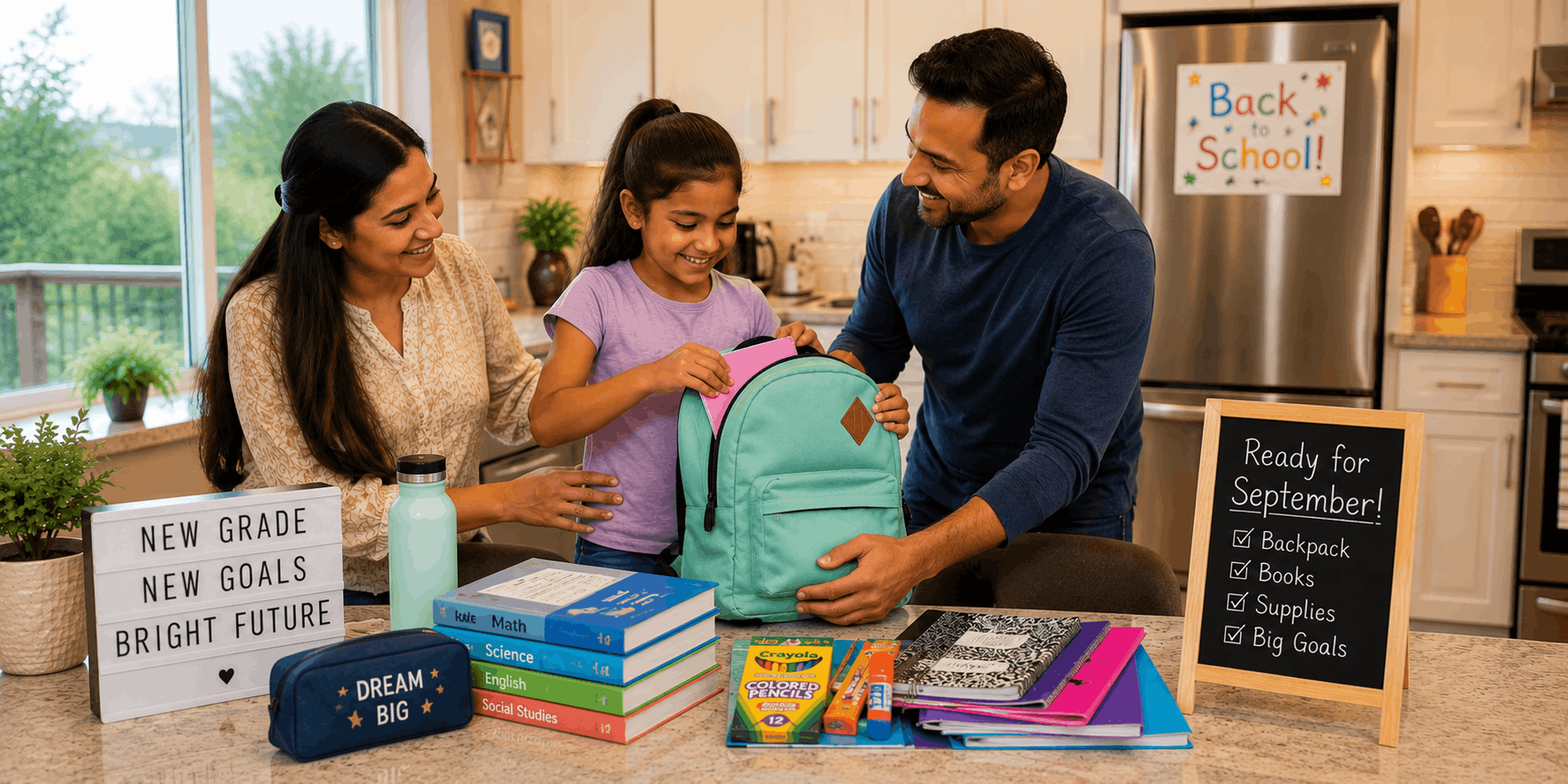
August in Abbotsford has a particular feeling. The days are still long and warm, but something in the air has shifted. School supplies have appeared at the front of every store. Backpacks are being tried on. Uniforms are being labelled.
And somewhere in most parents' minds, a quiet question is forming: is my child actually ready for the grade they are entering?
It is a more important question than it might seem. The BC curriculum moves at pace. Each grade assumes a child has mastered the content of the grade before it. A child who enters September with gaps from the previous year is not starting fresh — they are starting behind, and catching up while simultaneously learning new content is one of the hardest positions a child can be in.
This guide gives you a clear, grade-by-grade picture of what your child should know and be able to do as they enter each grade from 1 to 8. Use it as a conversation starter, not a test. It is not a verdict on your child — it is a planning tool for you.
One important note before you read: BC's report cards now use a proficiency scale across Kindergarten to Grade 9, with descriptors of Emerging, Developing, Proficient, and Extending. A child rated Proficient at the end of a grade is meeting expectations for that grade — but Proficient does not always mean the child has the depth of understanding that the next grade will assume. This guide is designed to help you see beneath the proficiency label.
HOW TO USE THIS GUIDE
For each grade, you will find three things:
What the grade expects — the key academic and developmental skills the BC curriculum assumes entering students have.
What to watch for — the specific signals that suggest a child may be entering the grade with gaps.
What parents can do — practical steps to address the gap before September or in the first weeks of school.
Read the section for the grade your child is entering this September. Then, if anything concerns you, read the note at the end about how Best Brains Abbotsford can help.
ENTERING GRADE 1 Age: typically 6 to 7
What Grade 1 expects
Grade 1 is the first year of formal structured learning in BC. The shift from Kindergarten is real: children are expected to begin developing reading fluency, not just letter recognition, and to engage with numeracy as a sequential, structured subject rather than through play alone.
Children entering Grade 1 should recognise numbers, count objects, and begin simple addition and subtraction. They should know basic sight words, sound out short words, and follow simple stories. They should be able to write their name, copy short sentences, and use both upper and lowercase letters.
Beyond academics, Grade 1 teachers also expect children to follow classroom routines, take turns, express their needs clearly, and attempt tasks independently before asking for help.
What to watch for
A child who cannot yet reliably recognise all letters of the alphabet, who cannot count to 20 without losing track, or who cannot sit and focus on a directed task for at least 10 minutes may find the Grade 1 pace challenging from the first week.
For multilingual and newcomer families in Abbotsford, the language demands of Grade 1 are worth paying particular attention to. A child who is still building English vocabulary will need support not just in reading but in following classroom instructions, which are delivered entirely in English.
What parents can do
Read together for 10 to 15 minutes every day. Ask questions about the story. Practice counting objects around the house. Write letters and simple words together. If your child is multilingual, keep your home language strong — this directly supports their English acquisition, not the reverse.
Best Brains Abbotsford connection: our Baby Genius Pre-K program (ages 3 to 5) and our Grade 1 entry programs build exactly the literacy and numeracy foundations described here. A free placement assessment will show you where your child is — and what they are ready to learn next.
ENTERING GRADE 2 Age: typically 7 to 8
What Grade 2 expects
Children entering Grade 2 should be reading simple chapter books independently, writing sentences with basic punctuation, and adding and subtracting numbers to 100 with confidence. They should understand place value for two-digit numbers and be beginning to recognise multiplication as repeated addition.
Socially, Grade 2 children are expected to work in groups, manage minor conflicts without constant adult intervention, and take increasing responsibility for their own learning materials and routines.
What to watch for
A child who is still reading word by word rather than in phrases, who relies heavily on counting on fingers for single-digit addition, or who has not yet grasped the concept of tens and ones may find Grade 2 moving faster than they are comfortable with.
What parents can do
Practice reading aloud together and ask your child to retell what happened in their own words — this is the comprehension skill Grade 2 builds on. Play math games that involve counting money, measuring ingredients, or keeping score. These build real number sense more effectively than worksheets.
ENTERING GRADE 3 Age: typically 8 to 9
What Grade 3 expects
Grade 3 is where reading truly shifts from learning to read to reading to learn. Children are expected to read longer texts with greater independence, write in complete paragraphs with a clear idea, and engage with multiplication and division as core concepts — not just as introduction topics.
Children entering Grade 3 should follow multi-step instructions, write complete paragraphs with a topic sentence and supporting details, and use multiplication and division facts fluently up to basic tables.
The social expectation also shifts: children are increasingly expected to self-manage during independent work time, which means the ability to stay focused on a task for 20 to 30 minutes without redirection.
What to watch for
A child who reads fluently but cannot summarise what they have read, or who knows some multiplication facts but does not understand what multiplication means, is showing the gap between procedural knowledge and conceptual understanding. This gap is easy to miss — the child appears to be doing fine — but it becomes significant in Grade 3 when the curriculum assumes both.
What parents can do
When your child is reading, pause occasionally and ask: what just happened? Why did the character do that? What do you think happens next? These simple questions build the comprehension muscles that Grade 3 demands. For math, practice explaining: if I said 4 times 6, what would that mean in real life?
ENTERING GRADE 4 Age: typically 9 to 10
What Grade 4 expects
Grade 4 is the most significant curriculum transition in the primary years — and the one most parents underestimate. We have written a full post on this: bestbrains.com/ca-en/abbotsford/article/why-grade-4-grade-5-math-matters-abbotsford
The short version: Grade 4 introduces decimals, fractions, multi-step word problems, early algebra with variables, and number concepts to 10,000. It also introduces a significant increase in reading demands within math itself — children must interpret complex question formats, apply academic vocabulary, and justify their answers in writing.
Fourth grade brings a noticeable rise in reading demands. Students are expected to interpret instructions, apply academic vocabulary, and explain their reasoning in full sentences. A student may know how to solve a problem but struggle to understand what is being asked or how to justify their answer.
In literacy, Grade 4 students are expected to read chapter books with complex characters and plot structures, write multi-paragraph compositions with evidence and reasoning, and begin to engage with non-fiction text analytically.
What to watch for
The most common Grade 4 gap is a child who has been performing well through procedural tasks — following steps to produce correct answers — but who has not developed the conceptual understanding that Grade 4's more complex content requires. A child who freezes on word problems, who cannot explain how they got an answer, or who struggles with fractions specifically, is showing this pattern.
This is also the year of the BC FSA. An Emerging result in numeracy or literacy on the Grade 4 FSA is a direct signal that the conceptual foundations need reinforcement before Grade 5 stacks more complexity on top of them.
What parents can do
Ask your child to explain their homework to you, as if you do not know how to do it. This one technique — called teach-back — is one of the most effective ways to identify whether understanding is genuine or surface-level. If they can teach it, they know it. If they cannot, they are executing without understanding.
ENTERING GRADE 5 Age: typically 10 to 11
What Grade 5 expects
Grade 5 builds directly and relentlessly on Grade 4. Every concept introduced in Grade 4 — fractions, decimals, multi-step reasoning, variables, financial literacy — is extended in Grade 5. Multi-digit multiplication and division move to two-digit multipliers. Fractions expand to include unlike denominators. Decimals extend to thousandths. Ratios and simple probability are introduced.
In literacy, Grade 5 students are expected to read and respond analytically to both fiction and non-fiction texts, write structured essays with thesis statements and supporting evidence, and begin using research skills to locate and evaluate information.
What to watch for
A child entering Grade 5 who cannot read with fluency and comprehension, who struggles to write more than a few sentences, or who has not mastered multiplication and division facts will find the pace of Grade 5 increasingly difficult to sustain without additional support.
What parents can do
If your child is entering Grade 5 with gaps in either multiplication fluency or fraction understanding — the two most common — the summer is the right time to address them directly. These are not gaps that resolve themselves when the new curriculum begins. They compound.
ENTERING GRADE 6 Age: typically 11 to 12
What Grade 6 expects
Grade 6 marks the final year of elementary school for most Abbotsford students before the transition to middle school. The academic demands reflect this: students are expected to work with a significantly higher degree of independence, manage longer-term assignments, and demonstrate understanding through both written analysis and oral presentation.
In mathematics, Grade 6 introduces integers (positive and negative numbers), order of operations, the full ratio and proportion strand, and introductory probability using fractions and percentages. These are genuinely new concepts — not extensions of what came before — and they require a solid base in all previous mathematics to access successfully.
In literacy, Grade 6 students are expected to produce persuasive writing, engage with complex non-fiction including informational and argumentative texts, and analyse author intent and perspective — not just what a text says, but why the author made the choices they did.
What to watch for
A child who has managed to produce correct answers in Grade 5 without genuine understanding of fractions, decimals, or multi-step reasoning will encounter Grade 6 mathematics as a wall. Integers and order of operations require deep number sense. If that sense has not been built, the child does not just struggle — they stop being able to follow the logic of what is being taught.
What parents can do
Talk to your child about what they found hardest in Grade 5 — specifically. Not "math" or "writing" in general, but which specific type of problem or task consistently felt confusing. That specificity points to the actual gap that needs addressing before September.
ENTERING GRADE 7 Age: typically 12 to 13
What Grade 7 expects
Grade 7 introduces the most conceptually demanding math that most students have encountered: full proportional reasoning, algebraic expressions, and the beginning of formal geometry including area, surface area, and volume of three-dimensional shapes. The FSA is also administered in Grade 7 — meaning this is the second formal assessment snapshot of a child's numeracy and literacy development within the BC school system.
In literacy, Grade 7 students are expected to engage with complex literary texts, write analytical essays that develop a sustained argument across multiple paragraphs, and respond to texts from multiple perspectives including cultural, historical, and ethical viewpoints.
Grade 7 students should be able to organise long-term assignments, advocate for themselves with teachers, manage stress around assessments, and balance academics with extracurricular activities. The self-management demands of Grade 7 are as significant as the academic ones.
What to watch for
The Grade 7 FSA numeracy result is the second formal data point on your child's mathematical development. If the Grade 4 FSA showed Emerging and no additional support was provided, the Grade 7 result is likely to reflect the same gap — now compounded by three additional years of curriculum built on the same shaky foundations.
Consistent frustration with homework is a signal at this stage. A child who gets through homework by guessing, copying, or giving up without attempting is showing you that the conceptual foundation beneath the surface performance has gaps.
What parents can do
At Grade 7, your involvement in homework naturally decreases — and should. What matters at this stage is creating the conditions for independence: a consistent time and place for work, a clear expectation that attempting is required before asking for help, and regular check-ins on what is feeling manageable and what is not.
ENTERING GRADE 8 Age: typically 13 to 14
What Grade 8 expects
Grade 8 is the transition year into high school mathematics and formal academic expectations. In BC, Grade 8 math introduces Pythagorean theorem, linear equations and graphing, surface area and volume of complex shapes, and the full algebra strand that will carry students through Grades 9 to 12.
A child who is not confident in proportional reasoning, integers, and order of operations from Grade 7 will find Grade 8 algebra extremely difficult — not because it is beyond them, but because the prerequisite knowledge has not been consolidated.
In literacy, Grade 8 students are expected to write sustained analytical essays, engage with sophisticated literary and non-fiction texts, and develop original arguments supported by textual evidence. These are the same skills assessed in Grade 10 and 11 provincial English courses.
What to watch for
Grade 8 is often the first year where a parent notices that their child has fallen significantly behind — because it is the first year where the accumulated effect of smaller, unfilled gaps from earlier years becomes large enough to prevent a child from accessing the current curriculum. A child who arrives at Grade 8 without understanding linear relationships or algebraic thinking is not failing Grade 8. They are dealing with the compounded consequence of gaps from Grade 5 and 6.
What parents can do
If your child is entering Grade 8 with acknowledged weaknesses in mathematics, do not wait until the first report card to act. The first six weeks of Grade 8 move quickly, and a child who is lost in the first unit of algebra is extremely difficult to bring back during the term. A placement assessment before September is the most effective tool available.
WHAT ALL OF THESE GRADES HAVE IN COMMON
Reading through this guide, a pattern should be clear: every grade builds on the one before it, every gap compounds over time, and the skills that seem small in Grade 2 — number sense, reading comprehension, the ability to explain your thinking — become enormous structural advantages or disadvantages by Grade 7 and 8.
The success of the foundational math curriculum has far-reaching consequences. Proficiency at each stage predicts future academic achievement in STEM fields, influencing career opportunities and economic prospects. Conversely, failure to master grade-level concepts can lead to cumulative learning deficits.
The same is true in literacy. A child who reads widely and deeply in Grades 3 and 4 arrives at Grade 7 with a vocabulary and comprehension toolkit that makes analytical writing feel accessible. A child who has moved through the grades without that depth finds the same tasks feel impossible — not because they are less capable, but because the foundation was never properly built.
This is not a reason to panic. It is a reason to act — and August is exactly the right time.
HOW BEST BRAINS ABBOTSFORD SUPPORTS EVERY GRADE
Best Brains Abbotsford serves children from age 3 through Grade 8 and beyond with certified-teacher-led Math and English enrichment programs designed around exactly the BC curriculum progression described in this guide.
Every new student receives a free placement assessment that identifies not just their grade level but the specific skills they have mastered and the specific gaps that need addressing. For a child entering Grade 4 with fraction gaps, we address the fraction foundation specifically — not by dropping back to Grade 2 content, but by building the conceptual understanding that was missed without losing ground in the current curriculum.
For families with children in multiple grades, Best Brains Abbotsford's multi-subject pricing means you can enrol siblings in Math and English enrichment together at a combined monthly fee that works out to significantly less than equivalent individual programs.
For multilingual and newcomer families — a significant part of Abbotsford's school community — our English enrichment program is particularly valuable as children transition into the higher literacy demands of Grades 3 through 6. We have written a full guide specifically for this audience: bestbrains.com/ca-en/abbotsford/article/help-child-homework-english-second-language-abbotsford
The free assessment requires no commitment and no obligation. It simply gives you and your child the most useful thing available before September: a clear, honest picture of where they stand, what they are ready for, and what one focused summer month can still do.
THE BOTTOM LINE
September is coming. For most Abbotsford families that means shopping, labelling, and hoping for the best.
But the parents whose children consistently outperform their peers — and consistently feel confident walking into new grades — are not the ones who hope the best. They are the ones who check, who act, and who build.
Use this guide to check. Then come see us to build.
FAQ SECTION:
Q: How do I know if my child is ready for the grade they are entering in Abbotsford?
A: The most reliable way is a professional placement assessment that identifies specific skill gaps — not just grade level. At Best Brains Abbotsford, every child receives a free placement assessment conducted by a BC-certified teacher before enrolment. In the meantime, use this guide's grade-by-grade checklist to identify areas where your child may feel uncertain or where homework has felt consistently difficult.
Q: What does the BC curriculum expect children to know entering Grade 1?
A: Entering Grade 1 in BC, children should recognise letters of the alphabet, count reliably to 20, recognise basic sight words, sound out short words, write their name and copy simple sentences, and follow two to three step instructions independently. Social readiness — taking turns, separating from parents without distress, and focusing on a task for 10 to 15 minutes — is equally important.
Q: My child's report card showed Proficient. Does that mean they are ready for the next grade?
A: Proficient means your child is meeting grade-level expectations — which is genuinely good. However, Proficient in the BC system does not always indicate the depth of conceptual understanding that the next grade will assume. A child can produce correct answers procedurally without the underlying conceptual understanding that becomes essential when the curriculum advances. A placement assessment will tell you whether the understanding is deep enough to support what comes next.
Q: What are the most critical grades for back-to-school readiness in BC?
A: Grade 4 is widely recognised as the most critical transition in the primary years — the point where math becomes conceptual, multi-step, and language-dependent, and where the BC FSA assesses foundational numeracy for the first time. Grade 7 is the second FSA year and the transition into pre-secondary mathematics. Grade 8 is the gateway to high school algebra. These three grades are the ones where gaps from earlier years most visibly compound.
Q: What is the BC FSA and when does my child write it?
A: The Foundation Skills Assessment is a provincially mandated assessment of literacy and numeracy administered to all BC public school students in Grades 4 and 7 every fall. Results are reported as Emerging, On Track, or Extending. The FSA is not graded and does not appear on report cards, but it is a valuable signal of whether foundational skills are developing on track. We have written a full guide to the FSA here: bestbrains.com/ca-en/abbotsford/article/what-does-bc-fsa-test-actually-measure
Q: Does Best Brains Abbotsford offer programs for all grades from 1 to 8?
A: Yes. Best Brains Abbotsford serves children from age 3 to 14 — covering Grades 1 through 8 and beyond — with certified-teacher-led Math and English enrichment programs. Every child receives a free placement assessment to ensure they are placed at exactly the right level for their current skills. Abacus and Coding programs are also available alongside Math and English.
Q: My child is entering Grade 6 and seems to be managing. Should I still get an assessment?
A: If your child is managing Grade 5 comfortably and enjoying mathematics and reading, an assessment will confirm that — and may identify areas where they could be stretched further. If there is any uncertainty about Grade 5 fractions, decimals, or reading comprehension specifically, an assessment before Grade 6 begins is exactly the right time to identify those gaps, because Grade 6 introduces genuinely new concepts — integers, order of operations, full proportion — that assume solid Grade 5 foundations.
Q: How much does Best Brains Abbotsford charge and what is included?
A: Best Brains Abbotsford charges $169 per month for one subject, $299 for two, $399 for three, and $499 for all four subjects — Math, English, Abacus, and Coding. Every enrolment includes a free placement assessment and weekly certified-teacher-led sessions. There are no hidden fees and no per-session pricing surprises.
CALL TO ACTION:
September starts now. Find out exactly where your child stands before the first bell rings.
Book your child's free placement assessment at Best Brains Abbotsford — no commitment, no cost, just a clear picture of where they are and where they need to go.
📍 3720 Townline Rd, Unit 230, Abbotsford, BC 📞 236-622-2074 🌐 bestbrains.com/ca-en/abbotsford 📧 abbotsford@bestbrains.com
SOURCES REFERENCED:
- BC Ministry of Education — BC Curriculum Learning Standards Grades 1 to 8 (curriculum.gov.bc.ca)
- BC Ministry of Education — K-9 Progress Reporting and Proficiency Scale, 2026 (gov.bc.ca)
- USCAA Academy — BC School Grading System 2026: Complete Scale and GPA Guide (uscaacademy.com)
- BC Government News — Progress Reporting Reaches Remaining School Districts, 2023 (news.gov.bc.ca)
- Brighterly — Grade 1 Readiness Checklist 2026: Ready for School or Not? (brighterly.com)
- Genie Academy — 45 Skills Your Child Needs Before Grade 1 (genieacademy.com)
- Hooked on Phonics — School Readiness Checklists: Preschool through Grade 2, April 2026 (hookedonphonics.com)
- Kaizly — Grade Readiness Checklist: Skills for the Next Grade, Grades 3 to 8, April 2025 (kaizly.com)
- Mathnasium — Why Fourth Grade Marks a Turning Point in Math Learning, January 2026 (mathnasium.com)
- Dash HRECOS — Grade 4 Math Curriculum: Significance and Implications, December 2025 (dash.hrecos.org)
- Abbotsford School District — 2024-25 Measuring Up Report (abbyschools.ca)
- Best Brains Abbotsford — Why Grade 4 and 5 Math Matters More Than Most Abbotsford Parents Realize (bestbrains.com/ca-en/abbotsford/article/why-grade-4-grade-5-math-matters-abbotsford)
- Best Brains Abbotsford — What Does BC's FSA Test Actually Measure? (bestbrains.com/ca-en/abbotsford/article/what-does-bc-fsa-test-actually-measure)
- Best Brains Abbotsford — How to Help Your Child With Homework When English Is Your Second Language (bestbrains.com/ca-en/abbotsford/article/help-child-homework-english-second-language-abbotsford)
- Best Brains Abbotsford — Is My Child Ready for Grade 1? (bestbrains.com/ca-en/abbotsford/article/is-my-child-ready-for-grade-1-abbotsford)