Mississauga - Cooksville
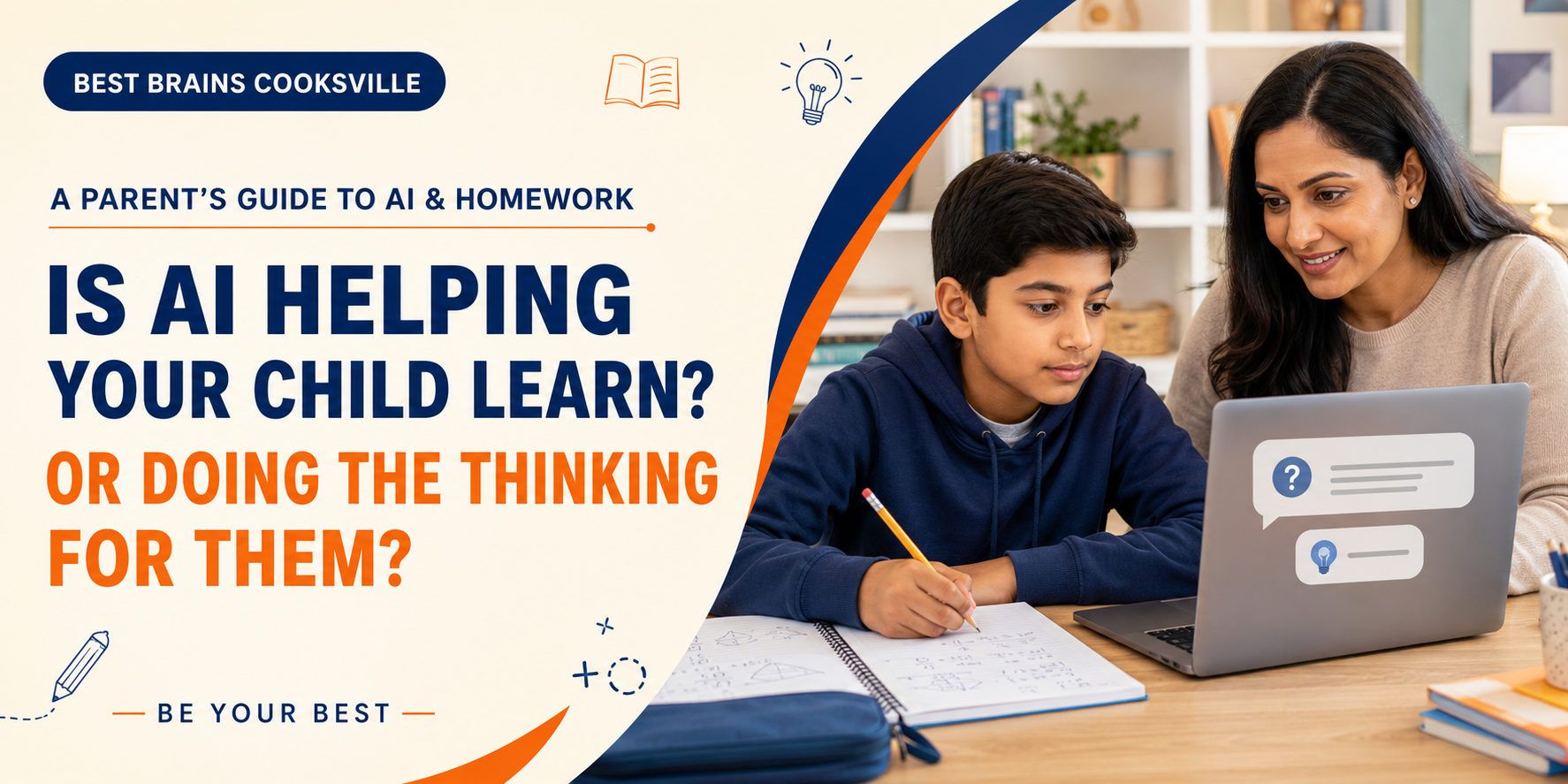
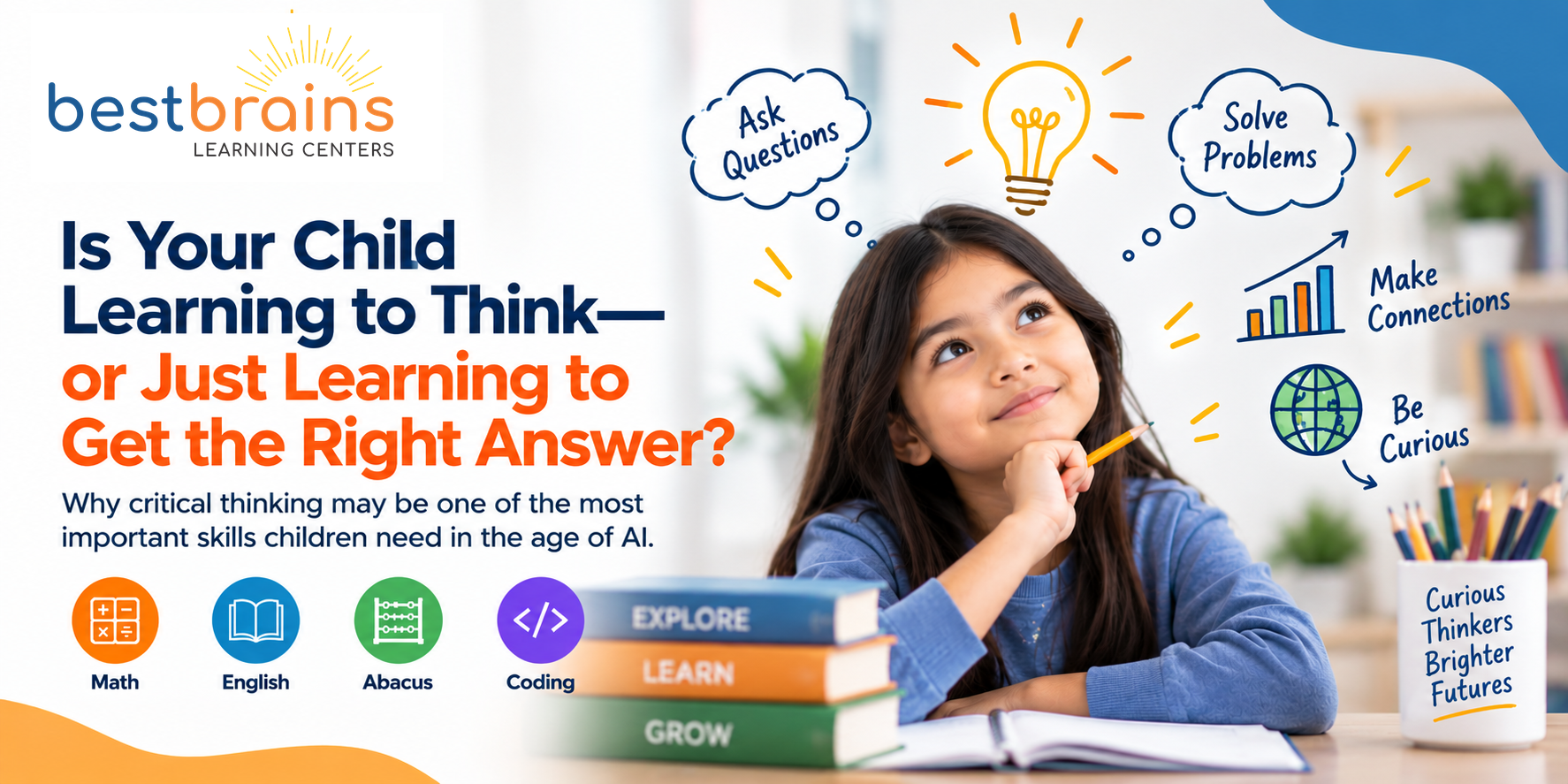
Is AI Helping Your Child Learn—or Doing the Thinking for Them?
Is AI Helping Your Child Learn—or Doing the Thinking for Them?
By Best Brains Cooksville
It is 8:30 p.m. Your child is stuck on a homework question, everyone is tired, and an AI tool can produce an answer in seconds. Artificial intelligence is already part of how many children search for information, generate ideas and complete schoolwork.
That leaves parents with a difficult question:
Is AI helping my child understand—or simply helping them finish?
The answer is not as simple as banning AI or allowing unlimited use. AI can be useful when it offers explanations, hints and feedback. But when it removes the effort involved in reading, writing and problem-solving, a polished assignment can hide very little actual learning.
The goal is not to raise children who never use AI. It is to raise children who can use it without surrendering their judgment, curiosity or ability to think independently.
AI Can Support Learning—When the Child Remains the Thinker
Used carefully, AI can support a student at the moment they become stuck. A child might ask it to:
- explain a difficult idea in simpler language;
- provide a hint without revealing the answer;
- create extra practice questions;
- quiz them before a test;
- identify where their calculation went wrong;
- suggest ways to improve a paragraph they already wrote; or
- compare two problem-solving strategies.
In each case, the child remains the thinker. AI acts as a guide, not a substitute.
When AI Becomes a Shortcut
AI stops supporting learning when it completes the most important part of the task—for example, solving a problem before the child attempts it, writing an entire assignment, summarizing a book the child has not read or producing information that is copied without being checked.
One large field experiment involving high-school mathematics found that students with a general-purpose AI assistant performed better during practice, but later performed worse when the AI was removed. The negative effects were largely reduced when the tool provided learning-focused guidance rather than unrestricted answers.
The lesson is important: better homework performance in the moment does not always mean better learning.
Helpful AI Use vs. AI Doing the Work
| AI supports learning when a child… | AI replaces learning when a child… |
|---|---|
| attempts the question first | requests the complete answer immediately |
| asks for a hint or explanation | asks AI to complete the assignment |
| uses AI to generate practice questions | uses AI to avoid reading or practising |
| requests feedback on an original draft | submits AI-generated writing as original work |
| checks the response against another source | assumes the first response must be correct |
| can explain the final answer independently | cannot explain how the answer was reached |
If your child cannot explain the answer without the screen, AI probably did not help them learn it.
The Four-Step AI Homework Rule
Families do not need a complicated technology policy. Start with four steps:
1. Try
The child attempts the question independently before opening an AI tool.
Even an incomplete attempt reveals what the child understands and gives the brain something to build on.
2. Ask
The child asks for guidance—not the finished answer.
Useful prompts include:
- “Give me one hint, but do not solve it.”
- “Explain this idea using a simpler example.”
- “Show me where my reasoning went off track.”
- “Identify one area I can improve in my paragraph.”
3. Explain
After using AI, the child explains the concept or solution in their own words.
They should be able to close the screen, explain why the answer makes sense and describe the steps they followed.
4. Verify
AI can produce confident-sounding information that is incomplete, biased or incorrect. Students should verify important facts, calculations and quotations using their textbook, class notes, teacher instructions or another reliable source.
The four-step rule can be summarized as:
Try first. Ask for guidance. Explain it back. Verify the result.
Is Using AI for Homework Cheating?
Using AI is not automatically cheating. The purpose of the assignment and the teacher’s instructions matter.
AI use may cross the line when a student:
- uses it after the teacher has said it is not permitted;
- submits AI-generated work as their own;
- uses AI during a test or independent assessment; or
- cannot demonstrate the knowledge in the submitted work.
Before using AI for an assignment, students should ask:
- Is AI permitted for this task?
- What kind of assistance is allowed?
- Must its use be acknowledged or cited?
- Can I explain everything I submit?
When in doubt, ask the teacher.
Age, Privacy and Safety Matter
Not every AI tool is designed for every age group.
ChatGPT, for example, is not intended for children under 13. Users between 13 and 18 require parental consent. OpenAI also advises that when ChatGPT is used in an educational context involving children under 13, the actual interaction should be conducted by an adult.
Parents should review the current age requirements and privacy settings of any tool. Children should never enter identifying information such as their full name, address, phone number, school, passwords, private photographs or unedited school documents.
UNESCO’s guidance emphasizes age-appropriate use, human oversight and protection of personal data. Children may treat a friendly chatbot as more private or trustworthy than it is.
Five Signs AI May Be Replacing Your Child’s Thinking
Parents do not need special detection software. Look for changes in the learning process:
- Homework is completed unusually quickly.
- The writing no longer sounds like your child.
- Rough work, corrections and intermediate steps disappear.
- Your child can read the answer but cannot explain it.
- They will not begin even simple work without AI.
One sign does not prove misuse. Ask your child to walk you through their process: “What did you try first?” and “What did the tool help you understand?”
Practical AI Rules for Families
A few consistent boundaries are more effective than constantly changing rules:
- School and teacher instructions always come first.
- AI is used only after an independent attempt.
- Ask for hints, questions and feedback—not finished work.
- Never submit words or solutions you do not understand.
- Verify information and protect personal details.
- Keep some homework, reading and writing completely AI-free.
- Be honest about when and how AI was used.
A useful family rule is:
AI may help you think, but it may not think for you.
How Best Brains Cooksville Supports Independent Thinkers
At Best Brains Cooksville, our goal is not simply to help students produce correct answers. We help them understand concepts, explain their reasoning, learn from mistakes and apply skills independently.
AI makes strong foundations more important—not less. Children need reading skills to judge a summary, mathematical understanding to recognize an incorrect solution, and critical thinking to evaluate what a tool produces.
Our Ontario-aligned Math and English programs combine structured practice with certified teachers, personalized feedback, progress monitoring and a non-repetitive curriculum. Students build the foundations to learn confidently—with or without technology.
Whether a child needs reinforcement, greater challenge or stronger learning habits, the first step is understanding what they can do independently and where guidance is needed.
A Note from the Centre Director
As a parent and someone who has spent more than 20 years working in learning and organizational change, I do not believe the answer is to fear every new tool. Children will grow up in a world where AI is part of education and work. Our responsibility is to help them use it with judgment and honesty.
Technology should extend learning—not replace the effort through which learning happens.
— Jasneet Kaur, Centre Director
Best Brains Cooksville
Frequently Asked Questions
Should I ban my child from using AI for homework?
A complete ban does not teach responsible use. Clear rules about age, permission, privacy and acceptable assistance are usually more useful. Teacher instructions should always come first.
Can AI genuinely help a child learn?
Yes, when it provides hints, explanations, practice questions and feedback while keeping the student actively involved. It is less helpful when it supplies finished answers.
How can I tell whether my child understands AI-assisted work?
Ask them to close the tool and explain the answer, method or main idea in their own words. Then give them a similar question to try independently.
Is ChatGPT suitable for elementary-school children?
ChatGPT is not intended for children under 13. In an educational context involving a child under 13, OpenAI advises that the actual interaction should be conducted by an adult. Parents should check the current rules for any AI product before use.
Should students disclose that they used AI?
Students should follow their teacher’s instructions. If the expectations are unclear, they should ask whether AI is allowed and whether its use must be acknowledged or cited.
Looking for Academic Support in Mississauga?
Best Brains Cooksville offers Ontario-aligned enrichment programs in Math, English, Abacus and Coding, taught in a supportive small-group environment.
Contact us to arrange a free consultation and placement test.
Best Brains Cooksville
Unit 15 – 35 King St E
Mississauga, ON L5A 4E2
Call or text: 437-616-6716
Email: cooksville@bestbrains.com
References and Further Reading
- OpenAI: Is ChatGPT safe for all ages?
- UNESCO: Guidance for Generative AI in Education and Research
- MediaSmarts: Understanding AI—Online Content
- Bastani et al.: Generative AI Without Guardrails Can Harm Learning
- Peel District School Board: Interim Guidance on Generative AI
Content Note: AI tools, product age requirements and school policies can change. Families should review current product terms and follow the instructions provided by their child’s school and teacher.