Mississauga - Cooksville
 Featured
Why Critical Thinking for Kids Matters in the Age of AI
By Best Brains Cooksville
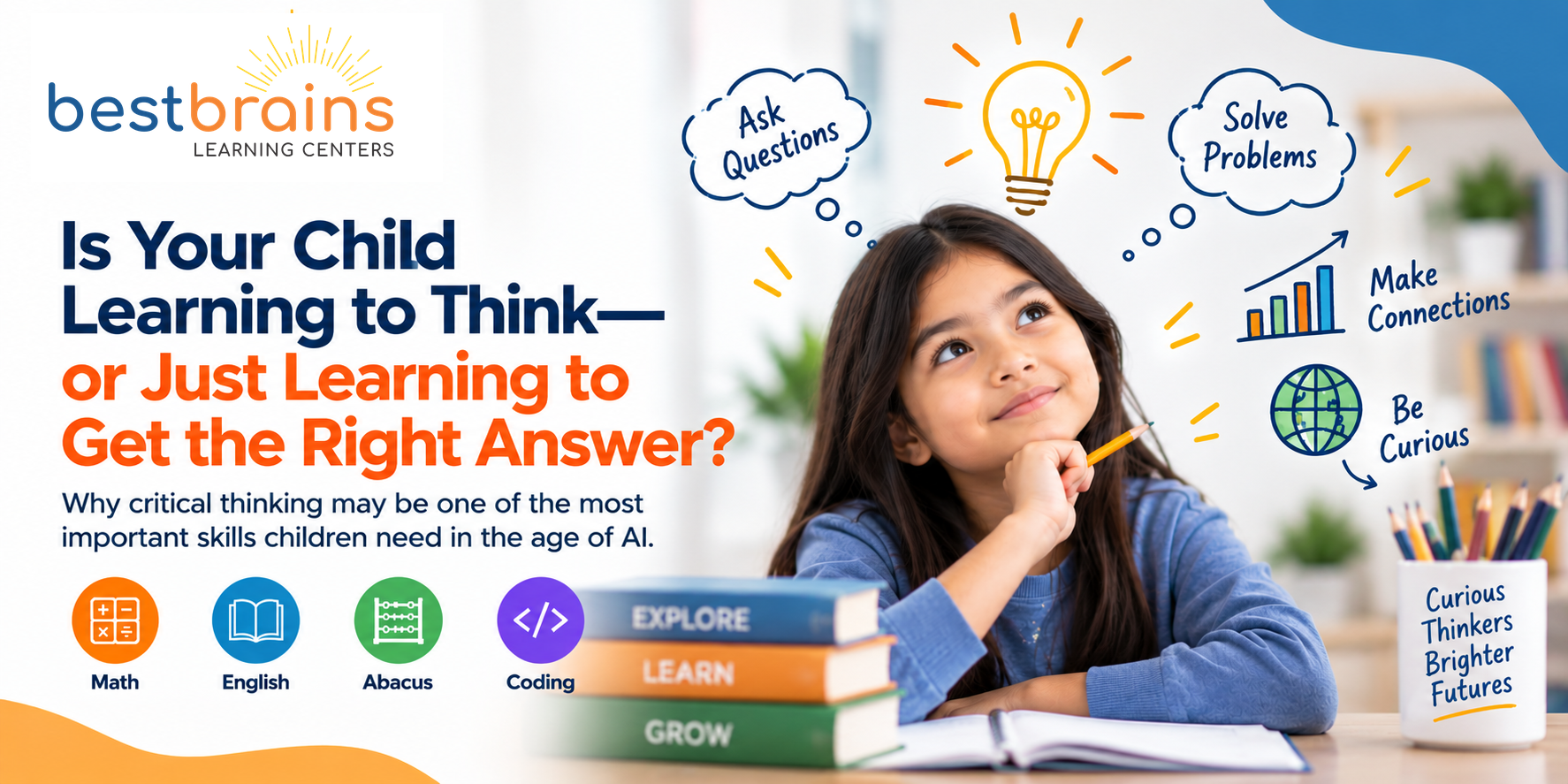
Why critical thinking may be one of the most important skills children need in the age of AI
Ask a child a factual question today, and the answer may be only seconds away.
Search engines made information easier to find. Now, artificial intelligence can explain a math problem, summarize a story, generate an essay, answer a question, or provide step-by-step instructions almost instantly.
For parents, this raises an important question:
If answers are becoming easier to access, what should our children actually be learning?
The answer isn't that knowledge no longer matters. Children still need strong foundations in Math, English, science, and other subjects.
But increasingly, knowing the answer is only part of learning.
Children also need to know how to question, reason, analyze, evaluate, connect ideas, and apply what they know to unfamiliar situations.
In other words, we need to teach children not just to get the right answer—but to think.
Knowledge Still Matters
With calculators, search engines, and now AI readily available, it can be tempting to think children no longer need to memorize facts or develop strong foundational skills.
The opposite is true.
Consider a simple example. If an AI tool gives a child an incorrect solution to a math problem, how will the child recognize that something is wrong?
They need enough mathematical understanding to think:
“That answer doesn't make sense.”
The same applies to reading. A child needs vocabulary, comprehension skills, and background knowledge before they can effectively evaluate something they read online.
Strong foundational knowledge gives children something to think with.
The goal, therefore, isn't to replace knowledge with critical thinking. It is to build knowledge and then teach children how to use it.
The Question Is Changing
Traditional learning can sometimes focus heavily on questions such as:
What is the answer?
Critical thinking takes learning further:
How did you get that answer?
Why does that strategy work?
Can you solve it another way?
What evidence supports your conclusion?
What information might be missing?
What would happen if one part of the problem changed?
These questions require more than recall. They require a child to understand what they are doing.
And that distinction matters.
A student may be able to follow a familiar procedure perfectly but struggle when the same concept appears in a slightly different form.
Another student may understand the underlying concept well enough to adapt their knowledge and work through a problem they have never seen before.
The second student is demonstrating something increasingly valuable: the ability to transfer learning to a new situation.
5 Signs Your Child Is Developing Critical-Thinking Skills
Critical thinking doesn't necessarily look like a child knowing more facts. You may notice it in the way your child approaches learning.
1. They explain their reasoning
Instead of simply saying, “The answer is 24,” they can explain how they arrived at 24.
Being able to explain a thought process is often a stronger indicator of understanding than producing the correct answer alone.
2. They ask questions
“Why?”
“How do we know?”
“What if...?”
Questions aren't a distraction from learning. Good questions are often evidence that a child is actively processing information rather than simply accepting it.
3. They try another strategy
When their first approach doesn't work, do they immediately give up—or try something different?
Learning to adjust a strategy is an important part of problem-solving.
4. They make connections
A child might recognize that a concept learned during a Math lesson can help solve a real-world problem or connect something from a story to an experience or another text.
Making these connections demonstrates deeper understanding.
5. They don't automatically accept every answer
As children get older, they should gradually learn to ask:
Does this information make sense?
Where did it come from?
Can I verify it?
In an online world filled with an enormous amount of information, this skill is becoming particularly important.
What Critical Thinking Looks Like in Math
Imagine two students are asked:
27 × 6 = ?
Both answer 162.
At first glance, they appear to have demonstrated exactly the same level of understanding.
But ask them:
“How do you know?”
One child may only know the steps of an algorithm.
Another might explain:
“I know 20 × 6 is 120 and 7 × 6 is 42. Then 120 + 42 = 162.”
That explanation reveals conceptual understanding.
Now change the problem.
Instead of asking 27 × 6, place the multiplication concept inside a word problem the child has never encountered before.
Can the child recognize that multiplication is required?
That is where mathematical learning begins moving beyond calculation into reasoning and problem-solving.
Fluency still matters. Children should know important number facts and be able to calculate accurately.
But the ultimate goal is for them to understand mathematical concepts well enough to use them independently.
What Critical Thinking Looks Like in English
The same principle applies to English.
Learning to read accurately and fluently is essential. So are vocabulary, spelling, grammar, and writing conventions.
But as children progress through school, reading becomes much more than recognizing words on a page.
A strong reader should gradually learn to:
- identify the main idea;
- make inferences;
- understand information that isn't stated explicitly;
- distinguish fact from opinion;
- compare different viewpoints;
- identify evidence in a text;
- evaluate an author's argument; and
- support their own conclusions with evidence.
Instead of only asking:
“What happened in the story?”
we can also ask:
“Why do you think the character made that decision?”
“What evidence from the text supports your answer?”
“Do you agree with the author's argument? Why?”
Those questions turn reading from a passive activity into an exercise in thinking.
Coding Provides Another Kind of Problem-Solving Practice
Coding offers children a different opportunity to develop logical thinking.
When a program doesn't work as expected, the solution isn't simply to memorize another answer.
A student needs to examine the problem, identify where something went wrong, test a possible solution, observe what happens, and revise the approach.
This process develops habits that extend beyond coding:
Break the problem down.
Look for patterns.
Test your idea.
Learn from the result.
Try again.
These are valuable problem-solving habits in many areas of learning.
And Then There Is AI
Children growing up today will likely interact with artificial intelligence far more extensively than previous generations.
Trying to keep AI completely out of children's lives is unlikely to be a long-term educational strategy.
Teaching them how to use it intelligently is far more important.
One of the limitations of AI is that it can produce an answer that sounds convincing even when the information is incomplete or incorrect.
That creates an important distinction.
A child who has primarily learned to find answers may see a polished response and accept it.
A child who has learned to think critically is more likely to ask:
Does this make sense?
How can I check it?
Is the reasoning correct?
What information might be missing?
Could there be another answer or perspective?
In an age of AI, the ability to evaluate an answer may become just as important as the ability to find one.
How Parents Can Encourage Critical Thinking at Home
You don't need special worksheets or complicated activities to help develop these skills.
Small changes in everyday conversations can make a difference.
When your child gives you an answer, occasionally follow it with:
“How did you figure that out?”
If they are stuck, rather than immediately explaining the solution, ask:
“What have you tried so far?”
When you're reading together, ask:
“What do you think will happen next? Why?”
When your child sees something online, ask:
“How could we find out whether that's actually true?”
And when they make a mistake, focus on the reasoning:
“Where do you think the solution started going off track?”
The objective isn't to question children constantly. It is to create regular opportunities for them to explain their thinking.
The Future of Learning Requires Both Knowledge and Thinking
Education doesn't need to choose between foundational skills and critical thinking.
Children need both.
They need multiplication facts and mathematical reasoning.
They need grammar and vocabulary and the ability to communicate complex ideas.
They need reading fluency and the ability to evaluate what they read.
They need to know information and know when information may be wrong.
Technology will continue to change the tools children use to learn.
But regardless of how sophisticated those tools become, children will still need the ability to reason, question, analyze, solve problems, and make sound judgments.
Because in a world where answers are becoming easier to find, one of the greatest advantages we can give a child is the ability to decide which answers are worth trusting—and what to do with them.
Building Stronger Thinkers at Best Brains Cooksville
At Best Brains Mississauga–Cooksville, our Math, English, Abacus, and Coding programs focus on building strong academic foundations while helping students develop greater understanding, problem-solving skills, and independence.
Our goal isn't simply for students to complete today's worksheet.
It's to help them build skills they can carry into the next grade, the next challenge, and an increasingly complex world.
Best Brains Mississauga–Cooksville
Unit 15, 35 King St E, Mississauga, ON
437-616-6716