Mississauga - Cooksville
Should Kids Memorize Multiplication Tables? | Best Brains Cooksville
By Best Brains Cooksville
For generations, learning multiplication tables meant one thing: memorizing them.
Times tables were recited, copied repeatedly and tested until children could answer almost automatically.
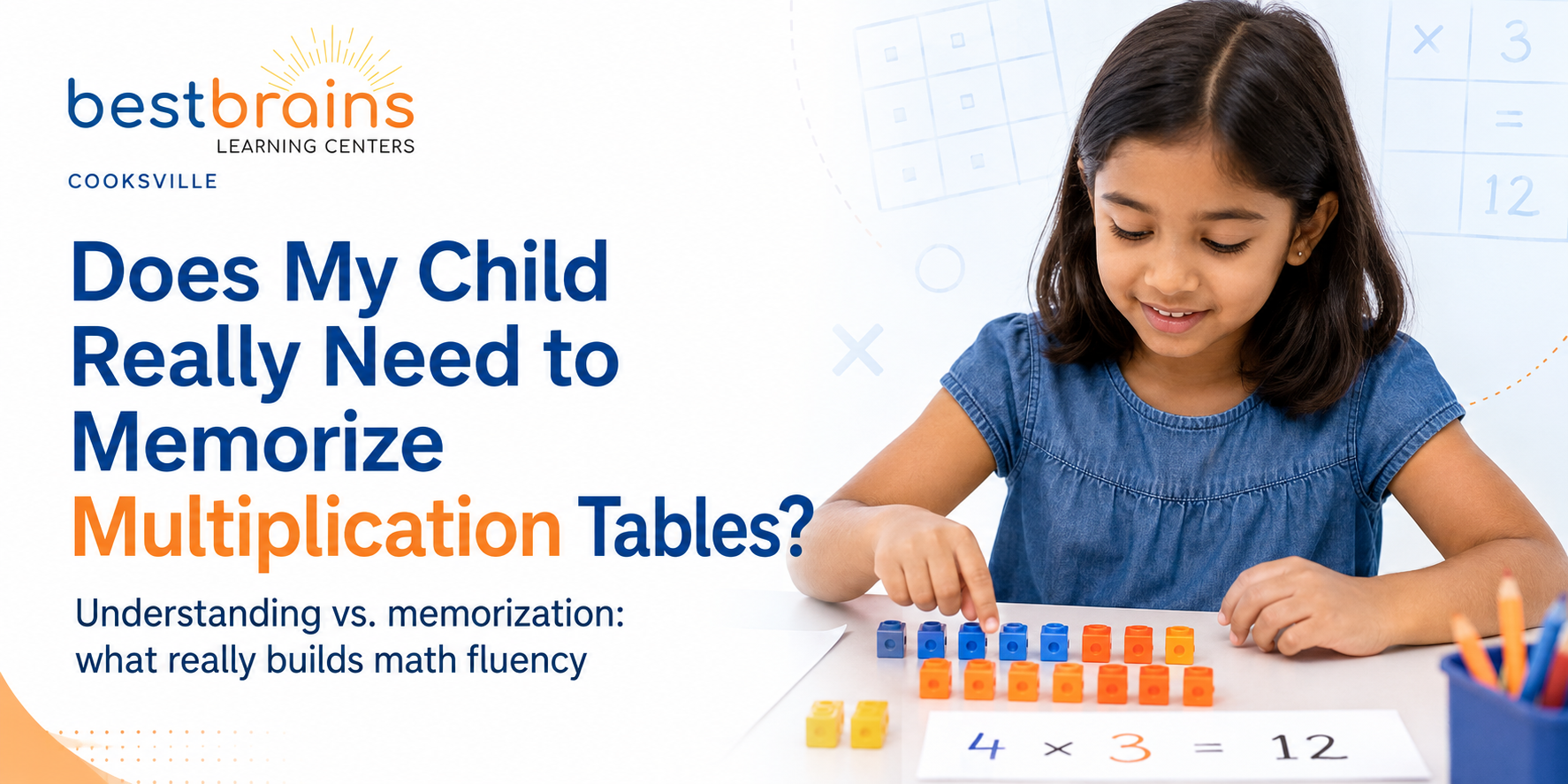
Today, math instruction places more emphasis on understanding why multiplication works. Children may use arrays, number lines, skip counting, equal groups and other strategies to develop number sense before being expected to recall multiplication facts quickly.
So, understandably, many parents are left wondering:
Does my child actually need to memorize the multiplication tables anymore?
The Quick Answer
Yes—but memorization should not be the starting point or the only goal.
Children need to understand what multiplication means and gradually develop efficient recall of basic multiplication facts.
The real goal is multiplication fluency: the ability to understand, recall and use multiplication facts accurately, flexibly and efficiently.
Memorization and Understanding Are Not the Same Thing
Consider a simple question:
6 × 4 = ?
A child who has memorized the answer may immediately say 24.
That is useful. But we also want the child to understand that 6 × 4 represents six groups of four, that it can be shown using an array, and that it is connected to repeated addition and division.
Understanding allows children to reason through unfamiliar problems.
Fact recall gives them the speed and mental space to apply that understanding efficiently.
Strong math skills require both.
Why Multiplication Facts Still Matter
Multiplication does not disappear as children move into higher grades. It becomes a building block for increasingly complex mathematics.
Multiplication fluency supports work with:
-
division
-
fractions
-
decimals
-
percentages
-
ratios and proportions
-
factors and multiples
-
area and volume
-
algebra
Imagine a child working on a fraction problem but having to stop and calculate 7 × 8 by counting or repeated addition.
The child may understand the fraction concept, but the basic calculation is using attention that should be available for solving the more complex problem.
When familiar multiplication facts become automatic, children can focus more of their mental energy on reasoning, problem-solving and checking their work.
Should Children Simply Memorize the Tables?
This is where the distinction becomes important.
Simply asking a child to memorize isolated facts such as:
7 × 8 = 56
6 × 9 = 54
8 × 7 = 56
without understanding multiplication can create fragile learning.
A child may perform well when shown a familiar equation but struggle when the same relationship appears in a word problem:
There are 7 tables with 8 students at each table. How many students are there altogether?
Or:
Fifty-six students are divided equally among 7 groups. How many students are in each group?
A child who understands multiplication can recognize the relationship among all three problems.
A child who has memorized only isolated facts may not.
A more effective learning sequence is:
Understand → Practise → Develop Fluency
What Does the Ontario Math Curriculum Expect?
Ontario’s elementary mathematics curriculum includes both conceptual understanding and the recall of multiplication facts.
The expectations develop gradually:
| Grade | Ontario multiplication-fact expectation |
|---|---|
| Grade 3 | Recall and demonstrate multiplication facts for 2, 5 and 10, along with the related division facts. |
| Grade 4 | Recall and demonstrate multiplication facts from 1 × 1 to 10 × 10, along with the related division facts. |
| Grade 5 | Recall and demonstrate multiplication facts from 0 × 0 to 12 × 12, along with the related division facts. |
Children are therefore expected to develop efficient recall—but they are also expected to demonstrate relationships, use strategies, solve problems and connect multiplication with division.
The curriculum does not treat understanding and fact recall as competing goals. Children need both as mathematics becomes more complex.
You can review the official expectations on the Ontario Mathematics Curriculum website.
For a parent-friendly overview of the skills children develop in each elementary grade, read our Ontario Math Curriculum Guide for Grades 1–8.
How Can I Tell Whether My Child Is Fluent With Multiplication?
Speed alone is not the best measure.
Instead, look at how your child approaches multiplication.
For example, ask:
8 × 6 = ?
A child who quickly recalls 48 is demonstrating automatic fact recall.
A child who thinks, “I know 8 × 5 is 40, so one more group of 8 makes 48,” is also demonstrating strong mathematical thinking.
Other signs of developing multiplication fluency include being able to:
-
explain what a multiplication equation represents;
-
use a known fact to work out an unfamiliar one;
-
recognize that 6 × 8 and 8 × 6 have the same product;
-
connect a multiplication fact to related division facts;
-
choose an efficient strategy instead of always counting; and
-
apply multiplication in word problems and real-life situations.
If your child regularly has to count:
8, 16, 24, 32, 40, 48...
to solve familiar multiplication facts, they may still be developing fluency.
That does not mean they are “bad at math.” It means the underlying facts have not yet become efficient enough.
What If My Child Understands Multiplication but Is Slow?
This is common.
Some children understand multiplication well but have not yet developed automatic recall. They can find the correct answer; they simply need more time.
Initially, that is perfectly reasonable. Accuracy and understanding should come before speed.
However, as children move into fractions, long division, multi-step problems and algebra, repeatedly working out basic multiplication facts can begin to slow them down.
At that stage, short and targeted practice can help move facts from something the child has to work out every time to something they can retrieve efficiently.
What If My Child Knows the Facts but Struggles With Word Problems?
This may indicate a different issue.
The child may have developed fact recall but need more support with mathematical reasoning, problem interpretation or reading comprehension.
Word problems require children to:
-
Understand the language.
-
Identify the relevant information.
-
Determine what the question is asking.
-
Choose an appropriate operation.
-
Solve the problem.
-
Check whether the answer makes sense.
This is one reason strong Math and English skills often work together.
If you are wondering what language and comprehension skills children are expected to develop at different grade levels, our Ontario English Language Curriculum Guide for Grades 1–8 provides a parent-friendly overview.
How Can Parents Practise Multiplication at Home?
Multiplication practice does not have to mean sitting at the kitchen table reciting times tables for an hour.
Short, frequent practice is usually more manageable and effective than occasional long sessions.
Use everyday situations
Ask:
“We need 4 plates for each table, and there are 3 tables. How many plates do we need?”
Look for relationships
Ask:
“If 5 × 6 = 30, how could that help us solve 6 × 6?”
Connect multiplication and division
Ask:
“If 7 × 8 = 56, what is 56 ÷ 8?”
Focus on a small group of facts
Instead of practising every multiplication table at once, focus on a few related facts until your child can use them confidently.
Use games and visual models
Cards, dice, counters, arrays and short mental-math games can make practice feel less repetitive.
Most importantly, ask your child:
“How did you get that answer?”
That question can reveal much more about their mathematical understanding than simply checking whether the answer is correct.
Should I Use Timed Multiplication Tests?
Timed tests should not be the main way to teach or measure multiplication fluency.
The National Council of Teachers of Mathematics notes that timed tests do not provide a complete measure of fluency and can negatively affect some students.
A child may understand multiplication and use effective strategies but freeze when placed under time pressure. Another child may complete a timed sheet quickly without understanding how to apply those facts in a problem.
The goal is not to produce the fastest mathematician.
The goal is to help a child become accurate, flexible, confident and increasingly efficient.
Parents can still notice whether recall is becoming easier over time, but practice should feel purposeful—not like a race.
How Much Multiplication Practice Does a Child Need?
There is no single amount that works for every child.
For many children, five to ten minutes of focused practice several times a week is more useful than one long practice session.
The practice should be challenging enough to promote growth but manageable enough that the child can experience success.
If your child is becoming frustrated, guessing repeatedly or relying on counting for nearly every fact, it may be better to step back and strengthen the underlying concept before continuing with recall practice.
So, Does My Child Need to Memorize Multiplication Tables?
Yes—but think fluency rather than memorization alone.
Children should gradually reach a point where common multiplication facts are readily available to them. At the same time, they should understand the relationships behind those facts.
A child who knows that 8 × 7 = 56 is well prepared.
A child who understands why 8 × 7 equals 56, can derive the answer using another known fact, recognizes its relationship to 7 × 8, and understands that 56 ÷ 8 = 7 is even better prepared.
That is the balance we are looking for:
Understanding + Practice + Fluency
Not Sure Where Your Child Stands in Math?
It can be difficult for parents to know whether a child simply needs more practice or whether there are gaps in foundational math skills.
At Best Brains Cooksville in Mississauga, our Math program focuses on strong fundamentals, conceptual understanding, fact fluency and problem-solving—not repetitive worksheets alone.
Students learn with certified teachers in small classes and progress through a comprehensive, non-repetitive curriculum designed to strengthen foundational skills while continuing to challenge them.
If you are unsure whether your child’s Math skills are where they should be for their grade, a free placement test can help identify their current level, strengths and areas that may need additional support.
Book a free placement test at Best Brains Cooksville and find out where your child stands.
Best Brains Cooksville
Unit 15, 35 King Street East
Mississauga, ON L5A 4E2
Call or text: 437-616-6716