Mississauga - Cooksville
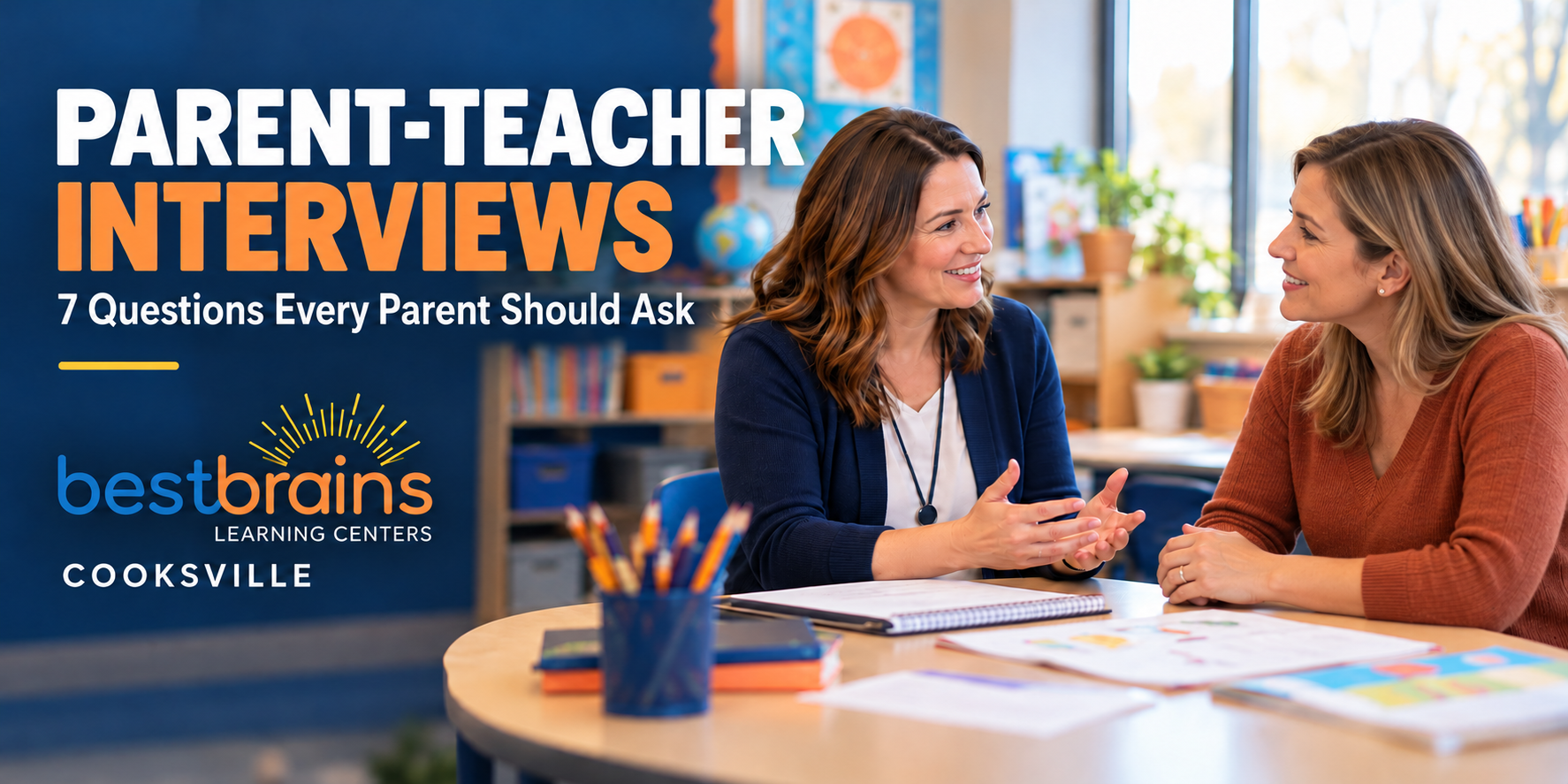
Parent-Teacher Interviews: 7 Questions Every Parent Should Ask
By Best Brains Cooksville
Parent-teacher interviews are an important opportunity to understand how your child is really doing at school.
However, these meetings are often brief. If the conversation begins and ends with:
“Is my child doing well?”
you may leave with a reassuring answer—but very little practical information.
A productive parent-teacher interview should help you understand:
-
your child’s strengths
-
the skills that still need development
-
how independently your child works
-
whether they participate and ask for help
-
what you can reasonably reinforce at home
-
what the teacher and family should monitor next
The goal is not to compare your child with other students.
It is to understand where your child is today, recognize the progress they have made and identify the next step that will help them continue growing.
Here are seven questions that can lead to a more meaningful conversation with your child’s teacher.
Why Are Parent-Teacher Interviews Important?
Report cards provide valuable information, but a grade or progress indicator cannot explain everything happening in the classroom.
A child may receive a satisfactory mark while requiring frequent reminders, extra time or significant assistance. Another child may understand the material well but lose marks because of incomplete work, disorganization or difficulty explaining their thinking.
Parent-teacher interviews provide context.
Ontario’s parent guide to the school system identifies report cards and parent-teacher meetings as important ways for families to stay informed about student progress.
Ontario teachers also use multiple demonstrations of learning—including conversations, observations and student work—to assess achievement. This means the teacher may be able to share patterns that are not visible from one assignment or test.
How Should I Prepare for the Interview?
A little preparation can make a short meeting much more useful.
Before the interview:
-
Review your child’s report card, recent tests and assignments.
-
Look for repeated comments or patterns—not just individual marks.
-
Ask your child what they enjoy and what they find difficult.
-
Write down any changes you have noticed at home.
-
Choose the three questions that are most important to you.
-
Bring a way to record the teacher’s recommendations.
Ask your child whether there is anything they would like you to discuss.
They may tell you:
-
“I don’t understand fractions.”
-
“I’m afraid to read aloud.”
-
“I finish my work but forget to hand it in.”
-
“The teacher goes too fast.”
-
“I know the answer, but I don’t like raising my hand.”
This information can help you begin the meeting with a more specific concern.
1. What Are My Child’s Biggest Strengths?
Begin with strengths.
This creates a balanced conversation and helps you understand the conditions under which your child learns most successfully.
A strength may be academic, such as:
-
strong reading comprehension
-
creative writing
-
mental mathematics
-
problem-solving
-
vocabulary
-
scientific thinking
-
explaining ideas clearly
It may also involve learning skills, such as:
-
persistence
-
curiosity
-
organization
-
collaboration
-
independence
-
creativity
-
willingness to accept feedback
Ask the teacher:
“Can you give me a recent example of that strength?”
You might also ask:
-
When does my child appear most confident?
-
Which subjects or activities bring out their best work?
-
What interests seem to motivate them?
-
How can we use this strength to support a more difficult area?
Understanding strengths is not simply about giving praise.
It helps parents and teachers identify learning strategies that already work for the child.
2. Which Skills or Concepts Need More Practice?
Instead of asking whether your child is “struggling,” ask which specific skills need strengthening.
A general answer such as “math is difficult” is not enough to guide meaningful support.
Ask for a more precise explanation:
-
Is the difficulty with number facts, fractions or problem-solving?
-
Is reading accuracy, fluency or comprehension the main concern?
-
Does writing need stronger ideas, sentence structure, spelling or organization?
-
Is the child misunderstanding the concept or making careless errors?
-
Is this a new concern or a repeated pattern?
-
Can the child complete the skill with help but not independently?
You can also ask:
“Can you show me an example of the type of question or assignment that is difficult?”
Specific examples help parents avoid practising the wrong skill at home.
For example, a child who struggles with word problems may understand the calculation but have difficulty identifying relevant information. Repeating pages of basic calculations may not address the actual problem.
The most useful answer identifies:
The exact skill + the type of difficulty + the next step
3. Does My Child Participate and Ask for Help?
Marks do not always show how a child behaves as a learner.
A student may understand the material but hesitate to participate. Another may appear quiet because they are confused and do not know how to ask for help.
Ask the teacher whether your child:
-
participates in discussions
-
attempts unfamiliar work
-
asks questions when confused
-
begins tasks independently
-
remains focused during instruction
-
contributes during group work
-
accepts corrections constructively
-
continues working when something is difficult
-
waits until an adult notices they need assistance
Useful follow-up questions include:
-
Does my child participate more in small groups or whole-class discussions?
-
Do they ask for help appropriately?
-
Do they avoid certain subjects or activities?
-
Are they confident sharing their ideas?
-
What happens when they make a mistake?
If your child rarely asks for help, discuss a simple strategy they can practise.
For example, they might:
-
Reread the instructions.
-
Review an example.
-
Try the first step.
-
Mark the part that is confusing.
-
Ask a specific question.
Learning how to ask for help is an important part of becoming an independent student.
4. Is My Child Working at the Expected Grade Level?
This question gives you more information than simply asking whether your child is passing.
Ontario students are assessed according to provincial curriculum expectations. Ask the teacher which areas are on track and which require additional development.
You might ask:
-
Is my child meeting the current expectations in reading, writing and mathematics?
-
Are there skills from an earlier grade that remain insecure?
-
Can my child apply the skill independently?
-
Does my child understand the concept when it is presented in a new way?
-
Is progress consistent across assignments and assessments?
-
How much support or prompting is required?
-
Is my child ready for the next level of work?
Try to separate achievement from work habits.
A child may understand grade-level mathematics but submit incomplete assignments. Another may be organized and hardworking but still need help with foundational reading skills.
Understanding the difference helps you choose the right response.
A work-habit concern may require better routines and organization. A skill gap may require targeted instruction and practice.
Parents can review our Ontario Math Curriculum Guide for Grades 1–8 and Ontario English Language Curriculum Guide for Grades 1–8 for grade-by-grade learning expectations and practical checkpoints.
5. What Should We Focus on at Home?
Parents often leave an interview knowing that their child needs practice but not knowing what kind of practice would be most helpful.
Ask the teacher to identify one or two priorities.
Useful questions include:
-
Which skill deserves the most attention?
-
How frequently should we practise?
-
What type of activity would be appropriate?
-
Should we focus on accuracy, speed, understanding or independence?
-
Are there strategies or methods being used in class that we should follow?
-
How will we know whether the practice is helping?
-
Is there anything we should avoid doing?
Home support should be focused and manageable.
Depending on your child’s needs, the teacher might recommend:
-
reading together for 15 minutes
-
discussing the main idea of a text
-
practising multiplication facts
-
reviewing weekly vocabulary
-
using real-life examples of fractions or percentages
-
checking an agenda or online classroom
-
breaking a large assignment into smaller tasks
-
asking the child to explain how they found an answer
More practice is not always better practice.
A short, consistent routine focused on the correct skill is often more helpful than a long session that causes frustration.
6. Have You Noticed Any Learning, Attention or Organizational Challenges?
Teachers observe children in situations that parents may not see, including independent work, transitions, group activities and classroom discussions.
Ask whether the teacher has noticed patterns involving:
-
maintaining attention
-
following instructions
-
remembering multiple steps
-
beginning work
-
completing work within the available time
-
organizing materials
-
recording homework
-
handing in assignments
-
shifting between activities
-
coping with mistakes
-
working independently
This question should not be used to ask the teacher for a diagnosis.
Instead, ask for observations and examples.
You might say:
“When does the difficulty usually appear?”
or:
“Does it happen across subjects or mainly during one type of activity?”
The context matters.
A child who loses focus during every activity may need different support from a child who disengages only when reading instructions are too difficult.
If a concern is significant or persistent, ask:
-
What strategies have already been tried?
-
Did those strategies help?
-
Is the same pattern visible with other teachers?
-
Should we speak with another member of the school team?
-
When should we review the situation again?
7. What Is One Thing We Can Work on Together Over the Next Few Months?
This may be the most important question of the entire meeting.
Without a clear priority, parents may leave with too many concerns and no practical plan.
Ask the teacher to help identify one achievable goal.
A useful goal is specific and observable.
Instead of:
“Improve reading,”
a clearer goal might be:
“Read for 15 minutes four evenings a week and retell the main idea and two supporting details.”
Instead of:
“Get better at math,”
a clearer goal might be:
“Practise multiplication facts three times a week and use them when solving division questions.”
Other possible goals may include:
-
beginning independent work without repeated reminders
-
checking completed work for errors
-
recording homework consistently
-
asking at least one question when confused
-
organizing writing before starting a paragraph
-
completing assignments by the deadline
-
using evidence from a text when answering comprehension questions
Before leaving, confirm:
-
What will the child practise?
-
What will the teacher reinforce?
-
What will the family do at home?
-
How will progress be measured?
-
When will everyone review the goal?
One clear goal is usually more useful than a long list of vague recommendations.
What Should I Listen for During the Interview?
Listen for more than positive or negative words.
Try to identify whether the teacher is describing:
-
an isolated difficulty or a repeated pattern
-
a new skill or an older learning gap
-
independent performance or performance with assistance
-
subject knowledge or work habits
-
lack of confidence or lack of understanding
-
improvement over time or limited progress
-
a concern seen in one setting or across several settings
If an answer feels too general, ask for an example.
Instead of accepting:
“Your child needs to focus more,”
you might ask:
“What does that look like during class?”
The teacher may explain that your child misses the second step in verbal instructions, begins talking during independent work or rushes through the final questions.
That information is much easier to act on.
What Should Parents Avoid During the Meeting?
Try to avoid:
-
focusing only on marks
-
comparing your child with classmates or siblings
-
becoming defensive before hearing the full example
-
discussing too many concerns at once
-
expecting the teacher to diagnose a learning or medical condition
-
asking only what the school will do
-
leaving without a specific next step
-
speaking negatively about your child in front of them
Approach the conversation as a partnership.
Parents know the child’s history, routines and behaviour at home. Teachers understand the child’s learning and participation in the classroom.
Both perspectives are valuable.
What Should I Do After the Interview?
Within a day or two, speak with your child.
Begin with something positive the teacher shared.
You might say:
“Your teacher told me that you explain your ideas very clearly during science.”
Then discuss the area selected for improvement:
“We also agreed that checking your work before handing it in will be our next goal.”
Keep the conversation calm and practical.
Your child should understand that the meeting was not about finding faults. It was about helping the adults around them provide more effective support.
Write down:
-
the agreed goal
-
the home routine
-
the school strategy
-
the review date
-
any questions that remain
If necessary, send the teacher a short follow-up message confirming the plan.
When May Additional Academic Support Help?
Sometimes a parent-teacher interview identifies a gap that requires more individual attention or structured practice than can reasonably be provided at home.
Additional support may help when a child:
-
repeatedly struggles with the same foundational skill
-
needs constant assistance to complete grade-level work
-
understands examples but cannot work independently
-
is becoming anxious or avoidant
-
has difficulty retaining previously taught concepts
-
needs enrichment beyond the current classroom material
-
would benefit from consistent practice and feedback
For more guidance, read When Should My Child Start Tutoring? 8 Signs It May Be Time.
How Best Brains Cooksville Can Help
At Best Brains Cooksville in Mississauga, our Math and English programs help students strengthen foundational skills while continuing to work toward grade-level expectations.
Students learn in small, instructor-led classes through a structured curriculum designed to develop:
-
conceptual understanding
-
reading comprehension
-
written communication
-
accuracy and fluency
-
mathematical reasoning
-
problem-solving
-
independent learning habits
We do not simply help children finish individual homework assignments.
Our goal is to identify the underlying skills that need reinforcement and help students become more capable, confident and independent learners.
A free placement test can help parents understand their child’s current level, strengths and areas that may require additional support.
Book a free placement test at Best Brains Cooksville and turn the information from your parent-teacher interview into a clear plan for progress.