Mississauga - Cooksville
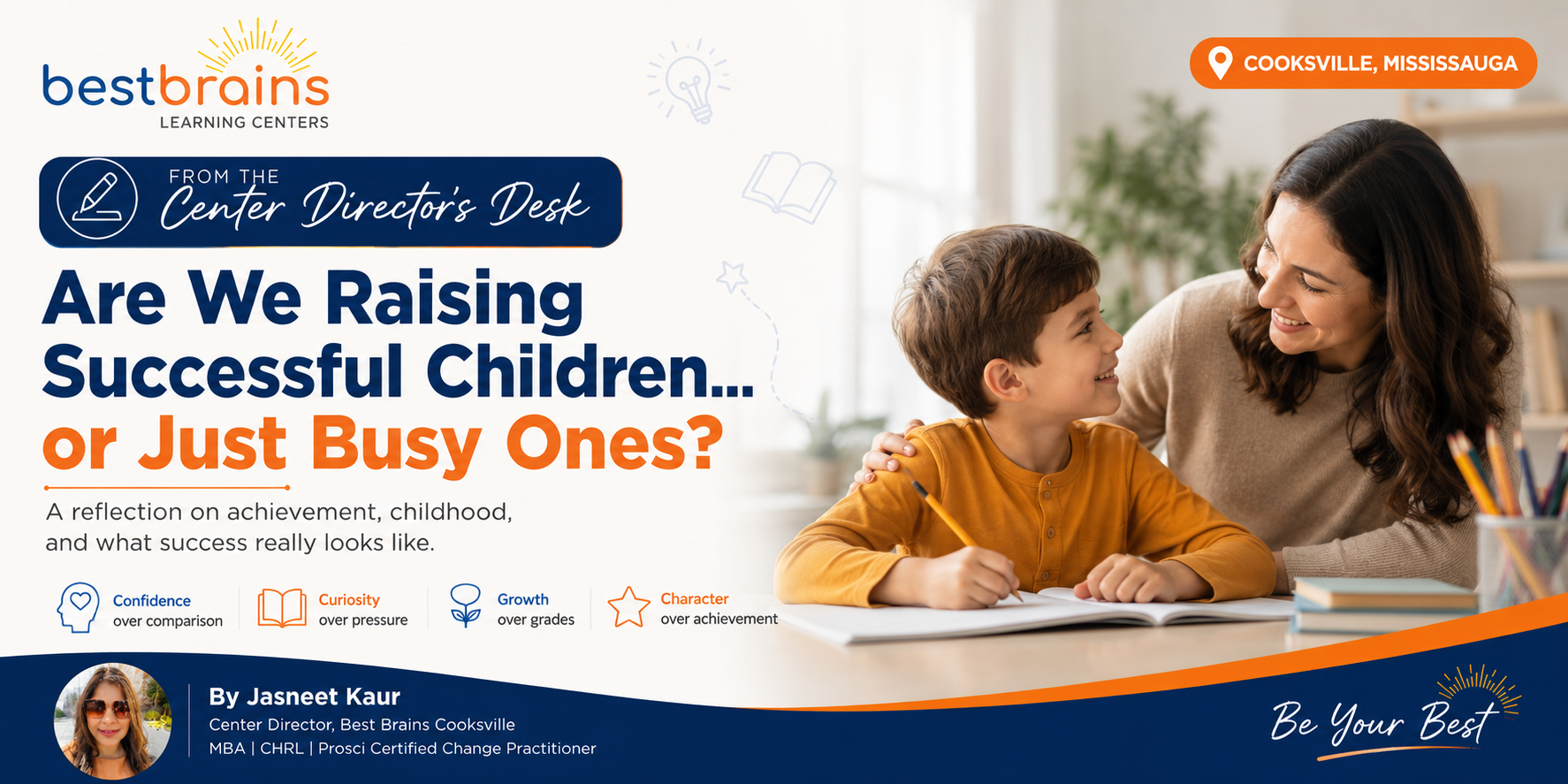
Are We Raising Successful Children… or Just Busy Ones?
From the Center Director's Desk
Are We Raising Successful Children… or Just Busy Ones?
A reflection on achievement, childhood, and what success really looks like.
By Jasneet Kaur
Center Director, Best Brains Cooksville
Not long ago, a parent sat across from me after her child's placement assessment.
She wasn't asking about grades.
She wasn't asking about homework.
She wasn't asking whether her child would qualify for a particular academic program.
Instead, after a brief pause, she quietly said,
"I just want my child to enjoy learning again."
That sentence stayed with me long after our meeting ended.
Because beneath almost every conversation I have with parents—whether it's about report cards, enrichment programs, homework, or assessments—I hear the very same hope.
Parents aren't simply looking for better marks.
They're looking for confidence.
They're looking for curiosity.
They're looking for reassurance that their child is going to be okay.
And it made me wonder:
When did childhood become so busy that joy became something we had to work so hard to protect?
Busy Isn't the Same as Growing
Today's children are busier than ever.
A typical week might include school, homework, sports, music lessons, swimming, coding, dance, tutoring, birthday parties, and weekend activities.
As parents, we fill these schedules with the very best intentions.
We want our children to have opportunities we perhaps never had.
We want them to discover their passions, develop new skills, and build a bright future.
There is nothing wrong with wanting those things.
But somewhere along the way, "busy" quietly became associated with "successful."
A full calendar became a symbol of good parenting.
Yet the more time I spend with children, the more convinced I become that activity and growth are not the same thing.
Children don't develop simply because every hour of their day is scheduled.
They grow when they have time to think, explore, ask questions, make mistakes, reflect, and discover.
Sometimes that happens during a structured lesson.
Sometimes it happens while building something from LEGO, reading a favourite book, helping prepare dinner, or asking endless "why" questions on the drive home.
Learning isn't measured by how full a calendar is.
It's measured by how deeply a child engages with the world around them.
What the Research Actually Tells Us
One of the privileges of my previous career in Learning & Development was discovering how people learn—not just children, but adults too.
One lesson has stayed with me.
Real learning is much deeper than performance.
Stanford psychologist Dr. Carol Dweck has spent decades studying what helps people continue growing. Her work suggests that children who understand abilities can develop through effective strategies, persistence, and feedback are more likely to embrace challenges and recover from setbacks. Importantly, Dweck reminds us that growth is not about praising effort alone—it also depends on guidance, reflection, and learning better ways to solve problems.
Research by psychologist Dr. Angela Duckworth highlights another quality that matters: perseverance. Her work on grit suggests that sustained effort toward meaningful goals often predicts long-term achievement more reliably than talent by itself.
The OECD's Programme for International Student Assessment (PISA) has also shown that students' sense of belonging, confidence, and attitudes toward learning are closely connected with how they perform academically and how they experience school.
These studies point in the same direction.
Children thrive when they feel capable.
They thrive when mistakes are viewed as opportunities to learn.
And they thrive when learning feels meaningful rather than simply measurable.
The Question We May Need to Ask More Often
As parents, we naturally ask questions like:
"How did you do on your test?"
"Did you finish your homework?"
"What grade did you get?"
They're reasonable questions.
I've asked them myself.
But lately I've been wondering if there are even better ones.
What if we asked:
- What surprised you today?
- What made you curious?
- What challenged you?
- What mistake taught you something new?
- What are you proud of today?
Those conversations don't replace academic expectations.
They enrich them.
They remind children that learning is about discovery, not just performance.
Confidence Is Built in Small Moments
People often think confidence comes before success.
I believe it's usually the other way around.
Confidence grows through small victories.
A child solves one problem they once found difficult.
They read one page more than they did yesterday.
They ask a question instead of staying silent.
They make a mistake—and discover it isn't the end of the world.
These moments seem small.
But over time, they change the story children tell themselves.
From:
"I'm not good at this."
To:
"I haven't figured it out... yet."
That quiet shift may be one of the most valuable lessons any child ever learns.
The Report Card I'll Always Care About
If I could design a report card, it wouldn't only include percentages.
I'd want to know:
- Did this child become more curious?
- Did they become kinder?
- Did they become more resilient?
- Did they gain confidence?
- Did they learn to believe in themselves?
Those qualities may not fit neatly into a grading rubric.
Yet they often determine how children approach every challenge they'll encounter throughout life.
Academic success matters.
But character, confidence, and curiosity matter just as much.
A Thought I'll Leave You With
Twenty years from now, I don't believe many parents will remember a Grade 4 math test.
Children won't remember every worksheet they completed.
But they will remember how the adults in their lives made them feel.
Whether someone believed in them.
Whether learning felt exciting or frightening.
Whether mistakes were treated as failures—or opportunities.
If I could wish one thing for every child who walks through our doors, it wouldn't be perfect grades.
It would be that they leave believing:
"I'm capable of learning anything if I'm willing to keep trying."
I have a feeling that belief will take them much further than any report card ever could.
About the Author
Jasneet Kaur is the Center Director of Best Brains Cooksville.
Before opening the center, she spent more than two decades in Human Resources, Learning & Development, Leadership Development, and Organizational Change, helping individuals and organizations grow through learning. She holds an MBA, is a Certified Human Resources Leader (CHRL), and is a Prosci Certified Change Practitioner.
Today, she combines that experience with her passion for education, working closely with families to help children build confidence, curiosity, resilience, and a lifelong love of learning. She believes every child has unique potential, and that meaningful learning begins when children feel supported, challenged, and encouraged to believe in themselves.
From My Desk
Thank you for taking a few minutes to read my reflections.
This is the first article in my From the Center Director's Desk series, where I'll be sharing thoughts on parenting, education, and child development—drawing on research, experience, and conversations with the many wonderful families I have the privilege of meeting.
Because raising successful children isn't just about helping them earn higher grades. It's about helping them become confident, curious, compassionate people who are ready for whatever the future brings.
— Jasneet Kaur