Surrey - South Surrey
BC Report Cards Explained: How Parents Can Tell If Their Child Is Making Academic Progress
A Parent's Guide to Understanding BC's Proficiency Scale, Teacher Feedback, and Academic Growth
Your child's report card arrives. You open it, scan through the subjects, and notice words like Developing, Proficient, and Extending.
But what do they actually mean?
Is "Developing" a cause for concern? Does "Proficient" mean your child is doing exceptionally well? And how can you tell whether your child is making meaningful academic progress when there are no percentages or traditional letter grades?
For many parents in South Surrey, White Rock, and across British Columbia, understanding the provincial report card system can feel confusing.
The good news is that BC's report cards are designed to show more than just academic results. They help families understand what children know, what they can do, and where they need to grow.
At Best Brains South Surrey, we believe informed parents are better equipped to support their children's learning.
This guide explains how BC report cards work, what the proficiency levels mean, and how parents can identify genuine academic progress beyond the report card.
1. How Does the BC Report Card System Work?
British Columbia introduced its updated K–12 Student Reporting Policy in 2023, changing how schools communicate student learning.
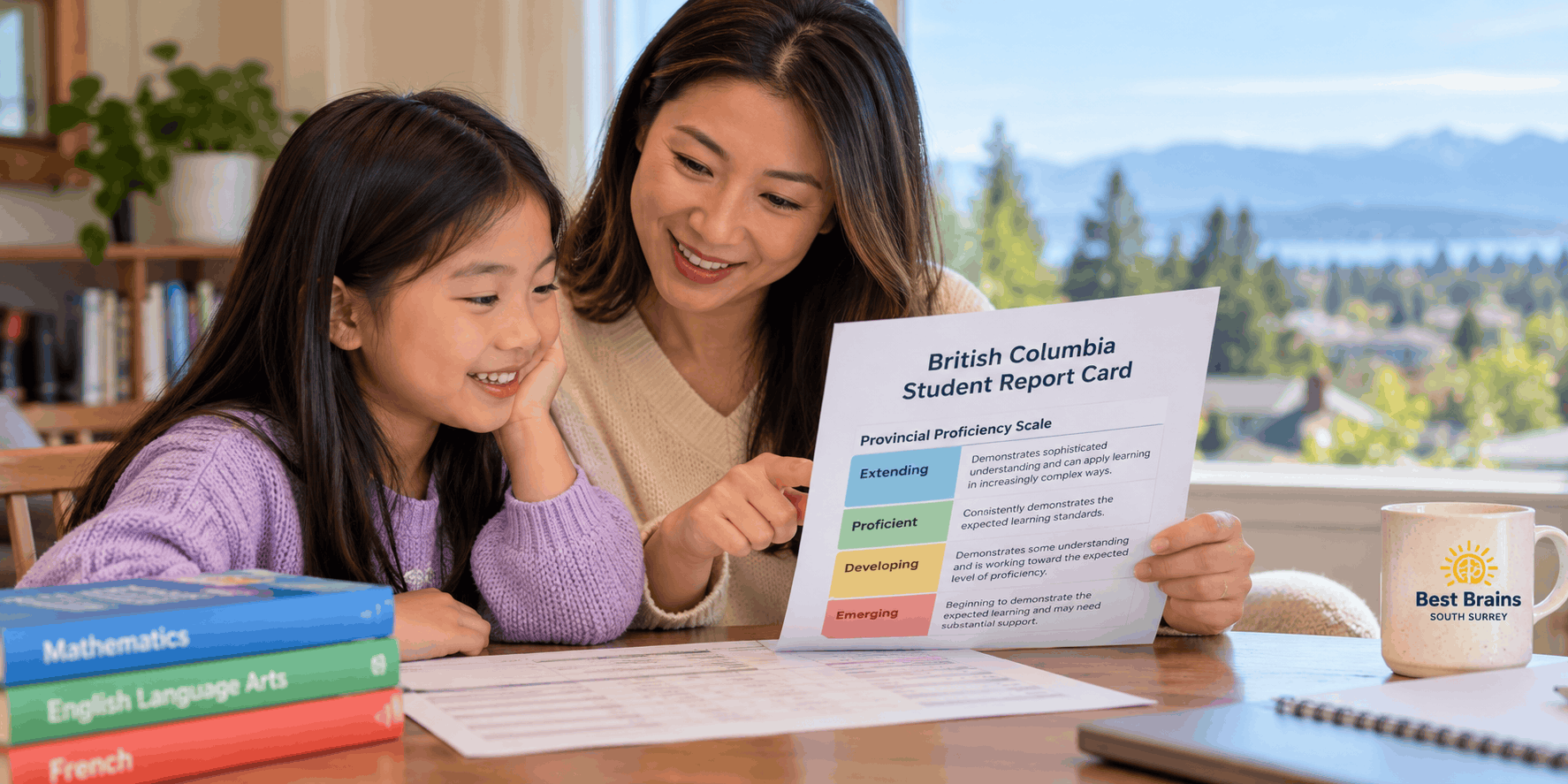
For students in Kindergarten through Grade 9, report cards use a four-level Provincial Proficiency Scale rather than traditional letter grades.
The four levels are:
-
Emerging
-
Developing
-
Proficient
-
Extending
For students in Grades 10–12, schools continue to use letter grades and percentages.
The purpose of the proficiency scale is to help parents understand how well their children are demonstrating the learning standards outlined in the BC curriculum.
Instead of focusing solely on a numerical score, teachers consider students' understanding, skills, application of knowledge, and overall learning progress.
The important distinction: A report card describes where your child is in relation to curriculum expectations. It is not simply a ranking against classmates.
2. What Do Emerging, Developing, Proficient, and Extending Mean?
Understanding the four proficiency levels is the first step toward interpreting your child's report card.
| Proficiency Level | What It Means for Your Child |
|---|---|
| Emerging | Your child is beginning to demonstrate the expected learning and may need substantial support. |
| Developing | Your child demonstrates some understanding and is working toward the expected level of proficiency. |
| Proficient | Your child consistently demonstrates the expected learning standards for the subject and grade. |
| Extending | Your child demonstrates sophisticated understanding and can apply learning in increasingly complex ways. |
Is "Developing" a bad result on a BC report card?
Not necessarily.
A Developing assessment means your child is demonstrating some understanding but has not yet consistently demonstrated the expected proficiency.
For example, a Grade 3 student might understand multiplication using pictures and manipulatives but struggle to solve multiplication problems independently.
The student is learning, but certain skills still need strengthening.
Parents should pay attention to whether their child is moving toward proficiency over time, especially when the same difficulties continue across multiple learning updates.
Is "Proficient" considered a good result?
Yes. Proficient is a positive result and represents the expected standard of learning in the BC curriculum.
A student receiving Proficient is demonstrating the required knowledge and skills for the learning standards being assessed.
Parents should not interpret Proficient as an average or mediocre achievement.
It means the child is successfully meeting the expected standard.
Does "Extending" mean my child is gifted?
Not necessarily.
Extending indicates that a student demonstrates a sophisticated understanding of the learning standards and can apply that understanding in more complex ways.
However, receiving Extending does not automatically indicate giftedness, nor is it equivalent to receiving 100% on a test.
A student can demonstrate Extending in Mathematics while being Proficient in English Language Arts, or vice versa.
Every child has different strengths.
3. How Often Do Parents Receive Report Cards in BC?
Under BC's student reporting policy, parents receive at least five communications about their child's learning each school year.
These include:
-
Two written Learning Updates during the school year.
-
One written Summary of Learning at the end of the school year.
-
At least two informal Learning Updates, which may include parent-teacher conferences, phone calls, or emails.
Written reports include information about student learning, descriptive teacher feedback, attendance, and student reflection and goal setting.
This means parents should not have to wait until June to understand how their child is performing academically.
The reporting system is intended to encourage ongoing conversations between families, students, and teachers.
4. How Can Parents Tell If Their Child Is Actually Making Academic Progress?
One of the biggest misunderstandings about report cards is that progress must always involve moving from one proficiency level to another.
A child who receives Proficient in Mathematics in November and again in March may still have made substantial progress.
Why?
Because the curriculum becomes more complex throughout the school year.
A student might initially demonstrate proficiency in addition and subtraction and later demonstrate proficiency in multiplication, division, or fractions.
The proficiency label remains the same, but the learning has advanced.
Here are five practical ways parents can assess academic growth.
1. Compare specific skills, not just proficiency levels
Look at what your child could do earlier in the school year compared with what they can do now.
For example:
Mathematics
-
Earlier: Solving addition problems using counting strategies.
-
Now: Solving multi-step word problems independently.
English Language Arts
-
Earlier: Reading short passages and identifying basic facts.
-
Now: Reading longer texts, making inferences, and explaining ideas using evidence.
These improvements often reveal more about academic progress than a single report card indicator.
2. Look for increasing independence
A child who previously needed constant assistance but can now complete similar tasks independently is demonstrating meaningful progress.
Ask yourself:
-
Does my child need fewer reminders?
-
Can they explain how they reached an answer?
-
Can they identify and correct their own mistakes?
-
Are they becoming more confident when approaching unfamiliar questions?
Increasing independence is an important sign of developing academic skills.
3. Review teacher comments carefully
Teacher comments can be among the most valuable parts of a BC report card.
For example:
"Demonstrates a strong understanding of number concepts but requires support applying strategies to multi-step problems."
This tells parents something specific.
The student understands foundational concepts but may need additional practice with problem-solving and application.
Rather than focusing only on the proficiency level, identify the particular skills the teacher recommends strengthening.
4. Observe whether learning transfers to new situations
Memorizing an answer is different from understanding a concept.
A student may know multiplication facts but struggle to apply multiplication when solving a real-world problem.
Similarly, a child may read fluently but have difficulty identifying the main idea or making inferences.
True academic progress includes the ability to apply knowledge in unfamiliar situations.
5. Track progress over several months
A single assessment represents learning at a particular point in time.
Looking at multiple learning updates, classroom assignments, and teacher observations provides a more complete picture.
The most useful question is not simply "What level did my child receive?" but "What can my child do today that they could not do three months ago?"
5. Five Warning Signs Your Child May Need Additional Academic Support
A report card is one piece of the academic picture. Parents can also look for patterns in everyday learning.
1. Repeated difficulty with foundational skills
If a child consistently struggles with multiplication, reading comprehension, sentence structure, or other essential concepts, those difficulties may affect more advanced learning.
2. Heavy dependence on parental assistance
Occasional homework help is normal.
However, if your child cannot begin or complete age-appropriate assignments without significant assistance, it may be worth investigating whether underlying concepts need reinforcement.
3. Declining confidence
Statements such as "I'm bad at Math" or "I can't do this" may indicate that academic frustration is affecting your child's confidence.
These statements deserve attention, even when report card results appear satisfactory.
4. Similar concerns across multiple reporting periods
A single Developing assessment is not automatically alarming.
However, repeated teacher comments about the same unresolved difficulties may suggest that your child would benefit from more targeted instruction.
5. Difficulty applying previously learned concepts
A student who understands a concept during a lesson but repeatedly struggles to apply it later may need additional practice, review, or a different instructional approach.
Important: These signs do not necessarily indicate a learning disability or a serious academic problem. They are reasons to speak with your child's teacher and better understand their learning needs.
6. What Should Parents Ask During a Parent-Teacher Conference?
Parent-teacher conferences are an excellent opportunity to understand the information behind a report card.
Instead of asking only, "Is my child doing well?", consider these five questions:
-
Which specific Math and English skills is my child demonstrating confidently?
-
Which grade-level learning standards does my child still need to strengthen?
-
Is my child becoming more independent when completing classroom work?
-
What progress have you observed since the beginning of the school year?
-
What two or three activities can we focus on at home to support further improvement?
These questions encourage specific, actionable feedback rather than general reassurance.
They also help parents distinguish between a temporary learning challenge and an area that may require sustained attention.
7. How to Support Academic Progress at Home
Parents do not need to recreate a classroom at home to help children succeed.
Small, consistent learning habits can make a meaningful difference.
For Mathematics
-
Practise number sense through everyday activities.
-
Encourage children to explain their problem-solving strategies.
-
Use shopping, cooking, and games to explore practical Math concepts.
-
Review previously learned skills before introducing more complex problems.
For English Language Arts
-
Encourage daily reading at an appropriate level.
-
Discuss characters, main ideas, and unfamiliar vocabulary.
-
Ask children to summarize what they have read.
-
Practise writing short paragraphs and explaining ideas clearly.
For French
-
Practise familiar vocabulary in everyday conversations.
-
Encourage listening, speaking, and reading activities.
-
Focus on understanding and communicating rather than memorizing isolated words.
For Learning Confidence
-
Recognize effort, strategies, and improvement.
-
Encourage questions and curiosity.
-
Treat mistakes as opportunities to learn.
-
Set small, achievable learning goals.
Consistency is generally more useful than occasional, intensive study sessions.
8. Why a Child Can Be Proficient and Still Benefit from Academic Enrichment
A common question among parents is:
"If my child is already Proficient, why would they need additional learning support?"
The answer depends on the child's individual goals.
Academic enrichment is not only for students who are struggling.
A student who meets grade-level expectations may still benefit from opportunities to strengthen problem-solving, deepen understanding, develop confidence, and explore new challenges.
For example:
A Grade 4 student may demonstrate proficiency in multiplication and division but benefit from additional work on mathematical reasoning and multi-step word problems.
A Grade 5 student may read fluently but benefit from developing stronger inference, vocabulary, and written communication skills.
The goal should not simply be to achieve an Extending indicator.
The goal is to build strong foundations, meaningful understanding, and the confidence to approach increasingly challenging learning.
9. How Best Brains South Surrey Supports Academic Growth
At Best Brains South Surrey, we understand that every student arrives with different strengths, learning experiences, and academic goals.
Our academic enrichment programs are designed to complement school learning while helping students develop confidence and stronger foundational skills.
We offer five subjects:
Mathematics: Building conceptual understanding, number fluency, logical reasoning, and problem-solving skills.
English: Developing reading comprehension, vocabulary, grammar, writing, and communication skills.
French: Supporting vocabulary development, language comprehension, and communication.
Abacus: Developing mental arithmetic, concentration, and number fluency.
Coding: Introducing computational thinking, logic, creativity, and problem-solving through programming activities.
What makes our approach different?
Our South Surrey learning centre offers:
-
BC-certified teachers who understand local educational expectations.
-
Small classes, with a maximum student-to-teacher ratio of 1:5.
-
Consistent teachers, helping students build familiarity and confidence.
-
Personalized placement assessments to identify appropriate starting levels.
-
Non-repetitive curriculum, introducing new concepts through structured weekly learning.
-
Free 24/7 academic support for enrolled students.
Our goal is to help students strengthen their understanding and build the skills needed for continued academic development.
We believe report cards should be the beginning of a productive conversation about learning, not the end of it.
10. A Simple Academic Progress Checklist for Parents
When reviewing your child's next BC report card, use this checklist:
-
I understand what each proficiency indicator means.
-
I have read the teacher's descriptive feedback.
-
I can identify my child's strongest academic skills.
-
I know which specific skills need further development.
-
I have compared my child's work with earlier examples.
-
I have discussed learning goals with my child.
-
I know what to ask during the next teacher conference.
-
I have a practical plan for supporting learning at home.
If you can confidently answer these questions, you are already taking an active role in your child's academic development.
Frequently Asked Questions About BC Report Cards
1. What does Proficient mean on a BC report card?
Proficient means a student consistently demonstrates the learning standards expected for the subject and grade. It is a positive result indicating that the student is meeting provincial curriculum expectations.
2. Is Developing considered failing in BC schools?
No. Developing means a student is demonstrating some understanding of the expected learning standards but is still working toward consistent proficiency. It is not equivalent to a traditional failing grade.
3. Is Extending the same as an A or 100%?
No. Extending indicates sophisticated understanding and application of curriculum learning standards. The BC proficiency scale is not directly interchangeable with letter grades or percentages.
4. Can a child receive Proficient throughout the year and still improve?
Yes. As students encounter increasingly complex concepts, they can demonstrate significant academic growth while continuing to meet the Proficient standard.
5. How many report cards do BC students receive each year?
BC students receive at least three written reports, including the year-end Summary of Learning, plus at least two informal learning updates during the school year.
6. What should parents do if their child receives Emerging in Math or English?
Start by reviewing the teacher's comments and asking which specific learning standards require support. Discuss appropriate strategies with the teacher, monitor progress, and consider additional targeted instruction if difficulties persist.
7. How can I tell whether my child is performing at grade level in BC?
Review the proficiency indicators, teacher feedback, and examples of classroom work. A Proficient indicator generally means the child is demonstrating the expected learning standards being assessed. Parents can also ask teachers which specific grade-level skills have been demonstrated.
8. Do BC report cards still use letter grades?
Students in Kindergarten through Grade 9 use the Provincial Proficiency Scale. Students in Grades 10–12 continue to receive letter grades and percentages.
9. What does IE mean on a BC report card?
IE stands for Insufficient Evidence of Learning. It is a temporary reporting symbol used when a teacher does not yet have enough evidence to assess a student's learning. It does not automatically mean the student is failing. Schools must identify the issue and establish a plan for obtaining the necessary evidence.
10. Should my child attend tutoring if they are already Proficient?
Not necessarily. A Proficient result indicates that your child is meeting the expected learning standards. Additional enrichment may be helpful if your child wants greater academic challenges, needs support in a particular skill, or would benefit from structured practice.
11. How is academic progress measured at Best Brains South Surrey?
Best Brains uses an initial placement assessment and structured, level-based learning materials to help identify appropriate starting points and monitor student development. This provides an additional perspective on learning alongside school report cards and teacher feedback.
12. Where can parents find academic enrichment in South Surrey?
Families in South Surrey and White Rock can explore Math, English, French, Abacus, and Coding enrichment at Best Brains South Surrey, located at 1990 152 Street, Unit 1A, Surrey, BC. A free placement assessment is available to help determine a suitable starting level.
Final Thoughts: A Report Card Is a Starting Point, Not the Whole Story
A BC report card is an important tool for understanding your child's learning, but it cannot capture every aspect of their academic development.
Confidence, independence, curiosity, persistence, and the ability to apply knowledge are all meaningful parts of progress.
Whether your child is Emerging, Developing, Proficient, or Extending, the most productive approach is to understand where they are today and identify what will help them grow tomorrow.
For parents in South Surrey and White Rock, the combination of regular communication with schoolteachers, supportive learning habits at home, and appropriate academic enrichment can create a strong foundation for continued success.
Discover Your Child's Academic Strengths with Best Brains South Surrey
Wondering whether your child has mastered the foundations needed for their next academic challenge?
At Best Brains South Surrey, we offer a free placement assessment to help families better understand their child's current academic skills and identify suitable enrichment opportunities.
Best Brains South Surrey
1990 152 Street, Unit 1A, Surrey, BC
Phone: 604-704-9378
Programs: Math | English | French | Abacus | Coding
Ages: 3–14
Book a free placement assessment and take the next step toward confident learning.
References and Further Reading
The following official British Columbia government resources provide additional information about student reporting, curriculum expectations, and academic assessment.
-
British Columbia Ministry of Education and Child Care — K–12 Student Reporting Policy.
https://www2.gov.bc.ca/gov/content/education-training/k-12/administration/legislation-policy/public-schools/student-reporting -
BC Curriculum — K–12 Student Reporting Information for Parents and Caregivers.
https://curriculum.gov.bc.ca/reporting/resources-for-parents-and-caregivers -
BC Ministry of Education and Child Care — Communicating Student Learning Guidelines.
https://www2.gov.bc.ca/assets/gov/education/administration/kindergarten-to-grade-12/k-12-student-reporting-policy-communicating-student-learning-guidelines.pdf -
BC Curriculum — Student Reporting Resources for Educators and School Leaders.
https://curriculum.gov.bc.ca/reporting/information-for-educators-and-school-leaders -
British Columbia Curriculum — Provincial Curriculum and Learning Standards.
https://curriculum.gov.bc.ca/
This article is intended as general educational guidance for parents and reflects BC's student reporting framework as of October 2026. Individual reporting practices and learning needs may vary. Parents should consult their child's schoolteacher for student-specific guidance.