Surrey - South Surrey
BC Math Curriculum K–8: What Should Your Child Know at Each Grade Level?
BC Math Curriculum K–8: What Should Your Child Know at Each Grade Level?
The short answer: BC's math curriculum builds in a clear sequence. Kindergarten to Grade 3 builds number sense and basic operations, Grades 4 to 6 build fractions, decimals, and multiplication fluency, and Grades 7 and 8 move into integers, ratios, proportional reasoning, and early algebra. Each grade also asks students to reason, explain, and solve problems, not just get answers.
If you're a South Surrey or White Rock parent wondering whether your child is "where they should be," this guide breaks down the BC Ministry of Education and Child Care's math content by grade, in plain language.
How BC math is organized
Every grade in BC math is built from three elements: Content (what students know), Curricular Competencies (what students can do), and Big Ideas (what they understand). Students are expected to reason and analyze, understand and solve, communicate and represent their thinking, and connect and reflect. That's why your child may be asked to explain how they got an answer, even a correct one.
The content is organized into five strands: number, computational fluency, patterning, geometry and measurement, and data and probability, plus financial literacy.
Quick-reference chart: math milestones by grade
| Grade | Numbers up to | Big focus |
|---|---|---|
| K | 10 | Counting, number concepts, simple patterns |
| 1 | 20 | Addition and subtraction to 20 |
| 2 | 100 | Addition and subtraction to 100, standard units |
| 3 | 1,000 | Fractions, intro multiplication and division |
| 4 | 10,000 | Decimals to hundredths, multi-digit multiplication |
| 5 | 1,000,000 | Equivalent fractions, area, decimals to thousandths |
| 6 | Billions | Ratios, percents, GCF and LCM, order of operations |
| 7 | n/a | Integers, two-step equations, circles |
| 8 | n/a | Fractions operations, Pythagorean theorem, proportional reasoning |
Grade-by-grade guide
Kindergarten
- Number concepts to 10, including ways to make 5 and breaking numbers apart
- Repeating patterns with two or three elements
- Comparing length, mass, and capacity directly
- Recognizing single attributes of 2D shapes and 3D objects
- Understanding balance as "equal" and imbalance as "not equal"
Grade 1
- Numbers to 20 and ways to make 10
- Adding and subtracting to 20, with understanding of what the operations mean
- Measuring with non-standard units (blocks, paper clips)
- Comparing 2D and 3D shapes
- Knowing coin values
Grade 2
- Numbers to 100, using benchmarks like 25, 50, and 100
- Addition and subtraction facts to 20, then addition and subtraction to 100
- Repeating and increasing patterns
- Measuring length with standard metric units
- Coin combinations to 100 cents, and spending versus saving
Grade 3
- Numbers to 1,000 and addition and subtraction to 1,000
- Fraction concepts, introduced for the first time
- Introduction to multiplication and division
- Telling time and measuring with standard units
- Solving simple equations with an unknown number
Grade 4
- Numbers to 10,000 and decimals to hundredths
- Comparing and ordering fractions
- Multiplying and dividing two- or three-digit numbers by one-digit numbers
- Adding and subtracting decimals to hundredths
- Perimeter, line symmetry, and reading analog and digital clocks (12- and 24-hour)
- Making change with amounts up to $100
Grade 5
- Numbers to 1,000,000 and decimals to thousandths
- Equivalent fractions
- Multiplication and division to three digits, including remainders
- Area of squares and rectangles, and how area relates to perimeter
- Classifying prisms and pyramids, and single transformations
- Simple equations with variables
Grade 6
- Factors and multiples, including greatest common factor and least common multiple
- Improper fractions and mixed numbers
- Introduction to ratios, whole-number percents, and discounts
- Order of operations and multiplication and division of decimals
- Area of triangles, parallelograms, and trapezoids, plus angle measurement
- Volume, capacity, and line graphs
Grade 7
- How decimals, fractions, ratios, and percents relate to each other
- Operations with integers (negative numbers) and with decimals
- Two-step equations
- Circumference and area of circles, and volume of rectangular prisms and cylinders
- Cartesian coordinates and graphing
- Circle graphs and experimental probability with two independent events
Grade 8
- Perfect squares and cubes, and square and cube roots
- Proportional reasoning with rates, ratios, proportions, and percent
- Operations with fractions (all four operations plus order of operations)
- Writing and evaluating algebraic expressions
- Surface area and volume of prisms and cylinders
- The Pythagorean theorem
- Theoretical probability with two independent events
Three skills that quietly decide how math goes later
- Fact fluency builds slowly, over years. Multiplication and division facts to 100 are introduced in Grade 4, built up through Grades 5 and 6, and expected to be extended by Grade 7. A child who is shaky on facts in Grade 5 will feel the strain when fractions and ratios arrive.
- Fractions are the bridge. They first appear in Grade 3, return in Grades 4 and 5 as equivalent fractions, and reappear in Grade 8 as full operations. Gaps here show up later in percents, ratios, and algebra.
- Explaining thinking is part of the curriculum. If your child can solve it but can't say why, that's worth practicing.
Signs your child may need extra support
- They avoid or panic over math homework
- They rely on counting on fingers or slow methods for facts well past the grade where fluency is expected
- They get the right answer but can't explain it
- Fractions, decimals, or word problems consistently stall them
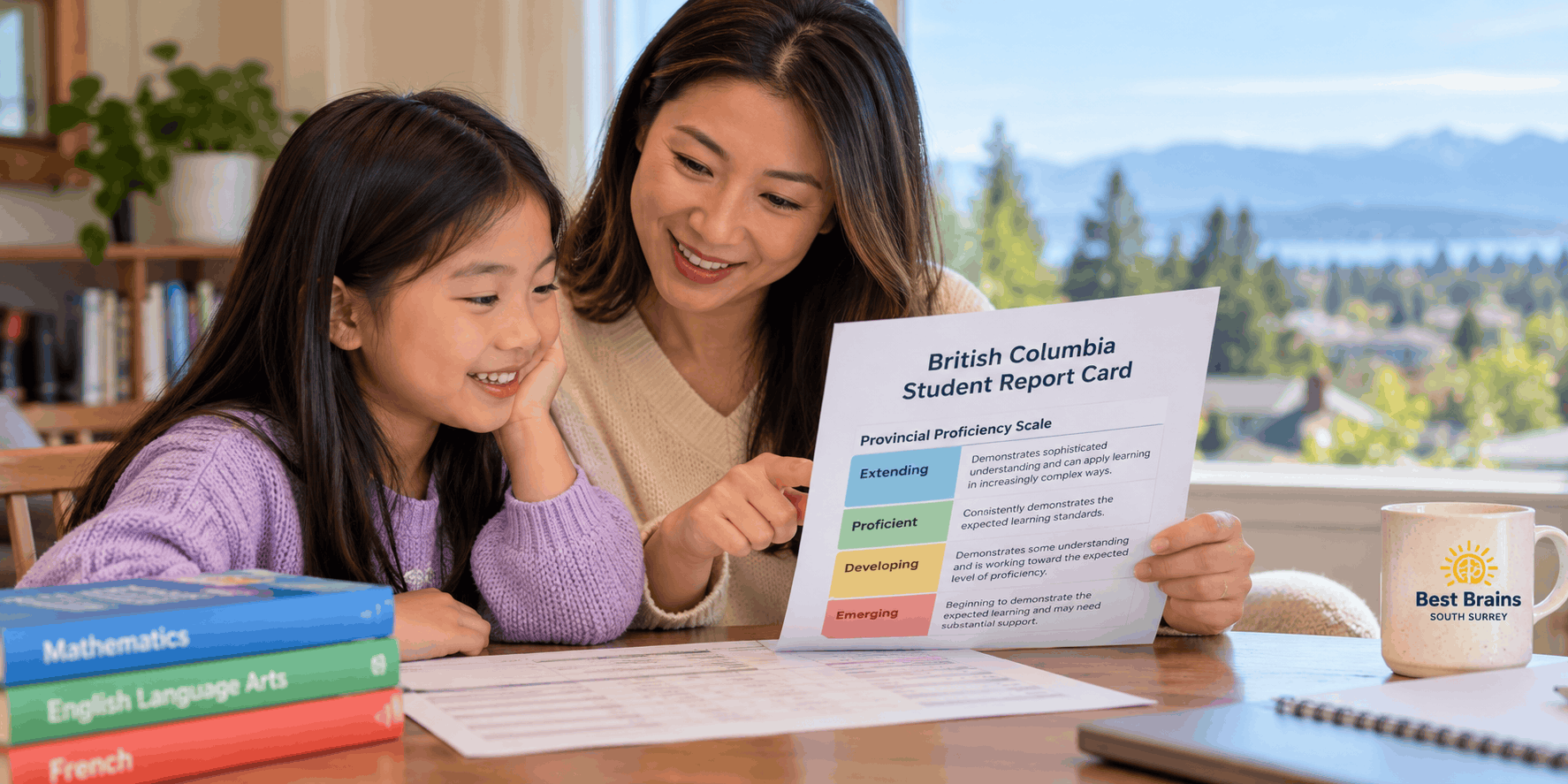
- Their report card shows "Emerging" in math
Early support is easier than catching up later. A short, targeted check in Grade 3 or 4 can prevent a much bigger gap in Grade 7.
How Best Brains South Surrey supports BC math
At Best Brains Learning Center South Surrey (1990 152 St), our Math and Abacus programs help children ages 3–14 build the foundations above:
- BC-certified teachers only, with the same certified teacher every class
- A structured, non-repetitive curriculum that builds each skill step by step
- A free placement assessment that shows exactly which skills are solid and which need work
- Free 24/7 online academic support between classes
Frequently asked questions
What math should a Grade 4 student know in BC?
Numbers to 10,000, decimals to hundredths, comparing fractions, multiplying and dividing multi-digit numbers by one-digit numbers, perimeter, line symmetry, and making change up to $100.
When do BC students learn fractions?
Fraction concepts are introduced in Grade 3, then expand to comparing fractions in Grade 4, equivalent fractions in Grade 5, mixed numbers in Grade 6, and operations with fractions in Grade 8.
When should my child know their multiplication facts?
BC introduces facts to 100 in Grade 4 and builds fluency through Grades 5 and 6, with extending fluency expected in Grade 7. Regular practice early matters more than memorizing all at once.
When do BC students start algebra?
Simple equations with an unknown number start in Grade 3. Equations with variables appear in Grade 5, and two-step equations in Grades 7 and 8.
Is the math curriculum the same in Surrey as the rest of BC?
Yes. Surrey schools teach the provincial BC curriculum. Teaching methods and pacing can vary by school and teacher.
How do I know if my child is behind in math?
Compare their skills to the grade-level lists above, check their report card, and talk to the teacher. A free placement assessment gives a clearer, skill-by-skill picture.
Wondering where your child stands?
Book a free placement assessment at Best Brains Learning Center South Surrey. You'll get a clear, grade-level picture of your child's math skills and a plan for next steps, with no pressure.