Surrey - South Surrey
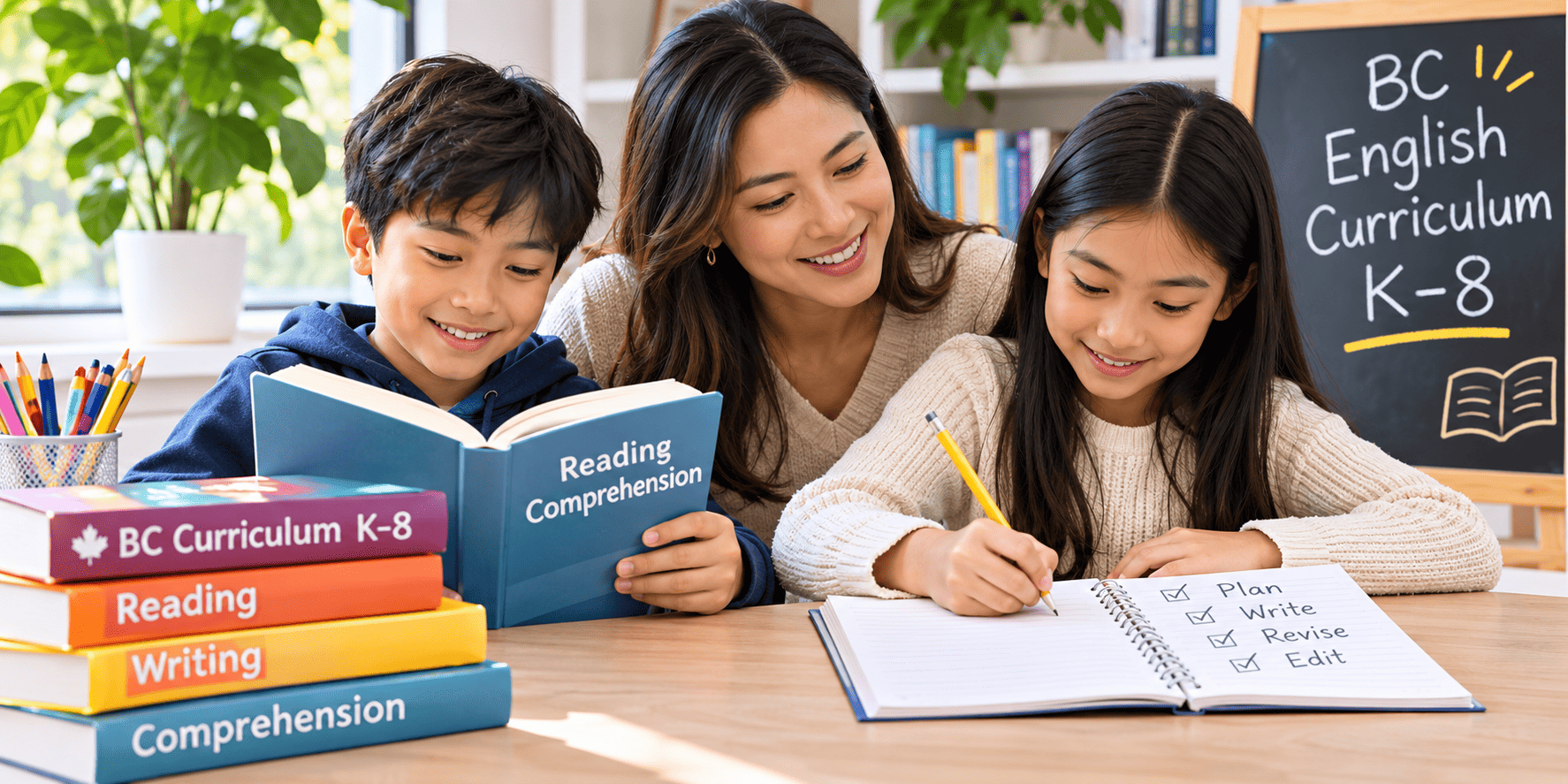
BC English Curriculum K–8: Reading, Writing and Comprehension Skills by Grade
BC English Curriculum K–8: Reading, Writing and Comprehension Skills by Grade
An easy-to-understand guide for British Columbia parents, including families in South Surrey and White Rock.
What should your child be able to read and write in Grade 2? How much reading comprehension is expected in Grade 5? And how does English become more challenging by Grade 8?
These are questions many parents ask as their children progress through elementary and middle school.
British Columbia's English Language Arts (ELA) curriculum develops much more than spelling, grammar and reading fluency. It encourages children to communicate effectively, understand different perspectives, think critically, express their creativity and make meaningful connections with the world around them.
At Best Brains South Surrey, we frequently meet parents who want to understand what their children are learning at school and how they can support that learning at home.
This guide explains the BC English curriculum from Kindergarten through Grade 8, with practical examples of reading, writing and comprehension skills at each grade.
Understanding the BC English Language Arts Curriculum
British Columbia's English Language Arts curriculum is organized around three interconnected components:
-
Big Ideas: Important concepts students develop and understand over time.
-
Curricular Competencies: Skills students develop through reading, writing, listening, speaking, viewing and representing.
-
Content: Knowledge, strategies, language conventions and literary concepts students learn.
Two major competency areas run throughout the curriculum:
Comprehend and Connect: Understanding, interpreting and making connections with written, oral, visual and digital texts.
Create and Communicate: Expressing ideas through writing, speaking, storytelling, presentations and other forms of communication.
Students also explore diverse cultures, identities and perspectives, including First Peoples stories and oral traditions.
Importantly, BC's curriculum is not simply a checklist of spelling words or prescribed reading levels. It emphasizes how children use language and demonstrate understanding.
BC English Curriculum: Kindergarten to Grade 8 at a Glance
| Grade | Reading focus | Writing focus | Comprehension focus |
|---|---|---|---|
| Kindergarten | Print awareness, sounds, letters, stories | Drawing, letters, emerging writing | Retelling, listening, connections |
| Grade 1 | Early decoding, reading fluency | Simple sentences, personal stories | Main ideas, predictions, basic inferences |
| Grade 2 | Greater fluency, varied texts | Connected sentences, short compositions | Story structure, questions, text purpose |
| Grade 3 | Independent reading strategies | Organized paragraphs and stories | Main ideas, supporting details, inference |
| Grade 4 | Broader fiction and nonfiction | Paragraph development, editing | Themes, perspectives, deeper connections |
| Grade 5 | More complex texts and vocabulary | Structured paragraphs, purposeful writing | Evidence, inference, interpretation |
| Grade 6 | Increasingly complex texts | Organized multi-paragraph writing | Critical reading, viewpoints, analysis |
| Grade 7 | Literary and informational analysis | Developed compositions, revision | Evidence, bias, themes and perspectives |
| Grade 8 | Complex literary and digital texts | Coherent multi-paragraph compositions | Source reliability, critical interpretation |
This table is a parent-friendly summary of the progression, not an official assessment rubric or a list of mandatory reading-level benchmarks.
Kindergarten English Curriculum in BC: Building the Foundations of Literacy
Kindergarten introduces children to language, storytelling, print concepts and early literacy.
Reading and language skills
Children explore:
-
Letter recognition and letter-sound relationships
-
Awareness of words, sounds and rhymes
-
How books and print work
-
Listening to stories and recognizing familiar details
-
Connecting pictures, words and spoken language
Writing skills
Kindergarten students begin communicating through pictures, symbols, letters and emerging written words.
A child might draw a family picture and attempt to label the people in it.
Comprehension skills
Children learn to listen, ask questions, make predictions and connect stories to their own experiences.
Try this at home: After reading a picture book, ask, "What was your favourite part?" and "What do you think will happen next?"
The objective is to encourage meaningful communication and enjoyment of stories.
Grade 1 English Curriculum in BC: From Letters to Early Reading
Grade 1 builds on early literacy foundations as children develop greater independence in reading and writing.
Reading skills
Students work on:
-
Letter-sound knowledge and word decoding
-
Recognizing familiar words
-
Reading age-appropriate texts with growing fluency
-
Using pictures, context and reading strategies to support understanding
-
Reading with attention to meaning and punctuation
Writing skills
Children increasingly communicate through complete sentences, short stories and personal experiences.
They develop basic punctuation, capitalization, spelling and sentence construction.
Comprehension skills
Students learn to identify important events, make predictions, discuss characters and draw simple inferences.
Try this at home: Ask your child to explain why a character made a particular choice.
This encourages thinking beyond simply remembering what happened.
Grade 2 English Curriculum in BC: Developing Reading Fluency and Understanding
Grade 2 is an important stage for strengthening foundational reading skills while expanding comprehension.
Reading skills
Students continue developing:
-
Word recognition and decoding
-
Reading fluency and expression
-
Vocabulary
-
Understanding fiction and informational texts
-
Recognizing different text structures and purposes
Writing skills
Children practise creating connected sentences, short stories, descriptions and simple informational pieces.
They continue developing spelling, punctuation and grammar.
Comprehension skills
Grade 2 students explore questions such as:
-
What happened in the story?
-
Why did it happen?
-
What might happen next?
-
How is this text different from another?
-
What is the author trying to explain?
Try this at home: Read a short story together and ask your child to describe the beginning, middle and end.
Parents should remember that reading fluency and comprehension are related but different skills. A child may read words accurately yet need support explaining their meaning.
Grade 3 English Curriculum in BC: Becoming a More Independent Reader
By Grade 3, students are increasingly expected to apply reading and writing strategies with greater independence.
Reading skills
Children develop their ability to:
-
Read a wider variety of texts
-
Use context and word structure to understand vocabulary
-
Identify main ideas and supporting details
-
Make predictions and inferences
-
Monitor their own understanding
Writing skills
Students work toward organizing ideas into coherent paragraphs and longer compositions.
They practise descriptive writing, storytelling, sentence variety, editing and revision.
Comprehension skills
Students begin explaining not just what a text says, but what it suggests.
For example, instead of simply identifying that a character is upset, they may explain which events or details support that interpretation.
Try this at home: Ask your child to summarize a chapter in three sentences and explain one important detail.
Grade 4 English Curriculum in BC: Expanding Vocabulary and Critical Thinking
Grade 4 introduces increasingly sophisticated reading, writing and communication tasks.
Reading skills
Students explore:
-
Fiction and nonfiction texts
-
Literary elements such as character, setting and plot
-
Vocabulary and word meaning
-
Different perspectives
-
Connections between texts and personal experiences
Writing skills
Children develop paragraphs with clearer organization, supporting details and attention to audience.
They also practise revising writing to improve clarity and effectiveness.
Comprehension skills
Students are encouraged to make inferences, recognize themes and explain their interpretations.
Try this at home: Ask, "What do you think the author wants us to understand?" and "Which part of the story helped you decide?"
Grade 5 English Curriculum in BC: Stronger Writing and Deeper Comprehension
Grade 5 is an important stage in the transition toward more independent academic reading and writing.
Reading skills
Students work with a broader range of texts and practise:
-
Identifying main ideas and relevant details
-
Making inferences and drawing conclusions
-
Using context clues to interpret vocabulary
-
Recognizing literary elements and perspectives
-
Applying comprehension strategies before, during and after reading
Writing skills
Grade 5 students develop greater control over:
-
Paragraph organization
-
Topic sentences and supporting details
-
Sentence structure and grammar
-
Punctuation and Canadian spelling conventions
-
Writing for different purposes and audiences
-
Revising and editing their work
Comprehension skills
Students increasingly explain interpretations and support their thinking with details from the text.
For example, a student reading a story about friendship may be asked to explain how a character's actions reveal their values.
Try this at home: Ask your child to write a short paragraph defending an opinion about a book, using two examples from the story.
Grade 6 English Curriculum in BC: Moving Toward Analytical Reading
Grade 6 brings greater complexity to reading, writing and communication.
Reading skills
Students encounter more demanding literary and informational texts.
They practise identifying themes, interpreting figurative language, comparing viewpoints and evaluating information.
Writing skills
Students develop longer, more organized compositions, including writing that explains, describes, narrates or argues a position.
Planning, drafting, revising and editing become increasingly important.
Comprehension skills
Students are encouraged to examine how authors communicate meaning through word choice, structure and perspective.
Try this at home: Read two short articles on the same subject and discuss how their approaches differ.
This introduces critical comparison without making reading feel like an examination.
Grade 7 English Curriculum in BC: Preparing for More Advanced Academic Literacy
Grade 7 strengthens the reading, writing and communication skills students need as they move toward secondary school.
Reading skills
Students explore more complex stories, articles, informational texts and digital content.
They examine literary devices, themes, perspectives and the ways language influences meaning.
Writing skills
Students increasingly produce developed compositions with logical organization, supporting evidence and purposeful language.
Revision becomes more than correcting spelling. It includes improving arguments, organization, clarity and tone.
Comprehension skills
Students practise:
-
Interpreting implied meaning
-
Comparing perspectives
-
Evaluating information
-
Recognizing how evidence supports an interpretation
-
Considering an author's purpose and intended audience
Try this at home: Ask your child to compare two characters' decisions and support their opinion with details from the story.
Grade 8 English Curriculum in BC: Critical Reading, Writing and Communication
Grade 8 marks the beginning of secondary school for many BC students.
English Language Arts increasingly emphasizes sophisticated interpretation, independent communication and evaluation of information.
Reading skills
Students work with literary, informational, visual and digital texts.
They explore:
-
Themes and characterization
-
Figurative language and literary devices
-
Author's purpose and perspective
-
Text structure and style
-
Reliability and accuracy of information
Writing skills
Students develop coherent multi-paragraph compositions with stronger organization, varied sentence structures and appropriate language conventions.
They consider audience, purpose, tone and style when communicating ideas.
Comprehension skills
Students increasingly evaluate information rather than simply accepting it.
For example, when reading an online article, they may examine whether the source is credible, whether claims are supported, and whether alternative perspectives should be considered.
Try this at home: Choose an age-appropriate news article and discuss the difference between facts, opinions and unsupported claims.
How Reading, Writing and Comprehension Change Across Grades
Although each grade introduces new learning expectations, literacy development is continuous.
Kindergarten to Grade 2: Building foundations
The emphasis is on oral language, early reading, print awareness, decoding, emerging writing and basic comprehension.
Grades 3–5: Developing independence
Students increasingly read to gather information, organize written ideas, make inferences and explain their understanding.
Grades 6–8: Applying critical thinking
Students work with more complex texts, evaluate information, compare perspectives and communicate ideas through increasingly sophisticated writing.
These stages overlap. A student's reading, writing and comprehension skills may develop at different rates.
Reading Fluency vs. Reading Comprehension: What's the Difference?
Parents sometimes assume that a child who reads aloud smoothly must also understand everything they read.
But fluency and comprehension are not identical.
Reading fluency involves reading accurately, at an appropriate pace, and with expression.
Reading comprehension involves understanding, interpreting and connecting ideas within a text.
For example, a Grade 4 student might read a passage aloud confidently but struggle to explain why a character behaved in a particular way.
Another student might understand a story well when listening but need additional support decoding unfamiliar words.
Understanding the difference helps parents ask more useful questions about their child's progress.
How Do BC Schools Assess English Language Arts?
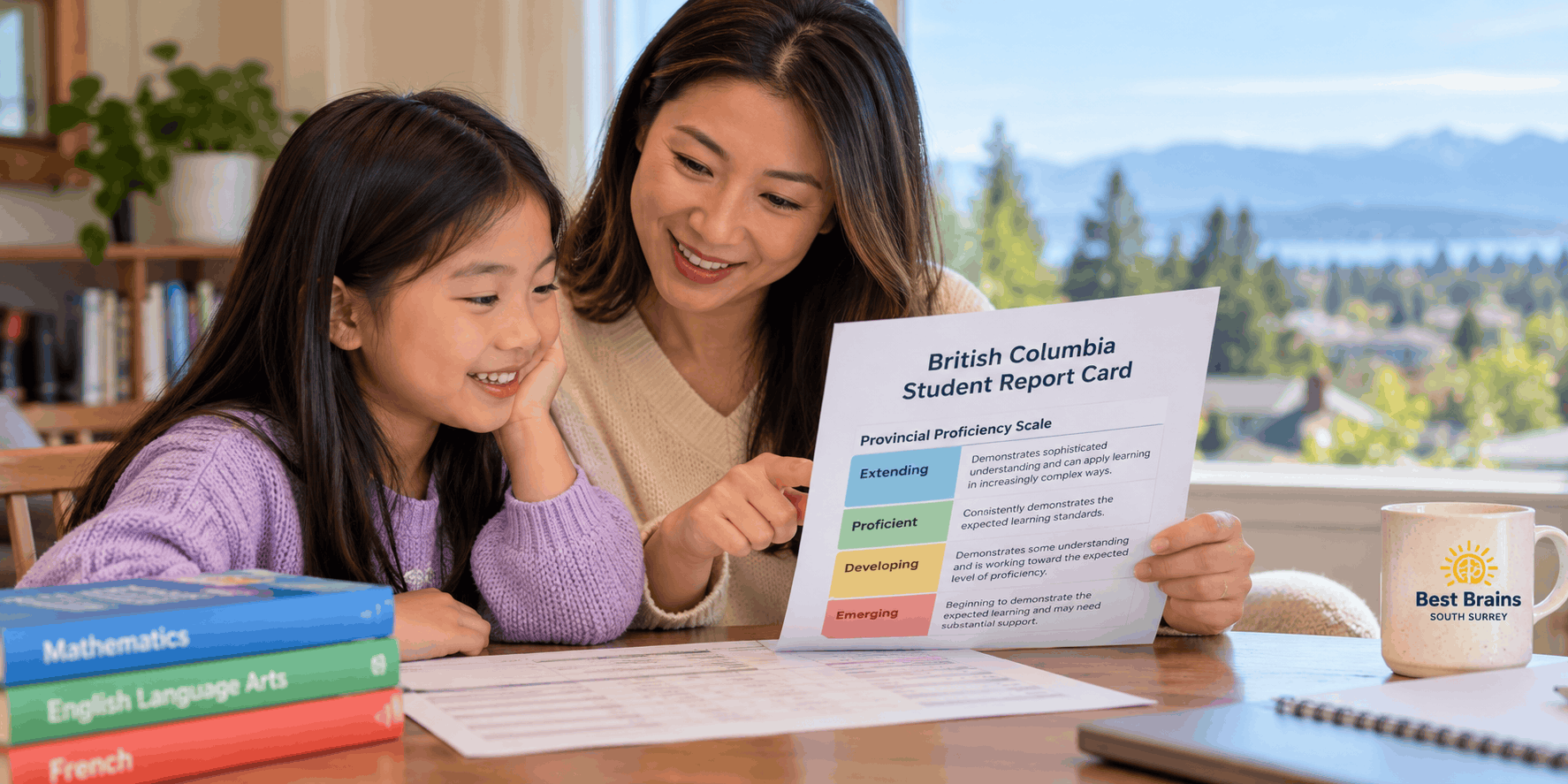
British Columbia uses a proficiency scale to communicate student learning.
The four commonly used proficiency descriptors are:
| Proficiency level | What it generally communicates |
|---|---|
| Emerging | Initial understanding of expected learning |
| Developing | Partial understanding; skills are still developing |
| Proficient | Demonstrates the expected learning |
| Extending | Demonstrates more sophisticated understanding and application |
Proficient is a positive achievement. It means a student is demonstrating the expected learning for the relevant curriculum standards.
Extending does not simply mean completing work from the next grade.
Teachers consider multiple forms of evidence, which may include reading activities, writing samples, conversations, presentations and classroom observations.
A report card should therefore be understood as part of an ongoing picture of learning rather than a single test result.
What If My Child Is Struggling With English?
A child may need support in one literacy area while demonstrating strengths in another.
For example:
-
A Grade 2 student may understand stories when listening but struggle to decode words independently.
-
A Grade 4 student may read fluently but have difficulty summarizing important information.
-
A Grade 5 student may have excellent ideas but struggle to organize them into paragraphs.
-
A Grade 7 student may understand literal information but find inference and critical analysis challenging.
These differences do not automatically indicate a learning disability.
Parents can begin by speaking with their child's classroom teacher, reviewing recent work, and identifying the particular skills that need attention.
If difficulties are persistent or significant, the school can help determine whether additional assessment or specialized support may be appropriate.
Seven Practical Ways Parents Can Support English Learning at Home
1. Read together regularly. Even older children can benefit from shared reading and discussions.
2. Ask open-ended questions. Instead of only asking what happened, ask why it happened.
3. Encourage writing for real purposes. Shopping lists, letters, journals, stories and emails all provide writing opportunities.
4. Discuss unfamiliar words. Encourage children to use context, word structure and conversation to explore meaning.
5. Let children choose books. Interest and enjoyment can help sustain reading habits.
6. Celebrate revisions. Show children that good writing often develops through planning, editing and improvement.
7. Stay connected with teachers. Ask which specific literacy skills your child is currently developing and how you can reinforce them.
How Best Brains South Surrey Supports English Enrichment
Understanding the BC English curriculum can help parents recognize their child's academic needs.
At Best Brains South Surrey, our English enrichment program provides structured opportunities for children to develop reading, vocabulary, grammar, writing and comprehension skills.
Our approach includes:
-
BC-certified teachers
-
Small-group instruction, with up to five students per teacher
-
A structured, progressive curriculum
-
A placement assessment to help determine an appropriate starting level
-
Weekly learning activities that introduce and reinforce academic concepts
-
Opportunities for students to ask questions and develop confidence
Best Brains is an independent enrichment program, not a replacement for classroom instruction or specialized educational services.
Our goal is to complement children's school learning and help them develop stronger academic foundations.
Frequently Asked Questions About the BC English Curriculum
1. What is taught in English Language Arts in British Columbia?
BC English Language Arts includes reading, writing, listening, speaking, viewing, storytelling, comprehension, critical thinking and communication. Students learn to understand and create different types of texts while exploring language, identity and diverse perspectives.
2. What reading skills should a Grade 1 student have in BC?
Grade 1 students develop foundational decoding, word recognition, reading fluency and comprehension strategies. They practise making predictions, discussing stories and connecting what they read to their experiences. Individual progress varies.
3. What should a Grade 2 student be able to write?
Grade 2 students increasingly create connected sentences, short stories and other simple texts. They continue developing spelling, punctuation, grammar and the ability to organize ideas.
4. What is expected in Grade 3 reading comprehension?
Grade 3 students develop greater independence in identifying main ideas, making predictions, drawing inferences, summarizing information and using reading strategies to understand different texts.
5. What are the Grade 5 English curriculum expectations in BC?
Grade 5 students work with more complex texts, apply comprehension strategies, explore perspectives and develop organized writing. They practise paragraph structure, grammar, vocabulary, revision and explaining their interpretations.
6. Does BC require specific reading levels for each grade?
The BC English Language Arts curriculum describes learning standards and competencies rather than establishing one universal commercial reading-level score for every grade. Schools may use reading assessments to monitor progress, but those measures should be interpreted in context.
7. Is grammar taught in the BC English curriculum?
Yes. Grammar, sentence structure, punctuation, spelling and language conventions are part of the curriculum. Students increasingly apply these skills in meaningful writing and communication.
8. What is the difference between reading fluency and comprehension?
Fluency concerns accurate, expressive reading at an appropriate pace. Comprehension concerns understanding and interpreting meaning. A student can demonstrate strength in one area while needing additional support in the other.
9. What does Proficient mean on a BC report card?
Proficient means a student is demonstrating the expected learning described by the relevant curriculum standards. It is a positive indicator of achievement, not a sign that the child is merely average.
10. How can I help my child improve English at home?
Regular reading, discussing stories, encouraging writing, exploring vocabulary and communicating with teachers are useful starting points. The most effective activities depend on the child's specific learning needs.
11. Does Best Brains South Surrey follow the BC English curriculum?
Best Brains uses its own structured English enrichment curriculum. Its program develops skills that overlap with BC English Language Arts learning goals, but its levels and sequence should not be assumed to correspond exactly to BC school grades.
12. When should parents consider additional English support?
Parents may consider additional support when difficulties with reading, writing or comprehension persist, affect confidence, or interfere with schoolwork. A discussion with the classroom teacher is a useful first step.
Final Thoughts: English Is More Than Reading and Writing
From recognizing letters in Kindergarten to evaluating complex information in Grade 8, British Columbia's English curriculum helps children develop skills they will use throughout their education and everyday lives.
The objective is not simply to read faster, write longer essays or memorize more vocabulary.
It is to understand ideas, communicate clearly, think critically and develop an appreciation for language and stories.
For parents in South Surrey and White Rock, understanding these expectations can make conversations about school progress more meaningful.
And when children need additional practice or enrichment, identifying their specific strengths and challenges is a useful place to begin.
Explore English Enrichment at Best Brains South Surrey
Best Brains South Surrey offers Math, English, Abacus, Coding and French programs for children aged 3–14.
Our BC-certified teachers work with students in small groups, using a structured curriculum and an initial placement assessment to guide appropriate starting levels.
Best Brains South Surrey
1990 152 Street, Unit 1A, Surrey, BC
Phone: 604-704-9378
Website: https://bestbrains.com/ca-en/surrey-south
Contact our team to learn more about English enrichment and arrange a free placement assessment.
Sources and Further Reading
The following official educational resources were consulted in preparing this parent-friendly guide.
-
Government of British Columbia — English Language Arts Curriculum (K–12)
https://curriculum.gov.bc.ca/curriculum/english-language-arts -
BC English Language Arts — Introduction and Curriculum Framework
https://curriculum.gov.bc.ca/curriculum/english-language-arts/introduction -
BC English Language Arts — Grade-by-Grade Learning Standards
https://curriculum.gov.bc.ca/curriculum/english-language-arts/courses -
BC English Language Arts — Kindergarten to Grade 9 Curriculum PDF
https://curriculum.gov.bc.ca/sites/curriculum.gov.bc.ca/files/curriculum/english-language-arts/en_english-language-arts_k-9.pdf -
BC English Language Arts — Curriculum Elaborations
https://curriculum.gov.bc.ca/sites/curriculum.gov.bc.ca/files/curriculum/english-language-arts/en_english-language-arts_k-9_elab.pdf -
BC English Language Arts — K–4 Proficiency Profiles
https://www.curriculum.gov.bc.ca/sites/curriculum.gov.bc.ca/files/pdf/learning-pathways/k-4-english-language-arts-proficiency-profiles-definitions.pdf -
Government of British Columbia — Student Reporting
https://www2.gov.bc.ca/gov/content/education-training/k-12/administration/legislation-policy/public-schools/student-reporting
This article is an informational guide, not an official BC Ministry of Education publication. Curriculum expectations are summarized for parents and should be interpreted alongside the official learning standards.